Zen practice doesn’t end when you leave the cushion. This page gathers teachings, writings, and recommended reading from Zen Fields for anyone wanting to carry the practice further into daily life, whether that means reading a reflection between sits, watching a dharma talk on your own time, or picking up a book to sit with the ideas a little longer. Here you’ll find three ways to go deeper.
Our Readings collect reflections and teachings from our sangha on meditation, Buddhist philosophy, parenting, and more. Our YouTube channel offers dharma talks, organized into playlists to make it easy to find what you’re looking for. And our recommended books list offers a short selection for exploring Zen and Buddhist thought on your own time. Start wherever you feel drawn, and come back to the rest whenever you’re ready.

Reflections, teachings, and reposted writings from our sangha over the years — on meditation, Buddhist philosophy, parenting, social and ecological justice, interfaith connection, and more. Click on "Explore more readings" and browse by category to find what speaks to you.
Integrating the spiritual element into trauma informed yoga practice.
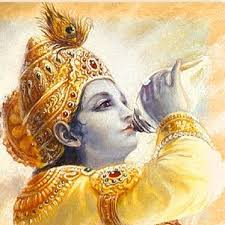
The Bhagavad Gita is one of the world’s greatest philosophical texts. We don’t know exactly when it was committed to writing, but some say around the 1st century of the current era, roughly 2000 years ago. It’s couched within the longest epic poem the world has known, the Mahabharata. The Bhagavad Gita, or the “Song of the Lord,” is recited daily by devout practitioners within the yogic tradition, with the aim of seeking truth or understanding about what one’s role is in life, and how to accomplish one’s goals.
The story is about a war that took place within an Indian family many centuries ago. The hero of the story, Arjuna, must fight alongside his four brothers, to put down their kinsmen – their cousins and uncles – to regain not just their material possessions, but the integrity of the family.
This war is symbolic of the war that each of us, today, must fight daily. It’s not necessarily a war with another country or within our country, but a fight with our own ego. Like the hero in the Bhagavad Gita, we struggle with the part of our self that tries to get us to give up on the challenges which we face. We struggle, for instance, to maintain our health through daily exercise and proper diet. We struggle sometimes to go to our job, perhaps because we don’t feel a sense of purpose or worth. Or we struggle to continue to learn because we fall into the trap of thinking we understand everything about how the world works.
Arjuna has this same struggle. It’s an ancient struggle of humanity. Arjuna is dejected and is ready to give up the fight and makes all kinds of excuses as to why he should put down his arms. His attendant, the God Vishnu in the human form of Krishna, advises him otherwise and explains to him the importance of carrying out his duties as a warrior to fulfill his destiny.
It may sound strange to westerner’s ears that we have been put here on this earth to carry out a mission. Certainly, we are told, we have so many choices available to us. But, while there are these myriads of possibilities presented, there’s only one thing we need to concern ourselves with, and it has to do with what we are doing at this moment. Our problem is that we are not focused and not in this moment. Our body is here, but our mind is somewhere else – either in the future or the past, or perhaps daydreaming.
The Bhagavad Gita gives us advice on how to return fully to the present moment to do what we need to do. Krishna, in the chapter on the “Yoga of Action,” offers the following sage advice:
· It’s better to do your own job poorly than someone else’s job well. (3.35)
· We can’t escape having to act by remaining secluded in meditation. (3.4 – 3.6)
· We need to learn to control our senses to accomplish our mission. (3.7)
· Perform our work without any attachments, and without thinking of the benefits or gains for ourselves. (3.9, 3.19, 3.25)
The key to doing any action is through controlling our senses, and we can understand better how our body and mind work through awareness of Krishna’s schema of what the whole person is comprised of. In this particular schema (there are other schemas he uses, and this is just one of them) he says there are five aspects to a human:
· The body
· The senses
· The mind
· The discriminating intellect
· The Atman
These five are in a hierarchical relationship to each other. The Bhagavad Gita reads:
The senses are stronger than the body. The mind is stronger than the senses; the discriminating intellect is stronger than mind; and Atman is above the intellect. (3.42)
In hatha yoga, we work with all five of these dimensions simultaneously. Our body is the most obvious of these elements, and contains our arms, legs, neck, shoulders, spine, head, as well as our internal organs. When we think of yoga in the west, we generally think of the physical, bodily practices, and of improving our body’s health.
However, in Yogic philosophy, body and mind are not two separate things as we often imagine them to be. Though there is a hierarchical relationship with the above five factors listed, when we act on any one of the five, it effects all the others. We use our senses, our eyes, for example, for balancing asanas like “tree.” We use our mind, the third aspect, to become aware of our body and how we are feeling in the various forms our body takes. When awareness is established, we can use our discriminating intellect – our ability to make choices – to help us decide what to do with our body, whether to extend our arms further, or to move them back, for example, in a forward fold.
In Trauma Sensitive Yoga (TCTSY), the discriminating intellect is what we develop when we make choices with our body. For survivors of early childhood trauma, this factor, the ability to discriminate between what we want and what we don’t want to do with your body, may be compromised or under-utilized. TCTSY calls our attention to the power we have within us to choose what we want to do with our body. This can have repercussions, of course, in our daily life, as we go about with myriads of moments in which we are confronted with a panoply of choices – such as which of the 1000 cereals to purchase at the supermarket.
Most of us are not aware of our power to choose, or even that every moment contains choice, and so we go about our daily life stuck in unconscious routines and habits, doing things because that’s the way we’ve always done them. There is a certain feeling of safety and comfort in the familiarity of our actions. We may not have a lot of motivation to change that which we are comfortable with, especially if we feel safe in those familiar actions.
The problem with this way of living is that safety is not reality, and we know this (perhaps unconsciously) on some deep level within us. Our wish to remain forever in a feeling of security deadens our sense of vitality to a certain degree. When we become awake to our ability to choose, however, our life starts to shift. We may feel at a crossroads between continuing on the way we have been, a way that is safe but not really alive on the one hand, and entering the unknown on the other hand. By consciously making decisions we disrupt a narrative we tell ourselves that says, “nothing about my life is going to change.”
In TCTSY we are encouraged to become curious about our felt experience, and then to choose from among a couple of options of how to hold our body. In this way we are developing both our mind – our ability to be aware – and our discriminating intellect – our ability to decide what to do next. This all happens by drawing awareness to our senses – eyes, ears, nose, etc. – and our physical body.
The fifth aspect, Atman, is a little more complex to understand. In Indian philosophy it has to do with the part of us that takes on different forms from one life to the next. Now we’re in a human form, but in a previous life we may have been an animal or a plant. In the next life we may be something else. Most westerners that I practice with don’t necessarily believe in reincarnation, or that our soul transmigrates from one body to the next. If they do believe in it, it doesn’t play a central or explicit role in their practice, and for the sake of TCTSY it’s not necessary to believe in reincarnation.
Another more scientific way to think about Atman, then, is as memory. There is a part of us, not just located in our brain, but in every fiber of our being, that remembers all our past experiences, and continues to get transmitted from one moment to the next. On a biological level we see this happening with DNA. DNA carries memory not just of what’s happening in our own life, but also in that of our ancestors. DNA is passed on to us through our parents, and so their experiences are also in us. What’s happened to our parents and their parents is part of the fiber of who we are. If our parents and grandparents experienced racism, for example and their parents and grandparents experienced slavery, that is also in our DNA in our present life.
In other words, all of our ancestors’ experiences, both the good and the bad, including trauma, get carried in our body whether we are aware of it or not. If we are not aware of this, then we can be acting out of past circumstances that no longer exist in our present life. Thus, we are often using coping skills that were relevant to our ancestors, but no longer relevant to us.
When we are practicing TCTSY we may get in touch with the trauma rooted in our physical body. We might see that the way that we act is like the way our parents acted, and that we’re no longer in the same boat as our parents were. There may be certain traits in us that got passed down from our unknown ancestors, yet they are also within us. TCTSY gives us the opportunity to become aware of how we are holding our body so that we can choose what makes the most sense to us now.
While doing TCTSY we don’t have to draw a conscious connection between what we do with our body and the experiences of our ancestors. Nor do we need to understand that connection or articulate it with words. All we need to do is focus on our physical body, on sensation. However, because our body, from a yogic perspective, also contains the other four aspects of senses, mind, discriminating intellect, and Atman, they are all influenced by what we do with our body.
Arjuna, like all of us, gets stuck in not desiring to act for the sake of his mission, what he was born here to do. The feeling of having a sense of purpose may feel foreign to us. But what might it feel like to have a sense of purpose in life? Is that not empowering? The message of the Bhagavad Gita and of TCTSY is that we have within us what we need to change our lives, to heal our lives, and to accomplish our goals – whatever they may be.

Can we make someone else practice?
The Quran states, “And had your Lord willed, those on earth would have believed – all of them entirely. Then, O Muhammad, would you compel the people in order that they become believers?” (Surah 10:99).
I love the Quran. I say this as a Buddhist. I’ve had the good fortune to study the Quran more deeply over the past year because I’ve been teaching a World Religions class. I’m by no means an expert in understanding even Buddhism, so I am humbled with the task of teaching about paths that I have not committed to. Yet, I cannot help but see similarities between religions, and this verse is one that speaks to me as a Buddhist.
The Quran is considered by Muslims not as the words of the Prophet Muhammad, but as the words of God or Allah spoken through the Prophet. It is poetic and beautifully sounding, and moves some even to tears to hear it recited. The power of the Quran is both in the meaning of the text as well as the sound that is invoked. The text itself has layers of meaning – literal, figurative, mystical – that if not carefully read can easily give rise to misunderstanding, intolerance and even violence.
The above verse bears striking resemblance to a teaching of the Buddha: Do not accept my teachings because I said so. Accept a teaching after putting it into practice and finding that it is effective, that it alleviates suffering.
I’m paraphrasing the above teaching, which is from the Kalama Sutta. The gist of it is that we need to use our faculties of reason to decide whether a teaching is appropriate for us or not. Even a teaching that we found helpful 10 years ago may no longer be helpful today. If we are not aware of this then we can remain stuck in a practice that is no longer addressing our suffering or that of others.
Having no compulsion in following Religion is often overlooked by those that practice the tradition. In Buddhism, for example, there are teachers who, rather than make suggestions for how to practice, expect their students to practice certain ways. Most Zen teachers that I’ve trained with seriously have been a mix of both not being compulsive and, at the same time, being demanding of how to practice. I myself have been a mix of both, but more recently, especially since studying trauma theory through the Trauma Sensitive Yoga program, see the importance of not using compulsion as a means to practice.
When parents want their children to follow their religion, or perhaps their non-religion, or maybe their particular outlook on something, then if they use compulsion too heavily, the end result is often resentment and rejection of whatever the parent wants. The baby is thrown out with the bath water. On the other hand, leaving things totally up to the child to figure out for themselves is not quite right either. Children need guidance by their parents, of course. They need to have something that they can reject or accept as they mature. In either case, the parent(s) needs to learn to let go of the results of their actions.
So, as I reflect on this teaching found both in the Quran and the Kalama Sutta it causes deep pause for me. Can I make someone practice?
No. I cannot.
Even if I love that person dearly and know that a particular teaching would benefit them, I cannot practice for them. There is a Zen saying that we cannot even urinate for another person. How much less so can we practice for another person?
I can only do my own practice and offer suggestions for others. I can remind people that they are in charge of seeing for themselves how they ought to practice. This goes both for meditation and for yoga. I am not God. Only God – the spirit of love, generosity, compassion, mercy, wisdom – when invited into my relationships, opens people’s eyes to truth. My responsibility is to allow for God to enter into my relationships. I do this when I am not being manipulative in the relationship.
It seems so obvious that, as I’m talking about being non-manipulative in relationship, that manipulation is not effective. But when I find myself in relationship to others, if I’m really honest, there are times when I want the person on the other end of the line to do something other than what I see them doing. In those moments, if I don’t refrain from coercion, I myself am being manipulative.
Practicing, therefore, no compulsion brings me to my own edge. It’s a tricky place to be. I need to continue to monitor my own state of mind and to be truthful with myself about what my intentions are in the moment. Feel free, if you would like to, to practice No Compulsion in Religion, or to not look for anyone to adopt your particular views about anything. See for yourself it leads to the end of suffering.
Fear for me is being asked by my wife to take care of our two-year old son, Malcolm, by myself.
Fear for me is being asked by my wife to take care of our two-year old son, Malcolm, by myself. I feel terrified by the prospects of inadequately responding to his unease or crying. I have a heightened awareness of being judged as a terrible parent. It has often been the case that, when I’m with him, I feel helpless to change anything, no matter what I try to do.
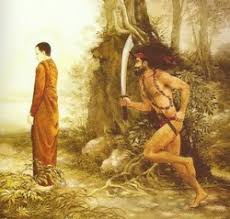
There is a story of the Buddha walking down the road where there was a vicious criminal and being told by the townspeople not to go down that way. Angulimala, the murderer, was looking for his next victim. When he saw the Buddha and approached him, Angulimala demanded that he stop. But the Buddha just kept on walking. Angulimala ran after him again yelling, “STOP!”
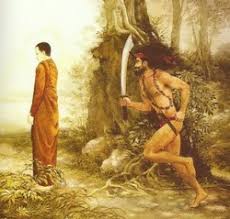
Buddha responded coolly, “Angulimala, I have stopped long ago. It is you who have not stopped.” The Buddha was pointing out Angulimala’s inability to stop the destruction of life. Angulimala miraculously recognized the error of his ways, bowed to the Buddha, threw away his sword, and asked to take refuge in the Three Treasures.
As I reflect on this story, I’m reminded of a line from the Yoga Sutras, “To one firmly established in non-harming (Ahimsa), all hostilities cease.” It’s not just the Buddha’s words that stopped Angulimala, but his presence.
I’m not the Buddha, and I don’t know if I could have the same presence of mind to stop a murderer. However, the genius of the Dharma is its universal application. We can apply it right now in whatever the circumstances we are in.
Every morning I practice meditation. I face the wall and follow my breath. Recently, my wife went out for a run and asked me to be attentive to Malcolm’s needs, which, of course, I obliged. When he awoke I was still sitting in meditation. In that moment, I had to make a decision about what to do. Should I go to him or have him come to me? On this day, I decided I would let him come to me. Being still, I was actually facing my fear. My thoughts went from, “I should run to him and try to make him feel all right,” to, “he’s okay as he is, there is no need to comfort him right now.”
Malcolm went looking for his mother, as is usually the case. When he could not find her, I noticed the anxiety in myself and stayed with it, watching it, breathing with it, focusing more closely on my breath. Malcolm then found me and asked me where his mother was. I told him that she was on a run and that she’d be back soon. Rather than trying to comfort him – as I could sense he felt agitated about this situation – I decided to just follow my breath closely and calm my own mind.
He came closer, and the closer he got the more he chilled out until he was simply leaning up against me. I was enjoying his presence and he mine, and we just stayed there for several minutes breathing together. Instead of reacting with actions that could have caused negative actions from Malcolm, my calm response elicited a calm and peace in him.
This saying from the Yoga Sutras, “To one firmly established in Ahimsa all hostilities cease,” has been increasingly on my mind since that experience. I’m by no means always feeling non-reactive, but I am inspired by how Malcolm responded to me, and by the practicality of this teaching. The practice of Ahimsa is not limited to the Buddha but can be realized by any of us in our daily lives and responses, such as dealing with a crying child, with an irrational family member, or just simply with our own mind. Can we see the universality and timelessness of this particular teaching?
The world tells us to hide from our fears, as symbolized by the people in the town warning the Buddha not to go in the direction of Angulimala. However, our practice is about facing our fears. Our fears lead us to deeper practice and understanding. Being afraid is not a sign of failure or weakness, but a natural and important ingredient for spiritual transformation. When our fears meet practice, there is potential for growth, as symbolized by the Buddha moving toward Angulimala.
Prefer to listen and watch rather than read? Our Talks and Recordings page gathers dharma talks, koan commentary, and teachings from Daishin and Jisho, along with videos from our YouTube channel, a way to sit with the practice even when you’re not in the room with us.
How to integrate spiritual practice into a trauma informed yoga practice.
An overview of the connection between a foundational guided meditation on mindful breathing
One way to practice shikantaza is to consider what the ends are. Here Daishin talks about the goal
We know many of us who weren't born into Buddhist families come to this path through books. Below are a few of our recommendations for exploration through reading. However, please know that awakening happens in relationship and practicing community is important. Please consider coming in person if possible to our offerings or to a center near you.
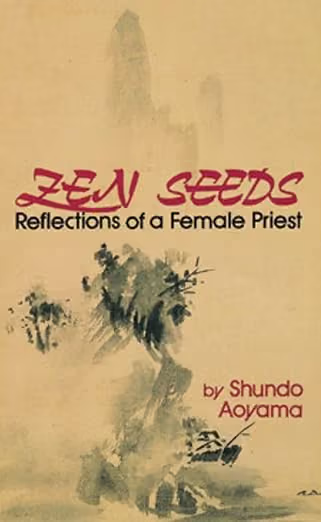
Zen Seeds: Reflections of a Female Priest is a collection of short essays by Shundo Aoyama, translated into English by Daishin's teacher, Patricia Daien Bennage and first published in Japan by Kosei Publishing in 1990. Aoyama is chief priest of Muryo-ji temple and of the Aichi Semmon Niso-do, one of the few Soto Zen training monasteries for women in Japan. She also serves as an advisor to Sojiji Monastery, one of the two head temples of the Soto school, and has trained more than fifty disciples of her own. Each brief chapter reads as a small reflection on everyday life, written in plain words that point to the seeds of awakening found in ordinary moments such as work, gratitude, effort, and relationships. Readers often describe the teachings as deceptively simple yet deeply useful, and one reviewer compared the short chapters to the sound of a temple bell lingering in the mind. Although the subtitle highlights her perspective as a woman and a mother, her message is meant for anyone, and the book is easy to take up a few pages at a time, making it a good companion for daily practice or for those new to Zen. It is also available in a 2019 Shambhala edition titled Zen Seeds: 60 Essential Buddhist Teachings on Effort, Gratitude, and Happiness.
Buy this book
In Shodo: The Quiet Art of Japanese Zen Calligraphy, Shozo Sato, a internationally respected master of the traditional Zen arts, uses the poetry of Zen as a path into Japanese brush calligraphy. The book centers on zengo, the one-line sayings drawn from Zen koans that are among the most familiar subjects of shodo. Because shodo helps cultivate the steady, meditative focus at the heart of Zen, it is a regular part of practice for Zen students throughout Japan. Sato opens with a short history of calligraphy in Japan and its close ties to Zen teaching, then introduces the materials and the basic brushstrokes a beginner needs. From there he presents thirty zengo. Each includes a model written by an accomplished Zen monk or master calligrapher, an explanation of the individual characters and the meaning of the phrase as a whole, and step-by-step guidance for writing it in several styles (Kaisho, Gyosho, and Sosho). Beautifully produced, the book brings together Japanese aesthetics and Zen thought, and it offers beginners and experienced students alike a deeper appreciation of shodo. Topics include the art of kanji, the Four Treasures of shodo, ideogram zengo, and students of shodo. The forward was written by Jisho's teacher, Gengo Akiba Roshi.
Buy this book
Zen Teachings in Challenging Times, by Daishin's teacher, Patricia Dai-En Bennage, gathers the voices of twenty-five leading American teachers of Soto Zen Buddhism. Speaking to anyone who has suffered and sought spiritual guidance, they share candid personal stories of illness and death, political anger, fear, jealousy, damage to the environment, disillusionment, and the deep longing for peace. Rather than offering abstract answers, each teacher draws on lived experience, showing how these struggles are part of being human and how they can be met with honesty and care. Together, their reflections point to how we can stand with poise amid the woes of existence and even emerge transformed by our own suffering. Running through the book is the conviction that the transformative nature of Zen practice gives us the strength to face all possibilities, whatever the times may bring. Because the teachers write from within a shared tradition yet from many different lives, readers can find voices that speak to their own circumstances, whether they are longtime practitioners or newcomers to Zen. The whole collection is offered in the spirit of Kanzeon, the bodhisattva of compassion, who hears the cries of the world and extends a loving hand to all living beings, and it invites readers to bring that same compassion to their own difficulties and to those of others.
Buy this book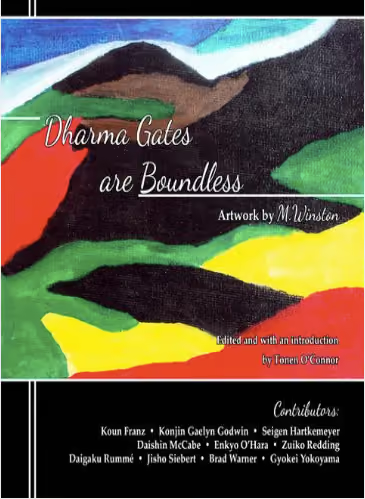
Dharma Gates Are Boundless offers a unique marriage of rich visual art and thoughtful essays by respected contemporary Soto Zen Buddhist teachers. Vibrant abstract miniatures by M. Winston, a brilliant African-American artist and member of a prison sangha, are paired with ten articles ranging from the scholarly to the deeply personal. Dale Wright, author of Buddhism, What Everyone Needs to Know, says of this work edited by Tonen O’Connor, “Illumination is the best word to describe this wonderful book.” The unusual combination of artistic vision and Buddhist insight has also received high marks from Muhammad Isa Sadlon, retired Executive Director of the Milwaukee Art Museum: “The artwork is lush, gorgeous. The book is a great success. Layout, art and essays amplify one another.” Asked to respond to the third of the Four Great Bodhisattva Vows, “Dharma Gates Are Boundless, I Vow to Enter Them,” Koun Franz, Konjin Gaelyn Godwin, Seigen Hartkemeyer, Daishin McCabe, Enkyo O’Hara, Zuiko Redding, Daigaku Rummé, Jisho Sara Seibert, Brad Warner and Gyokei Yokoyama have recounted their personal experiences of dharma gates, in what Rev. Dr. Daijaku Kinst, Institute of Buddhist Studies, Graduate Theological Union, describes as ”words whose honesty and insight inform and transform us.” These essays offer us an opportunity to examine how we ourselves understand Dharma or “the truth of how things are,” as well as varied perspectives that urge us to look closely at the dharma gates in our own lives. Each painting, by an artist whose work is carried by a well-respected gallery in Milwaukee, Wisconsin, and has been shown in New York, invites us to go beyond words and break through into intuitive understanding that rises from limitless depths of color and light. Each reading of the work offers new insights, both visual and literary, into the heart of Zen Buddhism.
Buy this book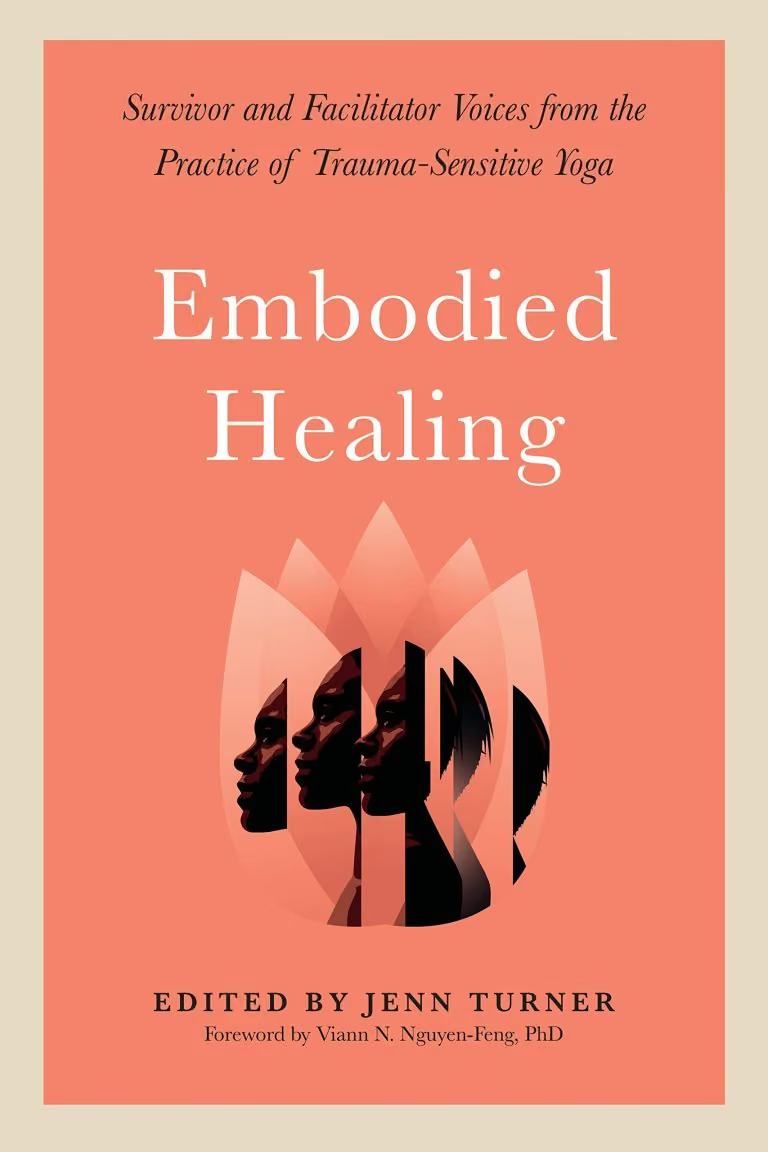
First-hand essays of embodied healing from the Center for Trauma and Embodiment at Justice Resource Institute: challenges, triumphs, and healing strategies for trauma-sensitive therapists and yoga teachers. All editor proceeds from Embodied Healing will fund direct access to Trauma Center Trauma-Sensitive Yoga (TCTSY). This collection of essays explores the applications of TCTSY–Trauma Center Trauma Sensitive Yoga–as a powerful evidence-based modality to help clients heal in the aftermath of trauma. Written by a range of contributors including yoga facilitators, survivors, and therapists, the first-hand accounts in Healing with Trauma-Sensitive Yoga examine real-life situations and provide guidance on how to act, react, and respond to trauma on the mat. Each essay centers the voices, wisdom, and experiences of survivors and practitioners who work directly with trauma-sensitive embodiment therapies. From navigating issues of touch and consent to avoiding triggers, practitioners and readers will learn how to support survivors of trauma as they reintegrate their bodies and reclaim their lives. Organized into sections based on principles of trauma-sensitive yoga–experiencing the present moment, making choices, taking effective action, and creating rhythms–the 12 essays are for yoga teachers, therapists, survivors, and mental health professionals and trauma healers. Daishin, a Trauma Sensitive Yoga facilitator, contributed to one chapter on how the practice of TCTSY has influenced how he understands and teaches Zen Buddhism.
Buy this book