
Here you’ll find reflections, teachings, and writing from the Zen Fields sangha, gathered over the years. Topics range from meditation and Buddhist philosophy to parenting, yoga, social and ecological justice, interfaith connection, and the places where Buddhism meets science. Browse by category below, or start with the most recent post and follow what draws you in.
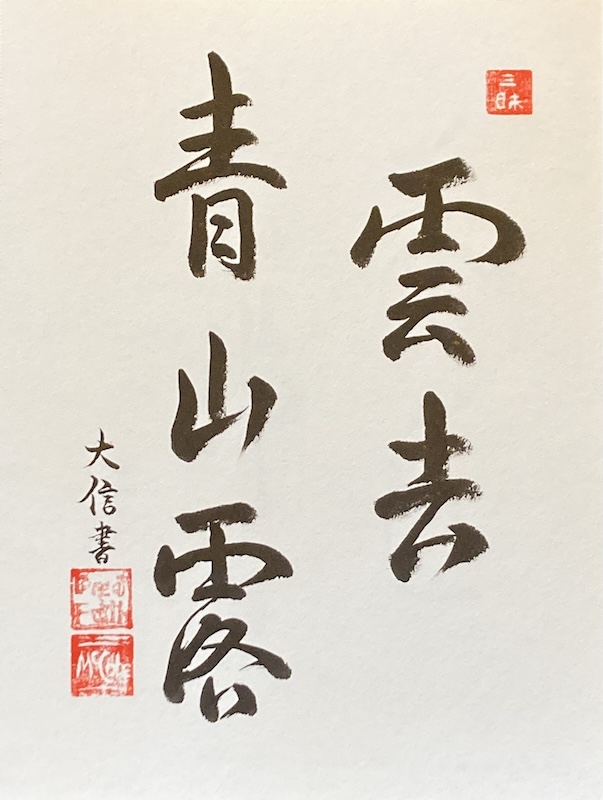
Our view is always partial, like clouds over a mountain; patience, not force, brings clarity.
“Cloud Goes, Blue Mountain Appears” is a metaphor for zazen. We might think of the clouds as thoughts and the mountain as what is real, or beyond thought. Or the clouds may be our deluded views and the mountain as Enlightenment. Or the mountain could be our very body/mind and the clouds our thoughts that prevent us from seeing the full picture.
Clouds could also be symbols for fluidity, acceptance, letting go, and not being obstructed by forms or social norms. Mountains are a symbol for stability, power, and groundedness. A Zen practitioner needs to have both qualities available depending on the circumstances. Sometimes we need to demonstrate flexibility, like a cloud, not getting too attached to ideas and views. Other times, like a mountain, we need to be rooted, not being swayed by the delusions of the masses, being strong in our physical posture and clear about the causes and end of suffering.
Clouds come and go in an endless cycle. In the same way, delusion and Enlightenment are a pair. There’s not a “once and for all” Enlightenment in our practice, but rather brief moments of clarity when the clouds’ part. But even when the clouds part, are we sure they have completely parted? Do they ever part completely? Is there not always something blocking our view?
Often, we are impatient with our practice and are looking for that “mountain.” We may try to forcefully remove the clouds from our minds. But this approach is to go against the natural flow of things, just as you can’t get a cloud to move by blowing at it from down on Earth. The cloud has its own timing and movement that needs to be respected. Developing patience in the process and not constantly seeking results is imperative.
However, is it a problem that the cloud obscures the mountain? What if we were to accept that our view of the world is almost always concealed, limited, and incomplete? What if we were to accept that what we are seeing is never the full picture? When anger arises, for example, can we notice how we are, in effect, desperately blowing at the clouds to no avail?
In one fascicle of Shobogenzo Dogen Zenji gives the image of looking at one corner of the sky through a bamboo pole. We mistake the one corner for the whole sky and don’t know it.
Practically speaking, it’s not until we socialize with those that have different views than our own that we realize the limits of our understanding. For example, on my travels, when I meet people for the first time, engaging in pleasantries, they eventually ask about my robes and ask what I do. I say, “I’m a Buddhist priest.” For some, this is a delight to hear, as it confirms their own beliefs. For others, however, they don’t know what to think or how to respond, as they have never met a Buddhist priest. I can sense their discomfort in that moment. There’s nothing I can do or say to such people, as I can sense them either reaching for some defense of their own views or having to modify existing prejudices. We all do this to some extent, and we must move outside of our social comfort zones to see this.
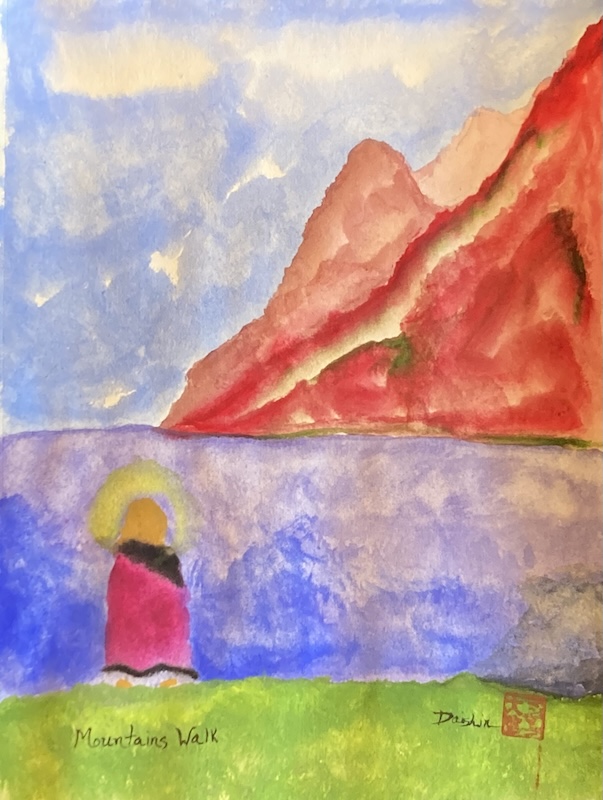
Dogen’s walking mountains teach deep time: even Iowa’s flat prairies are walking.
“Mountains do not lack the qualities of mountains. Therefore, they abide in ease and always walk. You should examine in detail this quality of the mountains’ walking.”
Dogen Zenji in "The Mountains and Waters Sutra"
It’s strange to be writing about mountains in central Iowa, one of the flattest regions of the country. Formerly tall grass prairie and teeming with wildlife, Iowa’s present land is a pale reflection of what it once was. Replaced by corn and soy crops in the Spring, Summer and Fall, it lies bare in the Winter months with little covering to support preexisting flora and fauna.
There is growing awareness of the need to “save the soil” through cover crops and prairie strips, and some farmers are taking this call seriously. Like many things, change is slow and requires a level of perseverance that few may be prepared to enact. The monocropping of the land doesn’t change the reality that I can drive for hours through cornfields that are as flat as a pancake. It also affirms a way of seeing the ground that, while having served humanity in terms of food production, is utilitarian. In other words, the land is not viewed as sentient and therefore (in our utilitarian oriented minds) entitles humanity to use it as we see fit. While proper stewardship of the land is a responsibility we cannot escape, I’d like to call into question the idea that land is dead or insentient. While some may argue right out of the gate that it is not inert because it grows corn and soy, I’d like to counter that by saying I find corn and soy fields largely uninspiring to look at. It’s not that they’re bad, nor are the farmers who put in a lot of hard work to cultivate the land, but my soul thirsts for diversity.
Where I trained in central Pennsylvania there is a very similar land ethic to Iowa, however, the terrain is quite different. There the soil is red, unlike the black soil of Iowa that has been singed by centuries of prairie fires. Perhaps the most striking distinction to the casual observer is the appearance of mountains. I could walk out the door of Mount Equity Zendo and see the mountains. Bald Eagle Mountain range was just off in the distance beyond the horizontal corn and soy fields. The level fields connected to the rising mountains in this area no doubt contributed to “Mount Equity Road” after which the Zendo was named.
Bald Eagle Mountain range was not named after the bird, as I once thought, but a leader within the Lenape (better known as the Delaware) tribe, a community of indigenous people that still exists today. This tribe has three clans within it, one of which is known as the “Muncy.” In the 1800’s the Lenape were pushed west by the expansion of the United States, and we find evidence of this westward movement by place names such as “Delaware,” “Muncy” (in Pennsylvania), and Muncie (in Indiana). The Lenape are perhaps better known for their “ceding” of what is now New York city and the surrounding Islands to settlers for a minimal price, yet their distinction from other indigenous tribes is often erased by the term “Indian.”
Bald Eagle Mountain range and other mountains like it comprise what is known as the Appalachian Mountains which span from Alabama all the way up to southeastern Canada. The Appalachian Mountains are considered older than the Rocky Mountains. Scientific studies of plate tectonics and sedimentation have revealed that these creatures (the mountains) were born some 480 million years ago and were once just as tall as the Rocky’s are today. Now, they are like old men and women with their hunched backs illustrating the Buddha’s teaching that no one can escape old age, not even a mountain. Yet to the common observer it may seem as though the mountains have always been the way they appear today.
Zen Master Dogen, in the 13th century on the mountainous Island nation of Japan, exhorted his students to observe the mountains “walking.” He was not privy to the extensions of the senses that technology has afforded modern humans. Meditation, rather, enabled him to see deeply into the nature of impermanence. Knowing that “mountains walk” with the intellect is not the same as penetrating it in the way that Dogen poignantly describes in his writing. Practice is seeing that we are those mountains walking. Dogen says:
If you doubt mountains’ walking, you do not know your own walking; it is not that you do not walk, but that you do not know or understand your own walking.
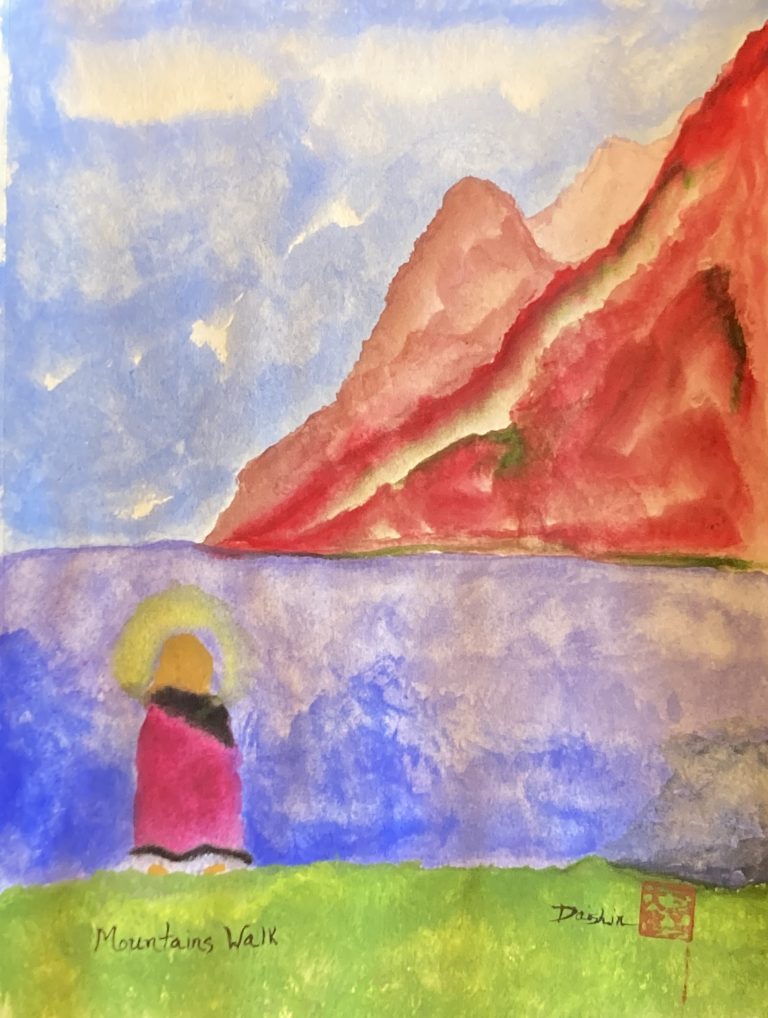
The monk in this image is standing on the bank of a river (or maybe a field) and is contemplating the mountain walking. This requires a deep time view. It requires that we keep alive the question, what was here before any of us was alive? Or perhaps, who was here before us? Who was here before our great grandparents? The Zen koan that invites us into a deep time view is, “What is your face before your parents were born?”
Returning to central Iowa, nestled between the two mighty rivers – the Missouri on the western border and the Mississippi on the eastern side – and to the Midwest sanctioned by the Rockies on the western bank and the Appalachians on the eastern edge, I find it imperative that I invoke my imagination to see with deep time eyes, that these two mountain ranges have been playing a tug of war with each other as they rise and fall, and thanks to them our prairies, too, walk.
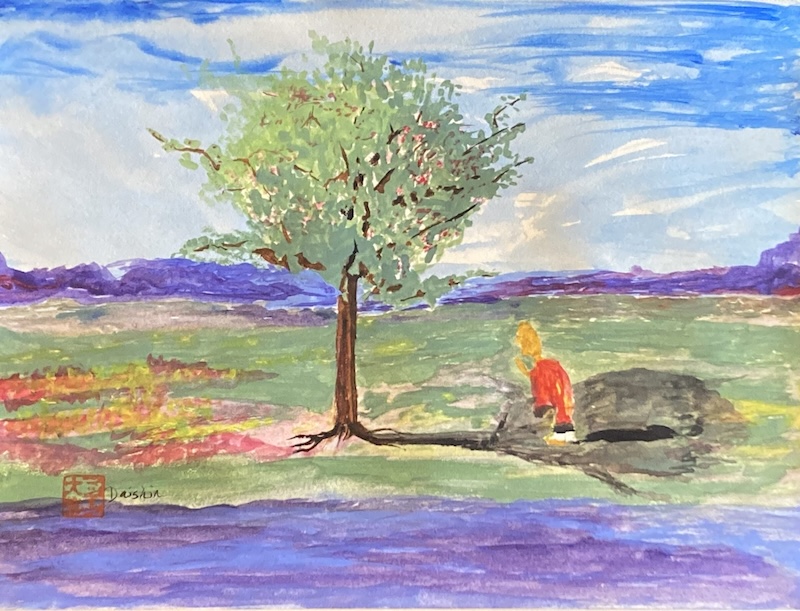
Zen’s lineage chant names only humans; what if trees, rivers, and animals were ancestors too?
Sitting at the edge of a small, sparsely wooded area on my college campus, the trees and grasses all around me brightened, as I could feel an immediate sense of intimacy with matter, with atoms, that was, until that moment, foreign. The realization: I share some of the same DNA as those trees and grasses. They were my ancestors, as was every dancing atom around me.
Almost 3-years later I entered a Zen monastery because, in part, I found a religious form where, through ritual, I could celebrate my relation to all living beings on Earth. In the Zen monastery, for example, I daily chanted the “Four Vows” which proclaim, “Beings are numberless, I vow to free them.” As someone who was a biology major studying endangered species like the Red Hills Salamander, this particular verse contained within it the spiritual inspiration I needed. If species are going extinct, a religious vow that says that the number of species are numberless and that we should do all that we can to free or save them seemed particularly relevant to me. It’s as if the Buddha is saying, “Do everything you can to prevent the mass extinction of species.” This seems to be an impossible vow – how could I single handedly save all beings? Yet, I am nonetheless vowing to do the impossible.
Since then, I’ve come across many more resources within the Zen tradition that affirmed my connection with the entirety of the natural world. The Buddha, in one sutra, says that there are no beings – from ants to zebras – that have not at one time been our mothers. Therefore, we should treat everything respectfully, as it continues to open us to the life energy that is us.
Zen Master Dogen, one of the founders of Soto Zen, further taught that “mountains walk just like people walk.” Dogen’s religious naturalism is infused throughout his writing. While I could go into greater depth on any of the aforementioned teachings, I would like to focus on a particular ritual found within the Zen tradition that I find, both problematic and encompassing tremendous potential for deepening our awareness of our animal and plant ancestors. This ritual is the chanting of the Buddhas and Ancestors lineage. I’ll begin with a description of the ritual, then talk about how it is problematic, and then how it may be “greened” or practiced such that it weaves us into a deep connection with the natural world.
A traditional Soto Zen morning chanting service begins by reciting the Lotus Sutra followed by the Great Compassionate Mind Dharani, and Heart Sutra. Sometimes other sutras and ancient Zen poems are included. Each of these sutras has its own separate and distinct dedication. The chanting of the sutras generates an invisible energy called “merit” which can then be directed through the dedication of that merit to a specific purpose. It’s the Zen way of soliciting help from forces beyond our understanding, but with the caveat that there are no expectations for a specific outcome. The outcome is beyond human control. The point is that the practitioner shifts their mind from preoccupation with ego-self to a concern for the welfare of others.
Following the chanting of the Heart Sutra is the recitation of two Chinese Zen poems called “Harmony of Difference and Equality,” and “Precious Mirror Samadhi.” The dedication for these two poems is the Zen ancestral lineage. In other words, we dedicate the merit generated by reciting these poems to all the teachers, including our present-day teachers, the Buddha, and the 7 Buddhas before Shakyamuni buddha, that came before us. It’s, first, a way of remembering the transmission of the Dharma throughout the ages, and of developing gratitude for those who have dedicated their lives to passing it on for our sake. Second, in reciting their names each ancestor becomes present in spiritual form, here and now, or, at least, the practitioner imagines them to be so. In dedicating the merit to the Zen ancestors, some feel that the ancestors can in turn help us in our present life.
It’s believed in the Zen tradition that, while from a historical angle Shakyamuni Buddha is the “founder” of Buddhism, and the original teacher, there were many awakened people before him that deserve credit and are thus symbolized in chanting the names of the seven Buddhas before Buddha. It is agreed upon that, within the Zen tradition, these seven Buddhas are not historical people. It’s important to note that the lack of empirical evidence for the existence of the people named in the lineage is irrelevant to most people who chant it. In fact, many Buddhist scholars believe that the lineage post Buddha was also largely fabricated in order to make Buddhism more adaptable to Chinese cultural norms.
To destroy any species is to destroy our own Enlightenment.
In any case, Shakyamuni Buddha’s name is chanted, followed by all the Buddha Ancestors in India, including Bodhidharma who carried the Dharma flame to China, then all the Chinese ancestors up to Great Teacher Tendo Nyojo Daiosho, who then passed on the Dharma to that first Japanese Great Teacher Eihei Dogen who carried the flame to Japan, and then all the Japanese ancestors up to my Dharma grandfather, Great Teacher, Noda Daito, then to my immediate master, an American, Great Teacher Daien Bennage. Obviously, many of the more recent generations of ancestors are not fictional characters. I and all my Dharma brothers and sisters who trained with and received the precepts from Daien Roshi are a part of the spiritual lineage of masters that extends not only to the Buddha Shakyamuni, but to the 7 Buddha’s before Buddha.
Every day I chanted these names in a monotone key, offering candlelight, sandalwood incense, water, food, and bowing to them, my whole body and mind reverberating with the vibration of these teachers, like bees swarming in their hive. I learned, further, that there were stories of Enlightenment attached to each of these ancestors. I continue to be nourished by these stories and by the ritual of chanting the names of the ancestors, as it has been emotionally moving for me, personally. However, I will now turn to two problems I see in it and consider initial ways to rethink it.
The first issue I take up is that, aside from my teacher, Dai-En Bennage Roshi, all the teachers in the lineage are male, and the second is that they are all human. The fact that they are all, but one, male, denotes the patriarchal nature embedded within Buddhist ritual. The fact that we limit our “spiritual” ancestors to human beings betrays an anthropocentric bias.
In response to the first problem, some Zen centers, including my teacher’s, have resorted to including a second list of names comprised of notable female Zen ancestors that are chanted after the male names. For many women and some men this has been a deeply meaningful addition, as it affirms the capacities for all genders to attain Enlightenment. However, in a male dominated culture, historically, women have mainly been marginalized, and this chanting of all men’s names is one way that has been woven into ritual and institutionalized. In Japan, for example, male clergy far outnumber female clergy. In the United States, too, if we include Asian-American practitioners, the number of men that are playing the role of priest/clergy/monk/teacher far out-number the women who play that same role. Not to say there aren’t women practitioners, just that their roles are marginalized in the form of “support” for the teacher. Thus, chanting the female ancestors has been a way to address the way women have been made invisible in Zen history through the lineage, and it has empowered many people to work for and realize gender parity.
The second problem is that of anthropocentrism. While, as mentioned previously, Zen teachings go above and beyond our western religious sensibilities with regards to feeling an intimate connection with the natural world, the Zen lineage falls into the same trap as the Abrahamic traditions because it stops short at human Enlightenment. It is the humans and their Enlightenment that are memorialized in the ceremony, not that of frogs, stars, or bees. This, to me, is a short coming that, like the addition of female ancestors, can be improved upon. Just as the ritual of reciting the names of the Buddha and Ancestors has helped me feel a deep connection with these amazing teachers and their Enlightenment, and that I too am part of that flow, including non-human ancestors may also help us to establish that Enlightenment is not just the purview of humanity, but that it extends to all creatures. To destroy any species is to destroy our own Enlightenment.
There are countless stories within the Zen tradition that affirm the Enlightenment of both sentient and non-sentient beings. As such, even walls and pebbles can be a teacher. In Dogen Zenji’s, “Self Fulfilling Samadhi,” he states,
The trees, grasses, and land involved in [realization] all emit a bright and shining light, and preach the profound and incomprehensible dharma, and it is endless. Trees and grasses, walls and fences expound and exalt the dharma for the sake of ordinary people, sages, and all living beings. Dogen Zenji
Furthermore, the Buddha was Enlightened under the Bodhi tree. Upon seeing a star, he attained Enlightenment. Buddha was born in a forest and died in a forest. What if, as a way to “green” this ritual, the names of these beings were incorporated into our lineage? Can we imagine the chanting the name, Great Teacher Bodhi tree? Should not the star (or planet) the Buddha saw at the moment of Enlightenment also be considered our ancestor? What about the grass that the Buddha sat and walked upon? How about the deer in the park where he resided? What about the Ganges River that he lived nearby? Could they not also be included in our sacred lineage?
These questions are meant to stimulate further discussion and envision possibilities as to the greening of our lineage ceremony. What or who might this lineage include one hundred years from now? Could we not include the names of our local region – the Des Moines River – and animals – the Red Fox – and trees – the Cottonwood? What or who might our lineage include 1,000 years from now? How about 10,000 years? 100,000 years? 1,000,000 years?
Shikantaza starts where the jhanas end: we sit as already awakened, with no stages to climb.

All art by Daishin

At the edge of a forest filled with immense banyan trees a man wearing ochre-dyed cloth draped over one shoulder, leaving the other bare, prepares a pile of mindfully gathered grass under large tree. Bending his knees to sit on the grass, he crosses his legs with great attention, placing his right foot on his left thigh and his left foot on his right thigh. His back lengthens like a cobra rising. He sits stably, like a thick and heavy stone, unmoved by howling wind, pounding rain, or swirling emotional hurricanes. His eyes half open not here nor somewhere else. His whole body seems to be covered with eyes. His face brightens as a subtle smile flowers forth. The mere sight of him is like gravity in the belly.
What did this man, known as the Buddha, or awakened one, experience while sitting in meditation? What were the meditative states that constituted his awakening? Some of his early teachings offer a clue.
I compare an early Buddhist text, “The Fruits of the Contemplative Life,” with Soto Zen teachings on Shikantaza, or “Just Sitting,” as I understand it. I attempt to show that ways of practicing and understanding Buddhist meditation (What was the Buddha experiencing under the tree?) have evolved over time. Earlier forms of meditation have become hidden in later teachings. Shikantaza is a unique practice within the Buddhist panoply of meditation practices that dispenses with earlier techniques, but at the same time assumes some of the “fruits of contemplative life” at the beginning of practice. In other words, these fruits of practice are not something practitioners of Shikantaza can anticipate. Rather, they are always present within Shikantaza from the very first time one practices.
It’s important to note that I have limited experience of Buddhist practice outside of Soto Zen. I speak from within my own tradition and mean no disrespect to other forms of Buddhism that may be more explicit about Jhanas or understand them differently. I’m especially grateful for earlier teachings of Buddha including how they manifest in what in modern times is known as Theravada Buddhism. What follows is not a critique of other schools of Buddhism, but simply an expression of my own finite understandings and musings based in experiences of shikantaza.
What did this man, known as “Buddha”, “awakened,” do while sitting in meditation? What did he experience in that profound state?
The Buddha lived for 80 odd years, over half of which he spent teaching the way to what came to be known as “Enlightenment.” Home leavers, wearing simple clothes, shaving their heads, sleeping under a canopy of trees, having cut family ties, having no job but to train for liberation of the heart/mind from this world of suffering, trading spiritual advice for food, clothing, and medicine, were attracted to him, and respectfully sought out his guidance. Far more of his students chose not to leave the comforts of a roof. They had their own families and jobs to tend. They too greatly benefited from his teachings, from simply witnessing him sitting, standing, and walking.
Kings, both wise and stupid, even, sought the guidance of Buddha. King Ajatasattu was such a person, plagued by fear and often acting with violence. He asked Buddha, as recounted in the Samannaphala Sutta (The Fruits of the Contemplative Life), about the fruits of meditation, what someone would gain from such a practice. Buddha graciously responded to the King with his own set of questions, and thus a dialogue ensued revealing the fruits of a life of renunciation.
King Ajatasattu was riddled with guilt and anxiety, having had his own father murdered so he could assume the throne. He encouraged divisiveness within the Buddha’s sangha by supporting Devadatta, a former disciple and cousin of the Buddha, who, like the King, was thirsty for power, even attempting (though failing) on three occasions to kill the Buddha. The price of the King’s rise to prominence was mental illness. In asking the Buddha for advice in spiritual matters he must have been experiencing bone-chilling regret and confusion, all affecting his internal peace.
Out of Ajatasattu’s dialogue with Buddha emerges a teaching that includes, among many things, descriptions of what are known as the four jhanas. The jhanas are the results of having generated mental stability through pratyahara, or withdrawal of the senses, having ended unwholesome qualities of mind like greed, hatred, and delusion, and having stilled “directed” thought. Having cultivated wholesome qualities of mind the practitioner experiences pleasure, rapture, joy, equanimity, and mindfulness, among other qualities.
Buddha describes the transition of the mind from delusion to Enlightenment and the practices that allow one to move through various jhanas. This must have been a very prized teaching in the 5th century BCE, in a worldview that proclaimed that escape from the round of suffering is possible, but only after many lifetimes of assiduous and dedicated practice.
A seismic change occurred with the emergence of the Lotus Sutra and other Mahayana texts between the first century BCE and the second century CE. The Mahayana texts are known for the radical proposition that liberation is available not only to monks who dedicate their lives to practicing meditation, but to everyone. No longer is there one Buddha–Shakyamuni, the historical Buddha who awakened under the Bodhi tree. Instead, there are many, including the solo practitioner who has no need for a teacher. In fact, the Buddha of the Lotus Sutra predicts that all of his disciples, male and female, are destined for buddhahood. He even guarantees enlightenment to those who doubt it’s possible.
Mahayana made enlightenment accessible to lay people, including:
The Lotus Sutra was a radical exposition then, and I think it remains so today. From the time of the historical Buddha to the present, the Dharma has been flowing like a river, its waters turning and churning as it emptied into the forest and city geographies of East and Southeast Asia, and crossed the Pacific Ocean entering North and South America.
Mahayana Sutras set the stage for shikantaza, a practice that may appear at odds with earlier forms of Buddhism that emphasized cultivation from an unenlightened state to an enlightened state.
Chan (Chinese for “Zen”) Buddhism, which developed in China in the sixth century CE, deepens the accessibility of Mahayana teachings to everyone by introducing the idea of “sudden and gradual enlightenment” . One no longer needs to wait lifetime after lifetime for liberation, as in the time of Shakyamuni Buddha. Instead, one can catch glimpses of liberation in one’s own lifetime. Freedom from the round of rebirth and suffering is possible here and now, in this very life, regardless of one’s previous lives.
The jhanas, as described in the “The Fruits of the Contemplative Life,” are the product of a different mindset, one that takes reincarnation for granted. Unlike modern America with its secular leanings, ancient India presumed a universe where we are continually reborn into a world of suffering until we have the means to escape this world (referred to as Nirvana) through meditative practices. This escape was only afforded to those who could renounce the world and become monks. According to “The Fruits of the Contemplative Life,” states of deep meditative absorption can be experienced in the here and now through exertion. However, unless one becomes a monk and dedicates oneself unremittingly to meditation, they are largely unattainable. A twenty-first century American reading the “The Fruits of the Contemplative Life” might get the impression that such lofty states require a great deal of time, patience, and, perhaps, instruction from a teacher regarding proper technique that could be experienced in this life. However, they may not be aware that it was written for someone who had lifetimes of practice and previous incarnations before they attempted such practices.
The practice of shikantaza, or “just sitting,” developed within a Chan context, and derived from a confluence of cultures, ideas, worldviews, and habits of the heart. While the idea of reincarnation was imported to Japan, this idea doesn’t play a big role in who could practice. Moreover, there’s no mention of the jhanas or how to reach them in Dogen’s Fukanzazengi, or “Universal Instructions for Zen Meditation,” written in the thirteenth century. Where did they go? How does one “attain” them?
The following story found in the Denkoroku, or Transmission of Light, a collection of koans attributed to the thirteenth-century Zen master Keizan, is instructive:
Seigen Gyoshi went to study with the Zen master Daikan Eno and asked, “What work is to be done so as not to fall into stages?” The Zen master inquired, “What have you done?” Seigen Gyoshi said, “I do not even practice the holy truths.” The Zen master said, “What stage do you fall into?” Seigen Gyoshi said, “If I do not even practice the holy truths what stages are there? The Zen master recognized his profound capacity.
Both ancient and modern Soto Zen teachers discourage practitioners of shikantaza from actively pursuing special states of mind such as those described by the jhanas. Seeking them generates separation or clinging and obscures awareness of anuttara samyak sambodhi, or complete perfect enlightenment. Rather, Soto Zen encourages becoming less concerned with a release from the world of suffering, and more concerned with identifying oneself as the very world one lives in.
Soto Zen says, “stop grasping after anything, good or bad,” for to push away the bad only makes it worse. Rather, learn from the wave. Water rushes backward to go forward. Bad and good are two sides of one coin: delusion and enlightenment can’t be separated. Enlightenment can only be found within the deluded mind, not once all delusions disappear.
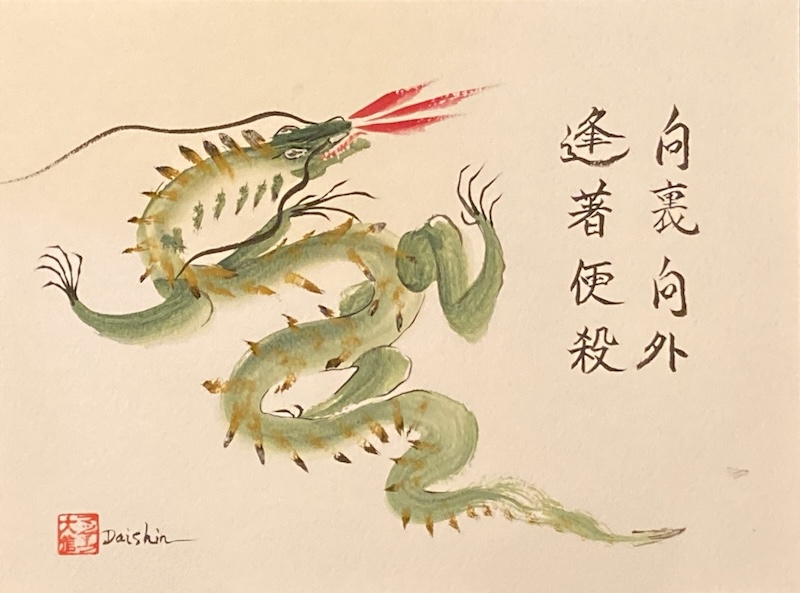
Zen Master Dogen used images to help the practitioner compassionately meet the mind that wants to eliminate delusion. In Universal Instructions for Zazen, for example, Dogen says“[t]he dragon attains water” and “the tiger returns to the mountain” . The dragon, a mythical beast of great power and wisdom, dwells in water—that’s its home. But the dragon also dwells within us. The tiger’s home is the mountain. That tiger, too, is within us. Shikantaza is the practice of returning, or rotating, the mind to something (not a place or state) that has never left us. When the dragon attains the water and the tiger enters the mountain it is in its natural environment – it knows where its family is, and where to find things.
In my experience, people often take a “pauper to a king or queen” approach to meditation. They devalue their present state of mind, like King Ajatasattu in “The Fruits of Contemplative Life” (and who could blame him for wanting to feel differently?), and are seeking something grander – the mind of a Buddha, an “enlightened” mind. They might work their way through various mental states and after many hard years of practice begin to get some glimpses of so-called “Buddha Mind.” They may equate this “Buddha Mind” with some kind of privileged status, and if they attain it may even gain some recognition from their teachers or others in their meditation community.
Shikantaza practice within mainstream Soto Zen takes a slightly different approach. From the very first moment of meditation, we are kings and queens: we manifest Buddha Mind simply by sitting upright on our cushions. Indeed, Dogen Zenji says, “Shu sho ichi nyo”: practice and enlightenment are one.
In shikantaza, we embrace whatever arises, so there’s no difference between the person who meditates for the first time, and the person who has been meditating regularly for 30 years. It’s not that people immediately experience the same psychological state when they practice shikantaza, but that whatever is present is given permission to be there. The person who has been at it longer only sees this more clearly than the person who’s just begun.
I find several similarities between the Buddha’s instructions to King Ajatasattu in “The Fruits of the Contemplative Life” and Dogen Zenji’s, Universal Instructions for Zazen. After introducing zazen as the practice of a Buddha, Dogen offers practical instructions for how to do it. First, he says, find a quiet room. Eat and drink moderately, and put aside all involvement with the world. To me, this mirrors the Buddha’s description in “The Fruits of the Contemplative Life” of the home leaver who abandons worldly attachments and eats just one meal a day. Dogen, however, makes shikantaza accessible to everyone by advising practitioners to “eat moderately” instead. Watch the quantity of food you put in your body so you can remain alert in meditation. You can have three meals a day, just eat in moderation.
Moreover, during the span of meditation practice—whether we are sitting for five minutes or 45 minutes, Dogen exhorts us to put aside worries about the day. Dogen was not opposed to cutting off ties to the world as the monks of the Buddha’s time did, but he also thought in terms of one meditation period. He encouraged practitioners to cut off worldly ties for however long they were meditating—five minutes, five hours, five days, five years, or a lifetime. Practice and enlightenment are always available immediately; there’s no need to wait for some special time. All of us, home leavers or not, can set aside five or ten minutes from our busy lives once or twice a day to let go of worldly attachments.
Buddha, in the “The Fruits of the Contemplative Life”, describes the ending of “directed” thought as responsible for the emergence of a particular jhana. But ending directed thought, in my view, is not the same as stopping thought altogether. When the Buddha speaks of “directed” thought, he means concentrated thought: focusing one’s mind on a particular object, and not losing that focus. People new to meditation often mistakenly think that the goal is to fix one’s mind so thoroughly on the breath that no thoughts whatsoever can penetrate the mind. While this might have some benefit and is not a necessarily a bad practice, it can be very misleading. Often I hear people express their failure at meditating because of this misunderstanding this practice.
When the Buddha instructs King Ajatasattu that one of the jhanas is the result of stilling directed thought, I believe he is describing the practice of allowing “undirected” thought—and this, in my experience, is exactly what shikantaza is about. In shikantaza we don’t try to fixate on a particular object, such as our breathing, or try to rid our minds of thought. Instead, we view our thoughts like a flowing river. Good and bad thoughts pass us by. There’s no need to hold on to the good ones or the bad ones. We just sit as if on on the bank of a river and watch the thoughts rush by. Practicing this way, the meditator may notice changes to the mind and may even experience feelings of mental ease. But ease of mind is only a possiblity; it is not a guarantee, and it is certainly not the “goal” of meditation practice.
Another point of convergence I found between the Buddha’s descriptions of the jhanas in “The Fruits of the Contemplative Life” and Dogen’s “Universal Instructions for Zazen” is the quality of joy that meditation can elicit. The Buddha says that joy is one aspect of the first of the four jhanas. The practitioner who reaches this state of meditative absorption will experience “rapture and pleasure born from withdrawal.” Similarly, Dogen Zenji describes shikantaza as anraku no ho mon—“the dharma gate of joy and ease.”
Joy ought to be present in our own practice as well. It arises from temporarily but responsibly turning our minds away from our incessant worries and desires.–We constantly want more: more money, more stuff, more attention, more sex. There’s no shame in mindfully observing these desires in ourselves. The problem happens when we are not aware of how destructive these desires are for our own lives as well as our planet when actively pursuing them.
The jhanas Buddha describes in “The Fruits of the Contemplative Life” are stages—states of concentration that one passes through on the way to enlightenment. For Dogen, practice begins at Buddha’s finish line: we practice as if we are already awakened beings—because we are! No former practice is necessary; there’s only now. Dogen invites us to trust in our own inherent Buddha nature, something our rapacious minds delude us into thinking we have lost. Shikantaza can be considered a non-dual approach to meditation that moves us, similar to the jhanas, from deluded humans to Enlightened Buddhas.
Two other areas of overlap between “The Fruits of the Contemplative Life” and Dogen’s shikantaza are the practice of confession and of the precepts. While, I will leave these for a later writing, it’s important to note that confession and the practice of the precepts are a common thread that runs through all forms of Buddhism, both in ancient and modern times. While in modern times meditation has become accessible to everyone, and one can experience liberation here and now, we cannot presume that we are above the need to confess our short-comings nor to practice the precepts.
On the surface there appears to be a great gap between shikantaza and earlier teachings of the Buddha. No doubt, shikantaza is not practiced in the linear fashion that “The Fruits of Contemplative Life” describes the jhanas. Because shikantaza doesn’t mention the jhanas, however, doesn’t mean they are not present in shikantaza. We see Dogen Zenji advocating for following the precepts, confessing, and leaving the world behind (even temporarily), just as Buddha either directly or indirectly supports in “The Fruits of the Contemplative Life.” While Dogen Zenji employs images like “the dragon attaining the water”, Buddha offers a more matter of fact approach – “if you do this, that will happen.” If you let go of worldly affairs, joy – the first jhana – will arise in the mind.
Lastly, the contrast between the Buddha’s approach and Dogen Zenji’s approach demonstrate the adaptability and flexibility of Buddhism across time and culture in meeting the needs of people where they are. Buddhism is not a monolithic tradition. There’s room for diversity of beliefs and practices, and we see that diversity fits well with the American mindset in the United States in the 21st century.