Here you’ll find reflections, teachings, and writing from the Zen Fields sangha, gathered over the years. Topics range from meditation and Buddhist philosophy to parenting, yoga, social and ecological justice, interfaith connection, and the places where Buddhism meets science. Browse by category below, or start with the most recent post and follow what draws you in.
Finding Joy in Leisure
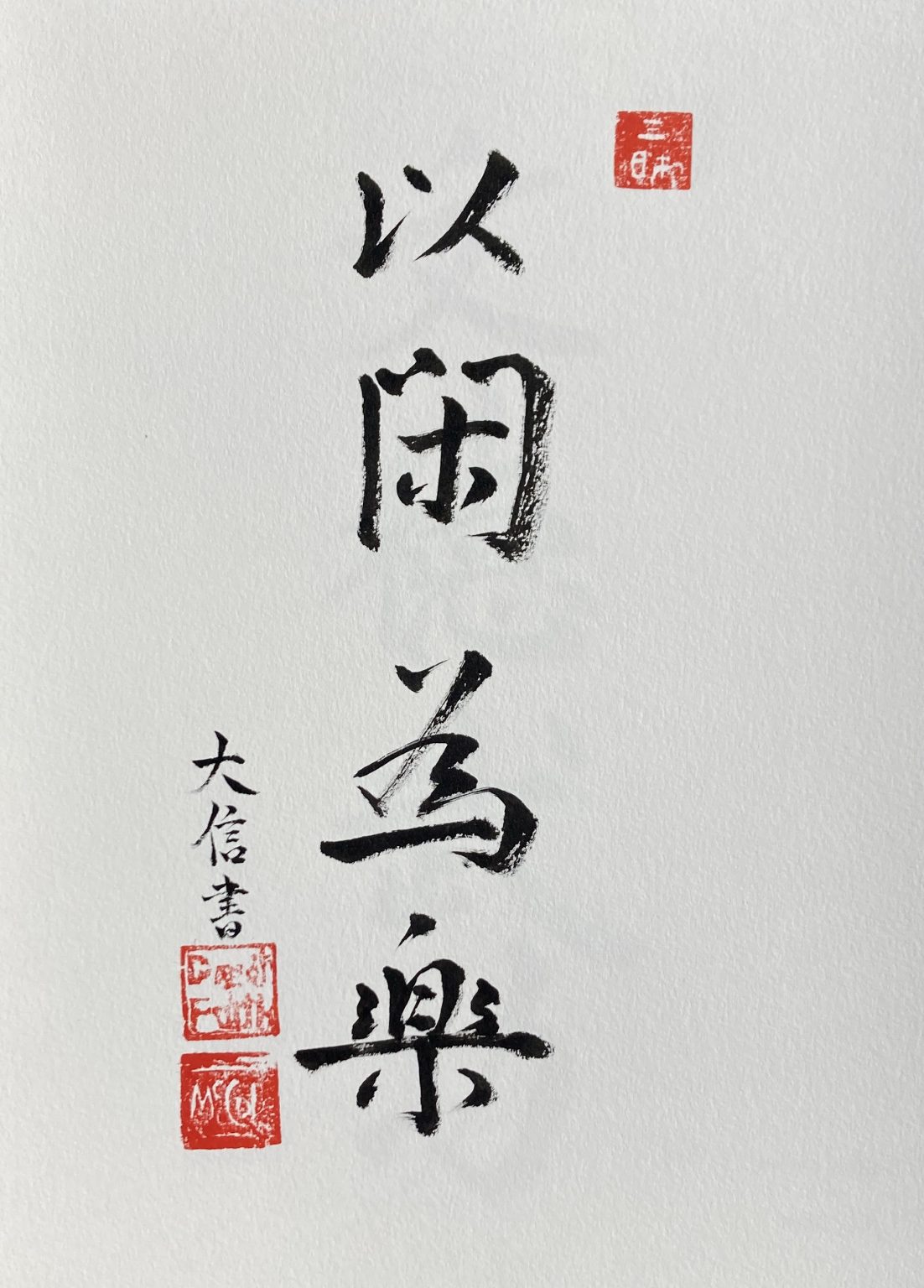
As a Zen priest, father, and husband sometimes I’m so busy that I feel guilty about taking rest or finding pleasure in quiet moments by myself. 以閑為楽 means, to find pleasure in leisure, or to find pleasure in a quiet place removed from the concerns of the world. On the surface it seems obvious that we should find joy in leisure time, but I find the statement to be a personal challenge from the universe to wake up to the joys of life all around us, even when we are totally stressed out.
I’d like to use the concept of leisure to segue into Zen perspectives on rest, specifically sleep. While finding joy in leisure is not the same as sleeping, there are certain parallels between the two. Both, for example, are sometimes considered luxuries, and perhaps not something to be taken seriously by the majority. To demonstrate my point, I recently heard a sportscaster ask a professional basketball coach how he slept at nights before a tournament. He said that he gets something like 2 hours of sleep at night and that, “sleep is over-rated.”
Similarly, when I was training with my teacher and asked her how she worked without taking breaks she responded, “You have to rest in the work.” No doubt this can be a useful and practical attitude to have for many endeavors, one’s that you feel passionate about, or there’s an urgency to something, or it’s a matter of life and death. Zen does teach that each moment is a matter of life and death. However, sustaining that attitude all the time can lead to extremism at worst or perhaps burn out, and disregards the moderation or “middle way” that Zen also upholds.
To be honest, Zen teachings on sleep are quite ambiguous. Many cast a dark shadow on the subject. Sleep is considered one of the five hindrances to awakening. There are stories of a monk who cut off his eye lids so that he would not sleep. Another is of the Buddha admonishing a sleepy monk to wake up. The monk was so ashamed of his practice that he vowed never to lie down to sleep. He consequently went blind. These stories are held up as noble ways to wake up. Zen Master Dogen is said to have had an awakening when his teacher hit the sleeping monk next to him. While the historicity to such stories is questionable, they nonetheless generate anxiety about sleeping within a Buddhist context.
It wasn’t until my health began to wane due, in part, to lack of adequate sleep that I began taking sleep more seriously. While this change of habits and ideas of sleep happened over a decade ago, I can’t help but think how difficult it is to prioritize sleep. I’m not alone in this.
I heard a recent podcast that featured sleep expert Dr. Gina Poe on “The Huberman Lab.” Dr. Andrew Huberman is a professor of neuroscience at Stanford University, and he continually encourages his listeners, not just in this one episode, to get adequate sleep. There is mounting evidence that many of us in America are sleep deprived and it is having health consequences including rising levels of anxiety and depression.
During the podcast, Dr. Poe gives us a road map about what happens inside the brain and body when we get a full night sleep, and makes recommendations for how to improve sleep hygiene. While I encourage those that are interested in learning more to watch the show, in what follows I’ll attempt to summarize some of the salient lessons.
A typical night of 7 – 9 hours of sleep consists of 4 or 5 “sleep cycles.” Within each cycle, from what I could glean, there are roughly 4 stages – 3 that are non-REM (Rapid Eye Movement), and 1 that is REM. Each cycle lasts somewhere around 90 minutes and is followed by REM.
The first stage is equated with gamma, or fast, brain waves. It’s what happens when we have the feeling of dosing or when we first begin to fall asleep. The second stage is somewhere between wakefulness and a deep state of sleep, but not yet dreaming.
The third stage is characterized by slow brain waves, is deep sleep and it has the function of “cleaning” the brain and restoring us. When someone is in this third stage they typically are very hard to wake. Consider how difficult it is to wake a small child out of a deep sleep. It’s probably because they are in this stage. Adults tend to spend less time in this third stage as we age.
Then there is REM sleep where our dreams are most active. When someone wakes from REM sleep, they usually remember what they were dreaming about before being woken.
The first REM period usually takes place 110 minutes after falling asleep, lasts about 10 – 15 minutes, and then the cycle begins again.
In a perfect night’s sleep there are between 4-5 cycles like this. During the first cycle there is a big boost of what’s known as growth hormone. This first cycle is associated with integrating memory, and I got the sense from Dr. Poe that it is crucial for our overall wellbeing. If we miss the first cycle we can’t make it up later because our bodies are on a circadian rhythm. If we go to sleep later than our usual bedtime we miss the boost of growth hormone that works at integrating memory.
Dr. Poe suggests having consistent sleep and wake times. A regular bedtime routine is the best marker for good sleep hygiene.
This conversation about the science of sleep made me delve a bit into affirmative teachings of sleep found in Zen literature. As I mentioned, Zen is quite ambiguous about sleep. Given our culture and time, drawing on those aspects of the Zen tradition that cast a positive light on sleep seems most appropriate. I’ll briefly outline three teachings on sleep, the first being a story.
A student asked a Zen master how they should practice the Way. The master replied, “When hungry eat, when tired sleep.”
The student was surprised by this response and asked, “Doesn’t everyone do that?”
The master responded, “Most people entertain a thousand desires while they eat and untie a thousand knots while the sleep.”
In other words, most people are not really paying close attention to their body. Their mind is on other things. They are not eating nor resting properly.
Secondly, in the Soto tradition, Dogen regards sleep as a practice. He tells his assembly to rise up and lay down at the same time. When the monks get up, everyone gets up. When the monks go to sleep, everyone goes to sleep. In other words, pay attention to what people around you are doing. Don’t try to stick out like a sore thumb. Don’t stay awake meditating into the night when everyone else has fallen asleep. Don’t think that you are better for not following the crowd.
This admonition goes against everything I was taught by family and society: Be yourself. Don’t follow the crowd. Be independent.
These ways of being – the way of individualism – is not wrong or bad, but it misses the mark when it comes to harmonizing one’s body with the bodies of others. Thus, in the West, Zen practice often becomes a “personal” practice that excludes what the Japanese call “Daishu Ichi Nyo” or “Being one with the great assembly.” There is benefit, in other words, to attempting not to stick out, to being a part of the group, to not creating waves.
Lastly, in the monastery where I trained, Shogoji, we were told to sleep on the right side of our body with legs slightly bent at the knees and our right hand under our pillow to support our head. This is the Nirvana pose of the Buddha and is said to stimulate the parasympathetic nervous system, that part of us that initiates rest and relaxation. One of my teachers knew how difficult it is to spend the entire night on your right side, so he suggested to at least begin the night on your right side and then move as needed. I found this instruction helpful, as I could never sleep in one position the entire night, and it also helped me to find comfort as I entered Nirvana pose, knowing I was embraced by the Buddha both while awake, sitting zazen and in everyday activities, and while going to sleep.
There is also a gatha I recite while going to sleep in the Nirvana pose:
“As I go to sleep this evening may all beings calm all things making the mind clear and untainted.”
I’m not going to pretend to suggest that I sleep fine all the time now. Indeed, there are times when I struggle to go to sleep or stay asleep. But here are a few things that I do to help me get a good night’s rest:
Yoga Nidra, or the practice of deep relaxation, has been clinically proven, according to Dr. Huberman, to have beneficial effects on stimulating the parasympathetic nervous system. I’m happy to share that we practice Yoga Nidra as a part of the yoga classes that I teach at Zen Fields, and I strongly recommend learning this practice.
In conclusion, 以閑為楽 means, to find joy in leisure. If I’m being totally honest, this is difficult for me for reasons mentioned above. I take it as a challenge to my practice, and suggest that if we are serious about Zen, we find ways to not just increase our sleep time, but to find pleasure in so doing.
Ths article talks about what it means to have "faith" from a Buddhist perspective.
People of many religious traditions come together across the globe to celebrate the end of a year and to wish for a prosperous new year to come. There’s something in our psyche that acknowledges this ending and feels the need to mark it, formally or informally, with ritual. Christmas is that time for Christians, Kwanzaa for certain African American communities, and in Japan, people ring in the new year with 108 sounds of the great bonsho bell at the Buddhist temple.
For many people in our own Buddhist community there may be mixed feelings about some of these rituals. We have perhaps dismantled our ideas of God, faith, and organized religion. Some of us may even be struggling with a sense of purpose and belonging. Without a strong faith, some may wonder, why even bother investing energy in celebrating the close of the year?
Most of the people I know associate faith with religion and God. Many who come to Buddhism may have rejected their religion of origin and are trying to find some guidance in their newfound spirituality. Some may not want to give up on religion but do want to give up on God. This was the case for me and a lot of other Buddhists I know. I was drawn to Buddhism, in part, because the Zen teachers I connected with said nothing about God, about having to believe in God, or that God played any significant role in Buddhism.
Today I feel differently about God. As a chaplain, I pray with Christians and invoke the name of Jesus. I find many aspects of the Bible personally comforting and I can totally understand how many people, especially when they are sick, can likewise find wisdom, compassion and a deep sense of belonging by reading passages and connecting with their Christian community and pastors.
However, I benefited greatly, too, from letting go of having a relationship with God and associating God with religion, as well as deconstructing the concept of God. I distanced myself, intentionally, from people who practiced with conservative views of Christianity. While this helped me to define myself religiously, my teacher, upon conferring the 16 Bodhisattva precepts, gave me the name of “Daishin,” or “Great Faith.” I don’t think it was an accident that she did that. Having taken on the name “Faith” in part of my name has led me to investigate what that concept means within Buddhism. Does faith, in Buddhism, have anything to do with God? Do I put faith in Buddha instead? These were some initial questions I wrestled with.
First, the Chinese character for faith – 信 – literally means “one who stands by their words.” One who says what they are going to do and then does it, is one who can be trusted and relied upon by others. It calls to mind the importance of being careful about what we say before we say it, especially if we intend to do something that has implications for others. Another possible translation, one that may be even better, is “confidence.” Faith is not blind.
In one of the earliest Buddhist teachings, the Dhammapada, the Buddha mentions a word that has been translated as faith:
As a strong wind blows down a weak tree, Mara the Tempter overwhelms weak people who, eating too much and working too little, are caught in the frantic pursuit of pleasure. As the strongest wind cannot shake a mountain, Mara cannot shake those who are self-disciplined and full of faith. (Chapter 1: 7-8)
Here, faith does not appear to be directed at an object, such as God. Buddha doesn’t say, “Have faith in me.” So, what is faith in, if anything? Perhaps a better way to view faith from this perspective is that faith is a state that each of us is naturally endowed with. Like a tree, that it can be full and strong, it may be in a younger developmental stage, it may be in a state of decay, or it may be more mature. It doesn’t matter what stage it’s in. From a Buddhist perspective, faith is a seed that we all have within us. The Buddha encourages cultivating it, not for him but for our own well-being and healing.
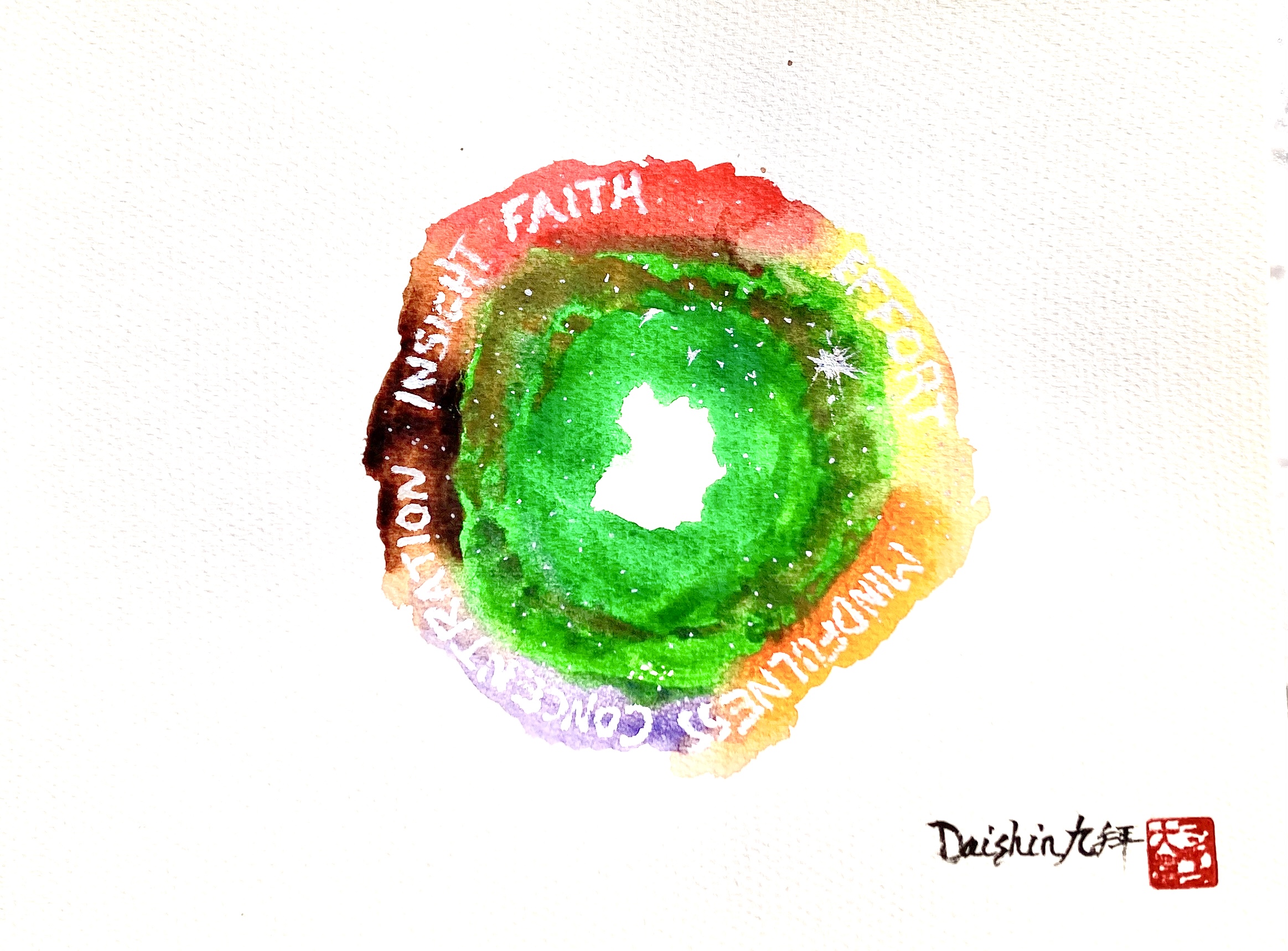
A second place where faith shows up in Buddhist teachings is in the Buddhist psychological perspective called Abhidharma, or “super Dharma.” There is a wonderful teaching about “The Five Powers,” the first power being faith. Faith is the foundation for effort or energy. Energy is the second power. When we have a strong faith, it gives us energy. Why? Because we are living with a sense of purpose. To have faith is to know that we belong and that what we do matters. This gives us energy.
With energy, we have the ability to nourish mindfulness, the third power. We become aware of what’s happening within and around us and are better able to choose what to do and what to refrain from doing. Mindfulness leads to the fourth power – concentration. When we become clear through mindfulness, the mind is better able to concentrate on what’s important and to give it our full attention. We’re able to discern what we want to let go of, without regrets, and to pour ourselves more fully into the present moment.
Concentration, then, leads to insight, the fifth power. Insight or wisdom is that which allows us to see into the depths of reality and to know that there is more here than meets the eye. Insight further increases our faith, and thus the five powers run in a cycle, mutually enhancing (or diminishing) each other. These five powers are operating so quickly that we may not always be able to tell one from the other. The Buddhist psychological perspective, though, has teased the five powers out of a single stream of energy so we can understand what’s at play, kind of like a map. When we see the map, we are clearer on the direction we want to go.
Faith can also be found in later Buddhist writings such as The Awakening of Faith in the Mahayana, by Ashvagosha, considered one of our Indian Zen ancestors. The gist of this treatise is that in addition to putting our faith in the three treasures – Buddha, Dharma, and Sangha – we put it, first, in the Absolute dimension of reality. Buddhism teaches what’s known as the two truths – the Absolute and the Relative dimensions of reality. These two realities are always here and now in every moment, but we are rarely aware of the Absolute dimension unless we have some kind of disciplined spiritual practice that prepares us for experiencing it (or we spontaneously experience it).
To have faith in the Absolute dimension we need to know how to understand what it’s referring to. According to Ashvagosha, what he calls “Mind” is the concrete manifestation of the Absolute in the here and now. “Mind” is not referring to what we usually associate with mind – such as the mind/body duality, or mind versus matter. Rather, Mind is an all-pervading reality found in everything. It is that aspect of the universe that enlivens all things, allowing us to see the magnificence in something even as tiny as an atom. This Mind includes our individual minds, as well as the consciousness of other beings, but also embraces or infuses all material reality. It is sometimes referred to as Thusness. It is this Mind that we put our faith in.
Faith shows up in other Buddhist sutras as well, but the main idea of it is that it’s never a blind faith, but faith in our ability to see more deeply than what appears before us and faith in our ability (and others’ ability) to wake up completely to our Buddha nature – our inherent wisdom and compassion in relation to all things. This leads us and society to the end of suffering.
As my own family prepares for Christmas, I feel apprehension (or maybe it’s internal conflict) around celebrating the year end. I know that Christmas is tied to a religious narrative that is often dismissed or downplayed by the larger society. Families get together to exchange gifts not so much because we are motivated by that narrative, but by the commercialization of Christmas. We often lack understanding on what it means to give. We may be completely oblivious to what giving has to do with the baby Jesus and thus base our giving on what commercials or family tell us is appropriate.
This is exactly the time, however, that a Buddhist perspective on faith can potentially transform us, and even augment whatever spiritual or religious tradition we engage with to transition to the new year. By focusing our attention on the power of faith within us we get clearer about our value in and to the world. We also potentially inspire others to look for or deepen their own sense of purpose, regardless of religious beliefs. In addition to whatever we wrap in decorative paper, the gift of faith can be included. Moving into this year end, may all of us connect with faith in ourselves and others. May we not only overcome whatever obstacles are pressing in on us, but may we also live out of a sense of deeper liberation and compassion.

An expanding universe illuminates Dogen’s Being-Time: the Big Bang is still happening now.
In 1924, exactly 100 years ago, Edwin Hubble peered through the darkness of the night sky using the most powerful telescope on the planet and discovered something that astonished the scientific community, including Einstein. Hubble was the first human to witness not just that there are multiple galaxies like our Milky Way, but that they are moving away from each other! This observation forever changed the way we see ourselves in relation to the world.
Prior to Hubble’s discovery we saw the universe as a static place. With Copernicus and Galileo that understanding began to shift about 500 years ago when we learned that Earth is not the center of the universe. However, we still largely understood ourselves as living in a universe that has always existed, relatively unchanged, from its inception.
Cosmogenesis is the revelation coming out of modern science that says the universe is not a place but an ever-evolving mystery that continually creates and recreates itself. While this is an amazing discovery, do we see it? Can we feel cosmogenesis in our bones? Most likely not, unless we take time to study this revelation and then meditate upon it.
What world are we meditating in and on? An unchanging static universe?
Are we sitting in a world of constant change? This is how the Buddha described it – all things are in flux. Nothing is fixed. Everything is impermanent and interdependent.
Are we sitting in a world that has an origin that reaches back 14 billion years to a singular point?
Our answer to these questions directs how we experience zazen!
The universe is expanding. That’s what Hubble saw through a telescope. This completely flies in the face of the cosmology that was most convincing at that time, namely that the universe is fixed, and that we live on a planet that has been around from the beginning in a Universe that has always been the way it is.
And, while the Buddha’s view is similar to the view of an expanding universe, the new understanding from science boggles the mind. We can get our heads wrapped around constant change, but not as easily around cosmogenesis, namely that the universe is not a place but a continual creative process that came from somewhere and is going somewhere, that is NOT directionless or pointless.
Charles Darwin, even earlier than Hubble, theorized the idea of evolution, that the creatures on earth, including us humans, are not fixed forms, but have evolved over vast periods of time, beyond what we can easily imagine.
Darwin, Hubble, and other scientists have rocked our worldview – literally and metaphorically! We’ve learned that we live in an expanding universe and that the human species is part of a world that is evolving, and that we – Humans – are also part of that evolution!
Pierre Teilhard de Chardin writes, “Has evolution … stopped in the human being …? Not at all. But without compromising what could be continuing to develop imperceptibly in the depths of nervous systems, since that date evolution has freely overflowed its anatomical modalities, to spread, or even perhaps emigrate, by what is most vital in itself, into the individual and collective zones of psychic spontaneity.” (p. 140 Human Phenomenon)
What world are we meditating in? Cosmogenesis and evolution are not simply thoughts among other thoughts that we need to let go of. They’re not simply more data or concepts. Rather, to see these processes active here and now is to live in a world that is strikingly different than the static world our ancestors assumed, and this has ramifications for our Zen practice.
Seeing through the eyes of cosmogenesis can help us understand, or perhaps interpret Dogen’s writings. Uji – “Being-Time” – hints at cosmogenesis. Knowing the empirical data of an expanding universe can give us great confidence in what Dogen intuited and wrote in Uji in the 13th century and can enliven our feeling for the expansion. The following quotes are from Dogen’s “Uji.”
“For the time being here means time itself is being, and all being is time.”
Time only comes into existence with being, and they are inseparable. There was no such thing as time before the big bang. Time came into being with the primordial flaring forth. It’s hard for us to see this because we’ve placed so much stock in clock time. But Dogen didn’t live in our world. He saw time in nature, in light and darkness, as well as in life and death, perhaps not too unlike our ancestors.
“Because the signs of time’s coming and going are obvious, people do not doubt it. Although they do not doubt it, they do not understand it.”
We need to bring doubt to our understanding of time. Time is not separable from being. There is no such thing as objective time. This is a human fabrication. While clock time is a useful tool in helping us organize our life, it also creates tremendous stress trying to squeeze ourselves into often unnatural rhythms. Consider how our ancestors moved and lived according to the seasons.
“The way the self arrays itself is the form of the entire world. See each thing in this entire world as a moment of time.”
Can we feel the world moving around us? Do we feel that this world is our Self moving, that we are the whole world, each one of us? My teacher, Daien Roshi, often said, “the only way we can see how much the world moves is for us not to.” If we’re really still, we can feel that movement. At this moment we’re moving 90,000 miles per hour around the sun. Can we feel it? Maybe we need to put our seatbelt on! The seatbelt is metaphoric for the Dharma, the teachings of the Buddha that help to ground us in the reality of impermanence.
“Know that in this way there are myriads of forms and hundreds of grasses [all things] throughout the entire earth, and yet each grass and each form itself is the entire earth. The study of this is the beginning of practice.”
Wow! The universe sets out in the Big Bang, everything is expanding away from everything else (the center is everywhere), and what happens in the human (itself a process of the universe) is that the universe becomes aware of itself. Thus Dogen says, “each grass and each form itself is the entire earth. This is the BEGINNING of practice.”
“When you are at this place, there is just one grass, there is just one form; there is understanding of form and beyond understanding of form; there is understanding of grass and beyond understanding of grass.”
Seeing things from an objective perspective misses the point. When we look at the universe objectively, we have not entered into reality completely. We become an outsider looking at an object that is not us. We’ve left ourselves out of the observation, as if this were possible. Zen practice, however, is about dissolving the subject-object dualism and entering fully into life as it is, including ourselves.
“Each moment is all being, each moment is the entire world. Reflect now whether any being or any world is left out of the present moment.”
We’ve got to enter into cosmogenesis, a worldview we’ve just learned about 100 years ago, but haven’t nearly digested. That’s going to aid us to see what Dogen says (and understood intuitively) that, nothing is left out of the present moment.
The big bang is not just something that happened 14 billion years ago, it’s continuing right now…. BOOM!
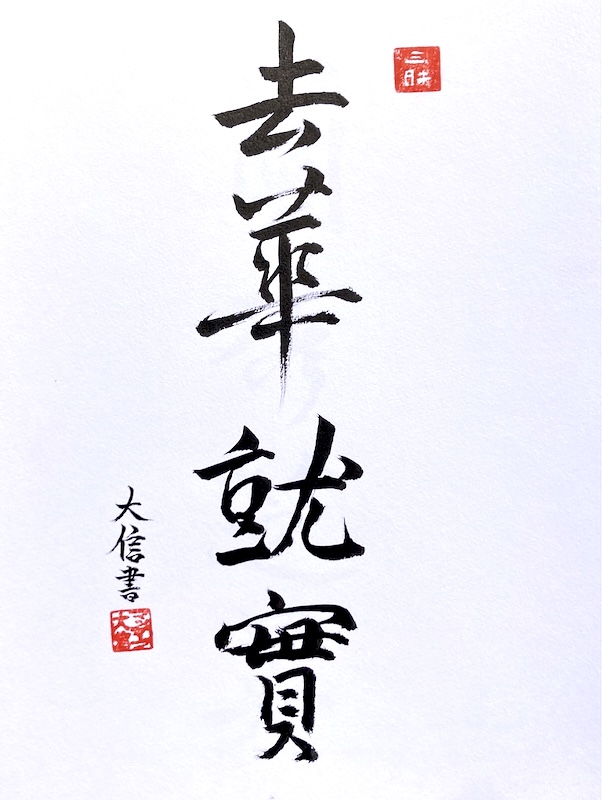
Enlightenment is the start of practice: as flowers fall, the universe awakens to itself as us.
In pre-modern times, it was a given that fruit would be local and eaten in season. It would be unheard of to have blueberries in the winter. These days, however, eating food that is locally grown and in season is truly precious and rare, at least where I live. I had the recent good fortune to taste mouthwatering strawberries from my mother-in-law’s backyard in June, after having eaten non-local, out-of-season strawberries through the late winter and early spring. While it’s amazing what technology and modern transportation has done for us, there was no comparison between in-season and out-of-season strawberries. Though my mother-in-law’s berries were smaller, they were packed with sweetness, unlike the others that tended to be dry and borderline sour.
In my own garden, the grapevines are bursting with bundles of tiny green bulbs that will eventually become grapes later this summer. My aronia berries (native to the Midwest) are abundant too, and though these black-colored berries are astringent, they are chock-full of antioxidants and give a beautiful deep purple hue when blended with other fruits in a smoothie.
A sangha member gifted me two dwarf fig trees, and I eagerly anticipate their fruit. They remind me of my recently deceased father. Dad planted what became a gigantic fig tree in his own yard that continues to give. My pear and plum trees have been struggling to produce flowers the past several years. I’m grappling to understand why. No flowers, no fruit, unfortunately.
Flowers and fruit also take on symbolic meaning in spiritual writings, such as Zen Master Dogen’s ‘Genjo Koan,’ where he writes, “Flowers fall even though we love them. Weeds flourish even though we dislike them.” “Flowers” may represent spiritual experiences that eventually fade away with time, yet we chase after the past, hoping to preserve the good times. My teacher, Dai-En Roshi, often warned us not to chase after previous experiences, saying, “Do you have the experience, or does the experience have you?” This is important to keep in mind as we enter a world where the traditional four seasons continue to lose their integrity. With the climate becoming unpredictable, we may find ourselves yearning for the past when nature was in greater balance. But here we are.
Creating an “Ecological Civilization,[1]” one where human beings allow the more-than-human beings to exist and even flourish, is now imperative. We Buddhists vow to accomplish the impossible because it gives us the strength we need in difficult times. We don’t know what the future holds, and there’s no going back to the past. Now, we can’t afford to forget the four great vows. These great vows provide the kind of vision that humanity needs to rise to the challenges that face us for generations to come.
This saying, “Flowers fall, fruit emerges,” reminds me that enlightenment is not the endpoint of my practice, but the beginning. Seeing the universe as Self is enlightenment, and it is also our practice. Moreover, enlightenment is not the purview of a few select people; it’s up to ordinary people to attain, and it’s a means to usher in an ecologically sensitive era that sees humans as one among many species, with all species having an integral part of life that goes beyond human use.
We begin practice when we are gripped by the self that sees itself. When we look out at the hackberry trees, the chipmunks, the clouds, the sun, and the fox and see them as our ancestors, as what has given birth to us humans,[2] we are gripped by our self. The squirrel that sees you is nothing less than your evolutionary ancestor viewing its descendants. From the moment of Enlightenment onward, it becomes our responsibility to practice that insight in everyday life.
Just as an infant lacks the ability to form coherent words to communicate with her parents and lacks the intellectual capacity to articulate their relationship with adults, we humans are similarly like infants in relation to the Earth and the infinite array of species. Our groping to understand ourselves in relation to the universe, too, manifests as the wondrous Dharma.
Our daily practice, both in the meditation hall and in the world, can be seen as the fruit of an initial Enlightenment experience. However, this fruit must always remember its flower. We must recall that humans evolved through processes spanning billions of years—no flower, no fruit. The flower gives birth to the fruit, which is an ongoing awakening fostered by skillful, everyday, moment-to-moment practice.
This everyday, ordinary practice-enlightenment (fruit-flower) has a rippling effect around the planet where we humans activate our role among all the other species, as that aspect of the universe that has the ability to reflect on itself, or, as Dogen Zenji puts it in ‘Genjo Koan,’ “That you go forth and experience myriads of things is delusion. That myriad things come forth and experience themselves is Awakening.”
[1] For more on Ecological Civilization, see the embedded link. Dr. Mary Evelyn Tucker, professor emeritus at Yale Divinity school articulates what is already happening in various countries in Asia.
[2] It may sound strange to say that foxes and other creatures gave birth to humans. I’m speaking from a deep-time perspective. Modern humans evolved more recently on our planet – some two to three hundred thousand years ago. It’s thanks to the creatures that have preceded us that we exist. From this perspective, they “gave birth” to us.
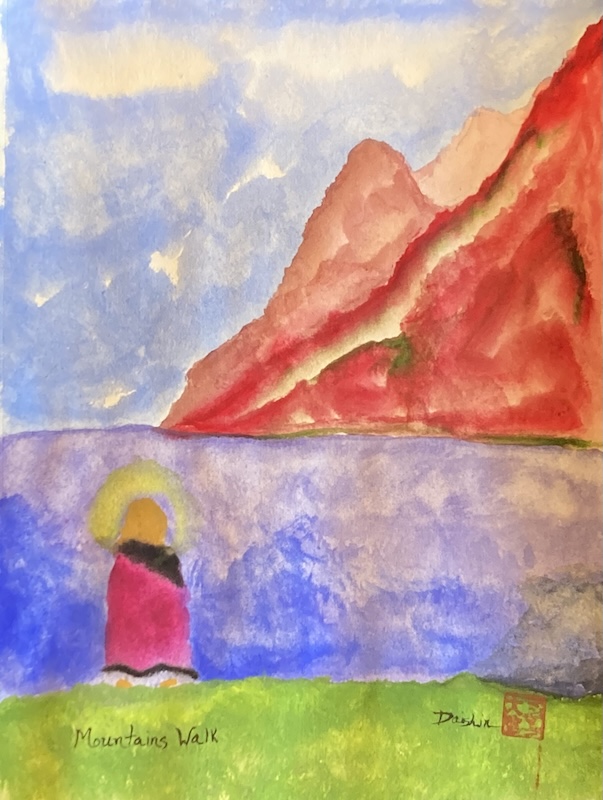
Dogen’s walking mountains teach deep time: even Iowa’s flat prairies are walking.
“Mountains do not lack the qualities of mountains. Therefore, they abide in ease and always walk. You should examine in detail this quality of the mountains’ walking.”
Dogen Zenji in "The Mountains and Waters Sutra"
It’s strange to be writing about mountains in central Iowa, one of the flattest regions of the country. Formerly tall grass prairie and teeming with wildlife, Iowa’s present land is a pale reflection of what it once was. Replaced by corn and soy crops in the Spring, Summer and Fall, it lies bare in the Winter months with little covering to support preexisting flora and fauna.
There is growing awareness of the need to “save the soil” through cover crops and prairie strips, and some farmers are taking this call seriously. Like many things, change is slow and requires a level of perseverance that few may be prepared to enact. The monocropping of the land doesn’t change the reality that I can drive for hours through cornfields that are as flat as a pancake. It also affirms a way of seeing the ground that, while having served humanity in terms of food production, is utilitarian. In other words, the land is not viewed as sentient and therefore (in our utilitarian oriented minds) entitles humanity to use it as we see fit. While proper stewardship of the land is a responsibility we cannot escape, I’d like to call into question the idea that land is dead or insentient. While some may argue right out of the gate that it is not inert because it grows corn and soy, I’d like to counter that by saying I find corn and soy fields largely uninspiring to look at. It’s not that they’re bad, nor are the farmers who put in a lot of hard work to cultivate the land, but my soul thirsts for diversity.
Where I trained in central Pennsylvania there is a very similar land ethic to Iowa, however, the terrain is quite different. There the soil is red, unlike the black soil of Iowa that has been singed by centuries of prairie fires. Perhaps the most striking distinction to the casual observer is the appearance of mountains. I could walk out the door of Mount Equity Zendo and see the mountains. Bald Eagle Mountain range was just off in the distance beyond the horizontal corn and soy fields. The level fields connected to the rising mountains in this area no doubt contributed to “Mount Equity Road” after which the Zendo was named.
Bald Eagle Mountain range was not named after the bird, as I once thought, but a leader within the Lenape (better known as the Delaware) tribe, a community of indigenous people that still exists today. This tribe has three clans within it, one of which is known as the “Muncy.” In the 1800’s the Lenape were pushed west by the expansion of the United States, and we find evidence of this westward movement by place names such as “Delaware,” “Muncy” (in Pennsylvania), and Muncie (in Indiana). The Lenape are perhaps better known for their “ceding” of what is now New York city and the surrounding Islands to settlers for a minimal price, yet their distinction from other indigenous tribes is often erased by the term “Indian.”
Bald Eagle Mountain range and other mountains like it comprise what is known as the Appalachian Mountains which span from Alabama all the way up to southeastern Canada. The Appalachian Mountains are considered older than the Rocky Mountains. Scientific studies of plate tectonics and sedimentation have revealed that these creatures (the mountains) were born some 480 million years ago and were once just as tall as the Rocky’s are today. Now, they are like old men and women with their hunched backs illustrating the Buddha’s teaching that no one can escape old age, not even a mountain. Yet to the common observer it may seem as though the mountains have always been the way they appear today.
Zen Master Dogen, in the 13th century on the mountainous Island nation of Japan, exhorted his students to observe the mountains “walking.” He was not privy to the extensions of the senses that technology has afforded modern humans. Meditation, rather, enabled him to see deeply into the nature of impermanence. Knowing that “mountains walk” with the intellect is not the same as penetrating it in the way that Dogen poignantly describes in his writing. Practice is seeing that we are those mountains walking. Dogen says:
If you doubt mountains’ walking, you do not know your own walking; it is not that you do not walk, but that you do not know or understand your own walking.
The monk in this image is standing on the bank of a river (or maybe a field) and is contemplating the mountain walking. This requires a deep time view. It requires that we keep alive the question, what was here before any of us was alive? Or perhaps, who was here before us? Who was here before our great grandparents? The Zen koan that invites us into a deep time view is, “What is your face before your parents were born?”
Returning to central Iowa, nestled between the two mighty rivers – the Missouri on the western border and the Mississippi on the eastern side – and to the Midwest sanctioned by the Rockies on the western bank and the Appalachians on the eastern edge, I find it imperative that I invoke my imagination to see with deep time eyes, that these two mountain ranges have been playing a tug of war with each other as they rise and fall, and thanks to them our prairies, too, walk.