Here you’ll find reflections, teachings, and writing from the Zen Fields sangha, gathered over the years. Topics range from meditation and Buddhist philosophy to parenting, yoga, social and ecological justice, interfaith connection, and the places where Buddhism meets science. Browse by category below, or start with the most recent post and follow what draws you in.

Can we make someone else practice?
The Quran states, “And had your Lord willed, those on earth would have believed – all of them entirely. Then, O Muhammad, would you compel the people in order that they become believers?” (Surah 10:99).
I love the Quran. I say this as a Buddhist. I’ve had the good fortune to study the Quran more deeply over the past year because I’ve been teaching a World Religions class. I’m by no means an expert in understanding even Buddhism, so I am humbled with the task of teaching about paths that I have not committed to. Yet, I cannot help but see similarities between religions, and this verse is one that speaks to me as a Buddhist.
The Quran is considered by Muslims not as the words of the Prophet Muhammad, but as the words of God or Allah spoken through the Prophet. It is poetic and beautifully sounding, and moves some even to tears to hear it recited. The power of the Quran is both in the meaning of the text as well as the sound that is invoked. The text itself has layers of meaning – literal, figurative, mystical – that if not carefully read can easily give rise to misunderstanding, intolerance and even violence.
The above verse bears striking resemblance to a teaching of the Buddha: Do not accept my teachings because I said so. Accept a teaching after putting it into practice and finding that it is effective, that it alleviates suffering.
I’m paraphrasing the above teaching, which is from the Kalama Sutta. The gist of it is that we need to use our faculties of reason to decide whether a teaching is appropriate for us or not. Even a teaching that we found helpful 10 years ago may no longer be helpful today. If we are not aware of this then we can remain stuck in a practice that is no longer addressing our suffering or that of others.
Having no compulsion in following Religion is often overlooked by those that practice the tradition. In Buddhism, for example, there are teachers who, rather than make suggestions for how to practice, expect their students to practice certain ways. Most Zen teachers that I’ve trained with seriously have been a mix of both not being compulsive and, at the same time, being demanding of how to practice. I myself have been a mix of both, but more recently, especially since studying trauma theory through the Trauma Sensitive Yoga program, see the importance of not using compulsion as a means to practice.
When parents want their children to follow their religion, or perhaps their non-religion, or maybe their particular outlook on something, then if they use compulsion too heavily, the end result is often resentment and rejection of whatever the parent wants. The baby is thrown out with the bath water. On the other hand, leaving things totally up to the child to figure out for themselves is not quite right either. Children need guidance by their parents, of course. They need to have something that they can reject or accept as they mature. In either case, the parent(s) needs to learn to let go of the results of their actions.
So, as I reflect on this teaching found both in the Quran and the Kalama Sutta it causes deep pause for me. Can I make someone practice?
No. I cannot.
Even if I love that person dearly and know that a particular teaching would benefit them, I cannot practice for them. There is a Zen saying that we cannot even urinate for another person. How much less so can we practice for another person?
I can only do my own practice and offer suggestions for others. I can remind people that they are in charge of seeing for themselves how they ought to practice. This goes both for meditation and for yoga. I am not God. Only God – the spirit of love, generosity, compassion, mercy, wisdom – when invited into my relationships, opens people’s eyes to truth. My responsibility is to allow for God to enter into my relationships. I do this when I am not being manipulative in the relationship.
It seems so obvious that, as I’m talking about being non-manipulative in relationship, that manipulation is not effective. But when I find myself in relationship to others, if I’m really honest, there are times when I want the person on the other end of the line to do something other than what I see them doing. In those moments, if I don’t refrain from coercion, I myself am being manipulative.
Practicing, therefore, no compulsion brings me to my own edge. It’s a tricky place to be. I need to continue to monitor my own state of mind and to be truthful with myself about what my intentions are in the moment. Feel free, if you would like to, to practice No Compulsion in Religion, or to not look for anyone to adopt your particular views about anything. See for yourself it leads to the end of suffering.

Fear for me is being asked by my wife to take care of our two-year old son, Malcolm, by myself.
Fear for me is being asked by my wife to take care of our two-year old son, Malcolm, by myself. I feel terrified by the prospects of inadequately responding to his unease or crying. I have a heightened awareness of being judged as a terrible parent. It has often been the case that, when I’m with him, I feel helpless to change anything, no matter what I try to do.
There is a story of the Buddha walking down the road where there was a vicious criminal and being told by the townspeople not to go down that way. Angulimala, the murderer, was looking for his next victim. When he saw the Buddha and approached him, Angulimala demanded that he stop. But the Buddha just kept on walking. Angulimala ran after him again yelling, “STOP!”

Buddha responded coolly, “Angulimala, I have stopped long ago. It is you who have not stopped.” The Buddha was pointing out Angulimala’s inability to stop the destruction of life. Angulimala miraculously recognized the error of his ways, bowed to the Buddha, threw away his sword, and asked to take refuge in the Three Treasures.
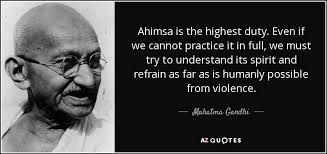
As I reflect on this story, I’m reminded of a line from the Yoga Sutras, “To one firmly established in non-harming (Ahimsa), all hostilities cease.” It’s not just the Buddha’s words that stopped Angulimala, but his presence.
I’m not the Buddha, and I don’t know if I could have the same presence of mind to stop a murderer. However, the genius of the Dharma is its universal application. We can apply it right now in whatever the circumstances we are in.
Every morning I practice meditation. I face the wall and follow my breath. Recently, my wife went out for a run and asked me to be attentive to Malcolm’s needs, which, of course, I obliged. When he awoke I was still sitting in meditation. In that moment, I had to make a decision about what to do. Should I go to him or have him come to me? On this day, I decided I would let him come to me. Being still, I was actually facing my fear. My thoughts went from, “I should run to him and try to make him feel all right,” to, “he’s okay as he is, there is no need to comfort him right now.”
Malcolm went looking for his mother, as is usually the case. When he could not find her, I noticed the anxiety in myself and stayed with it, watching it, breathing with it, focusing more closely on my breath. Malcolm then found me and asked me where his mother was. I told him that she was on a run and that she’d be back soon. Rather than trying to comfort him – as I could sense he felt agitated about this situation – I decided to just follow my breath closely and calm my own mind.
He came closer, and the closer he got the more he chilled out until he was simply leaning up against me. I was enjoying his presence and he mine, and we just stayed there for several minutes breathing together. Instead of reacting with actions that could have caused negative actions from Malcolm, my calm response elicited a calm and peace in him.
This saying from the Yoga Sutras, “To one firmly established in Ahimsa all hostilities cease,” has been increasingly on my mind since that experience. I’m by no means always feeling non-reactive, but I am inspired by how Malcolm responded to me, and by the practicality of this teaching. The practice of Ahimsa is not limited to the Buddha but can be realized by any of us in our daily lives and responses, such as dealing with a crying child, with an irrational family member, or just simply with our own mind. Can we see the universality and timelessness of this particular teaching?
The world tells us to hide from our fears, as symbolized by the people in the town warning the Buddha not to go in the direction of Angulimala. However, our practice is about facing our fears. Our fears lead us to deeper practice and understanding. Being afraid is not a sign of failure or weakness, but a natural and important ingredient for spiritual transformation. When our fears meet practice, there is potential for growth, as symbolized by the Buddha moving toward Angulimala.

Is corporal punishment ever okay?
Is it ever okay to hit your child? If so, what are the reasons that parents do this? If not, what can support a parent in choosing not to use physical punishment on their child?
My wife, Jisho, and I are taking a 10-week class to certify to become foster parents. The teachers of the class said during the first lesson that we may learn better parenting skills which we can apply to our own children. In many ways the subject matter has been illuminating. We have learned, for instance, the importance of maintaining good relations, as best we can, with the birth parents. This realization caused me to wrestle with my own assumptions that the birth parents didn’t care about the child, due to physical or sexual abuse or neglect. Though the child may have experienced these things from their birth parent, because of the strong role that attachment plays in bonding a child to their parent and vice versa, foster parents can never be a replacement for the birth parents. Severing that bond does not help the child, no matter how good the intentions may be to protect the child.
As our class turned toward the subject of discipline and punishment, we learned that foster parents were, by law, never permitted to physically punish their foster children. One teacher went as far to say that you can do that with your own child, but not with a foster child. In my ignorance, I assumed that all of the parents in the room did not use physical punishment as a form of discipline. I was deeply mistaken. I piped up and said, “Isn’t it not a good idea to use physical punishment on any child regardless of whether they are in foster care?” My question was ignored or not heard, as the facilitators chose to move on.
Later conversations during the class revealed that many Christians in our Ames area justify physical punishment to children based on Biblical verses. There are numerous verses that speak about discipline some are more sophisticated than others. Perhaps the most common one pointed to is, “Whoever spares the rod hates his son, but he who loves him is diligent to discipline him” (Proverbs 13:24). This verse is often quoted as, “Spare the rod, spoil the child.”
Honestly, at the end of the class I felt a sinking feeling in the pit of my stomach. Psychological and medical studies[1] reveal so much about the negative consequences of physically punishing a child regardless of whether the child is in foster care. Knowing this and knowing that I have never hit my own son give me deep pause to reflect on this situation. Have I ever lost my patience with my son? Absolutely. Have I come close to wanting to hit him? Yes. But if anyone needed a time out, it was me, not him.
While I understand that these thoughts and impulses are normal, I would be defending my own ego if I were to try and justify not only thinking them, but carrying them out. One study[2] has shown that, in America, most parents have used some sort of physical force on their children by the age of four. Moreover, two-thirds of American adults agree that children sometimes benefit from a strong spanking.[3] I’m sure that, of the 15 students in our foster certification classroom, those statistics were reflected. I can certainly understand the statistics, given that I was physically hit by my mother.
While I love my parents, regardless of their actions, I made the decision long ago to never willfully hurt any child physically or verbally as a form of punishment. I don’t agree with it as an effective means to stop an unwanted behavior, regardless of what the Bible or Zen Buddhist teachings say about it.
Many may be surprised to find that even within Buddhist teachings one finds justifications for corporal punishment. Zuimonki 1-7, Sayings of Eihei Dogen Zenji, says “If you are an abbot or a senior priest or even a master or a teacher, if your disciples are wrong, you have to instruct and guide them with a compassionate and parental heart.”
Note here that Zen Master Dogen makes the comparison between a parent and a Zen teacher. The Chinese character for “parental heart” is robashin, or “Grandmotherly mind.” A teacher is to care for the Dharma (in the student) in the same way that a parent takes care of a child.
Dogen goes on to say, “In doing so, however, when you slap those who should be slapped or scold those who should be scolded, do not allow yourself to vilify them or arouse feelings of hatred.”
Zen doesn’t get off the hook as a “better” religion when it comes to views of punishment. We need to learn both from present day psychological studies as well as teachings within the Buddhist tradition that can help us, ignoring ones, like the above that should be dismissed and/or criticized.
So, what can we do in lieu of physically punishing a child? I’ve provided some links in the footnotes to possible alternatives. These are good, but they don’t mention anything about introspecting on one’s own motivations. This is where Buddhism may be helpful. Punishment is all about getting a child’s behavior to change. Modeling the behavior you want to see can be effective, but only if we’ve done the internal wrestling with our own egos. Ego tells us to change our external environment so that we don’t have to change anything about ourselves. Ego says the problem is with the child, not “me.” If we can see our egos at work, then we can take it up as a practice in letting go of the hold of ego. The behavior that needs to change, then, is our own way of seeing the world. This is the first of the Noble 8-fold path: right view.
In practice, this may look like taking time to remove yourself from the situation and calming down using your breath or walking more mindfully. Asking yourself questions like, “where is my anger coming from?” may be helpful. Taking time to look at your own family history, and how you were treated, and seeing if there is any connection between your past and present, can be helpful in shedding light on abusive patterns in your family and in yourself. Then you can choose whether or not to continue those patterns.
Having compassion for yourself for having been hurt by significant caregivers that you trusted, is also an important element. Our anger, on the surface, appears to originate from the immediate actions of our children. Yet, a closer look may reveal one’s own grief and hurt stemming from the past and being triggered by the present.
I’ve seen this happen in myself. One time when Malcolm fell, hurt himself, and broke out into a scream, I found myself in anger mode, even blaming my wife for the situation. Jisho and I later talked about my response and, later still, talked about it while my mother was present for the conversation. My mother revealed that she would often feel extreme anger when things like that happened when I was a kid. It wasn’t something she could control. She would blame me or the other kids for their getting hurt.
My mother’s openness allowed for a moment of insight. When I would get hurt as a child, my mother’s response was often that of anger. Without conscious awareness, how could I possibly act different when my son gets hurt? My mother taught me to do this. She in turn, probably learned from someone in her family. This is something I need to be aware of and change in myself. This is not Malcolm’s fault, or anyone’s. I need to learn to respond out of compassion. I also need to grieve the fact that I did not receive compassion from my mother when it was needed. I don’t want or need to blame my mother. If anything, I can have compassion for her for the fact that she, too, didn’t receive compassion when she was hurting as a child.
This is obviously ongoing work and practice. I write about it here not to receive empathy, but as a reminder to myself of the work that I need to do, and to hold my own feet to the proverbial fire.
I love the following verse from Shantideva:
Where is there enough leather to cover the whole earth? But if I have leather on the soles of my feet, what need is there to cover the whole world? In the same way, how is it possible to control unruly beings who are as vast as space? But if I only control my mind, what need is there to control other things?
The Way of the Bodhisattva
How about my relations outside my blood family? What about when there is anger in the the student-teacher relationship? While the form looks completely different, there is still the same underlying pattern that is asking to be addressed.
While this foster parenting class has been an eye-opening experience for me on many fronts, what I’ve learned is how deeply ingrained it is for most of us in American culture to use physical punishment to control our children. This pattern is a problem not just for kids, but for how we treat adults as well, and how those kids grow up to be the kinds of adults who have not experienced the fullness of love that is their birth-right. Anger should never be suppressed in adults, but it needs to be reflected upon, and it is our responsibility as adults and as practitioners of the Buddhadharma to learn better ways of offering love and compassion to the most vulnerable, especially children, elderly, minorities, and marginalized populations.
[1] See Gershoff, E.T. (2002). Corporal punishment by parents and associated child behaviors and experiences: A meta-analytic and theoretical review. Psychological Bulletin, 128, 539-579.
And, Gershoff, E.T. (2008) Report on physical punishment in the U.S.: What research tells us about its effects on childnre. Columbus, OH: Center for Effective Discipline.
And https://pediatrics.aappublications.org/content/142/6/e20183112
[2] Straus, M.A. & Stewart, J.H. (1999). Corporal punishment by American parents: National data on prevalence, chronicity, severity, and duration, in relation to child and faily characteristics. Clinical Child and Family Psychology Review, 2(2), 55-70.
[3] National Opinion Research Center. (2006). General Social Survey. Chicago, IL: National Opinion Research Center.
When choice is robbed from us, then the bedrock out of which our ethical behavior follows.
I am privileged to have the opportunity and space to walk or ride a bike with my 3-year old son, Malcolm, almost every morning. His glider bike is green and has no pedals making it especially useful for children just learning how to balance without having to simultaneously learn how to pedal. Malcolm’s use of the bike has been a game-changer for our morning walks, allowing my wife and I to walk at a faster pace – much appreciated after either pushing him in a stroller, carrying him in our arms, or having to do shorter walks.
On mornings when Malcolm and I are together without mom, it’s especially interesting to me to be in a position to create space for Malcolm to make choices, and to witness his sense of agency over his environment. When I genuinely provide him the opportunity to choose where we are going, I notice some shifts in me. I feel a sense of spaciousness inside and around the place where my heart is located. I feel a releasing of my abdominal muscles, perhaps associated with a dissolving of my own fears and anxieties of having to be in control of the situation.
With Malcolm I notice how easily and quickly he takes control of the situation, without hesitation. He knows where to go without me telling him. As a parent, I find this wonderfully liberating. I don’t have to tell my son what to do, or what to be interested in. He knows!
We come to the corner of the sidewalk, for example, and there is the choice for him to go right or straight. I realize, as the adult, I could easily take that choice from him by making the decision myself, or worse, by being unconscious that there is an opportunity to make a choice– that we could go left or straight.
As we come to the corner, I ask Malcolm, “Which way do you want to go, left or straight?” I give him just two choices of the myriads of possibilities. He could go right or back, or simply choose to stay still. Malcolm responds, “let’s go left daddy.” It’s so wonderful to hear him say this. I notice an increase of energy in my core as Malcolm leads the way. I notice my own concentration (based on a subjective feeling of focus in my forehead) increases as I let go of my desire to control my son.
Many would perhaps question that a child has the ability to make an informed choice, but having observed him myself in this process, it’s fascinating for me to watch as he makes decisions for himself, based on what he wants to do. It requires on my end that I remain open, with “don’t know mind”, and with goal-less-ness. For, if I’m the director, I teach him how to follow. If he learns how to make decisions for himself, with his own physical body and mind, then he learns how to be a leader.
I do not merely become his follower letting him do whatever he wants – that would be irresponsible. Rather, I become the facilitator of him developing a sense of agency over his environment – that he feels he has some ability to influence the world as he experiences it based on his decisions. I also prevent him, if need be, from destroying property or hurting other people – though instances of destruction have been rare in him and often are tied to the need on my part to pay greater attention to what he’s doing, and to engage with him more deeply.
This shard of experience leads me to wonder about the connection between the early childhood development of choice and living an ethical life. How might these two things be connected?
Regardless of your beliefs or lack thereof in the Abrahamic religious traditions, Judaism, Christianity, and Islam make freedom to choose the bedrock of living a life centered on or in God. All the stories in the Hebrew Bible, to my knowledge, point to the importance placed on choice, and choosing to live a life based in closeness with God – understood not as a perfect life, but a life of meaning and a sense of belonging to the world, to the human race, and to the divine with every atom of one’s existence, and a life of awareness of the sufferings of others and what to do about it.
The very first story in the Bible of human interaction with God – the story of Adam and Eve has been interpreted in a variety of ways. I invite my readers to keep their minds open and curious when re-reading this story because I feel it has very important things to say about our early childhood psychology as humans.
In the story God gives the first humans a choice. God tells them that they can eat from any of the trees except from the one in the center of the garden. Yet, at the same time, though God forbids eating from this tree, Adam and Eve are given the opportunity to choose whether or not to do that. In other words, God gives them permission to disobey. They have freewill.
Similarly, all human beings, from the very beginning, are endowed with freewill. If we look at this story from a psychological perspective, Adam and Eve prior to exiting the Garden of Eden are symbolic of humans in a pre-pubescent state, or maybe an adolescent state. Our ability to distinguish and choose right from wrong, from this perspective, is not something we are born with, but something that is developed over time, and cannot be shaped without the freedom to choose. We have to realize that we have choices. That we can make a choice isn’t often readily apparent to any of us, and we slowly discover this ability as we mature.
If it is true that the ability to choose needs to be realized (regardless of whether one chooses right or wrong), then as a caretaker of a 3-year old it is part of my responsibility to facilitate that learning, and it could be done with the most basic of tasks such as going for a walk and allowing Malcolm to exercise not only his legs, but his ability to choose.
From a Buddhist perspective, what role does choice play? I love the Kalama Sutra. In it the Buddha basically recommends checking things out for oneself, and making a decision based on your own experience, rather than what someone else says.
The Kalama Sutra was written for a community that had many different teachers of a variety of doctrines wandering through their town. The people became confused as to which teacher to follow. This scenario is very common in our present world. In times when we are inundated by so much information at our fingertips, how do we figure out which path to take? The Buddha’s advice in the Kalama Sutra is extraordinarily generous. He doesn’t say, “follow what I’m doing, and I forbid you from following anyone else.” He instead implores us to check things out and see through our own experience whether something is true or not. In other words, we have the power to choose how to live (even if we don’t think we do), and we can learn from our past experiences as opposed to someone simply telling us what to do or not do.
The Abrahamic faiths as well as Buddhism offer ethical guidelines for how to attain their respective goals – whether it be intimacy with God or Awakening. The Hebrew Bible talks about, among other things, Commandments. But just the word, “Commandment” can be problematic if we have not properly developed our ability to choose from an early age, prior to understanding right from wrong. The 10 Commandments are really an advanced kind of practice, in my view, once an understanding of choice has been well established. If choice has not been well established during youth, in other words if a young person is consistently denied opportunities to make choices, or even consistently given things that they would never choose, then that person will not be prepared to even consider living by the 10 Commandments. I think the same can be said of the Buddhist precepts. The flip side of this is that – considering that the mental factor of choice has not been well developed – then precepts or “commandments” will most likely be followed blindly without the ability to question them.
In modern times thanks to social media and the internet we can find so many examples of unethical behavior and there is an almost immediate condemnation of those behaviors. Without condoning unethical behavior, I would like to see us begin to uncover the roots of such behavior in adults. When we look at criminals in the justice system, for example, murderers, drug dealers, rapists, etc., who would not condemn their actions? Maybe they do need to serve time. However, what do we know about that person’s background? How were they treated by their adult caregivers? How were they treated by their community? Was there abuse or neglect involved? What about the role of generational trauma such as what the Black community has experienced, or indigenous peoples? Where is our responsibility for these traumas? In what ways may we have benefited, for example, from the oppression of Black people?
If we look at people of color, indigenous peoples, or anyone with early childhood trauma there may be a common thread: denial of choice – being forced to do something against one’s will. Black people did not choose to come to the United States. They came on slave ships. Indigenous peoples did not freely give over their lands to the white settlers. It was taken by force. No child chooses to be beaten or sexually exploited. These are examples of trauma that results from extreme lack of choice. While some notable individuals rise up out of these kinds of traumas, are able to pull themselves up by their bootstraps , how can we, as a society, expect people to act ethically if we don’t understand what a person or community has been through, nor our own complicity in this trauma?
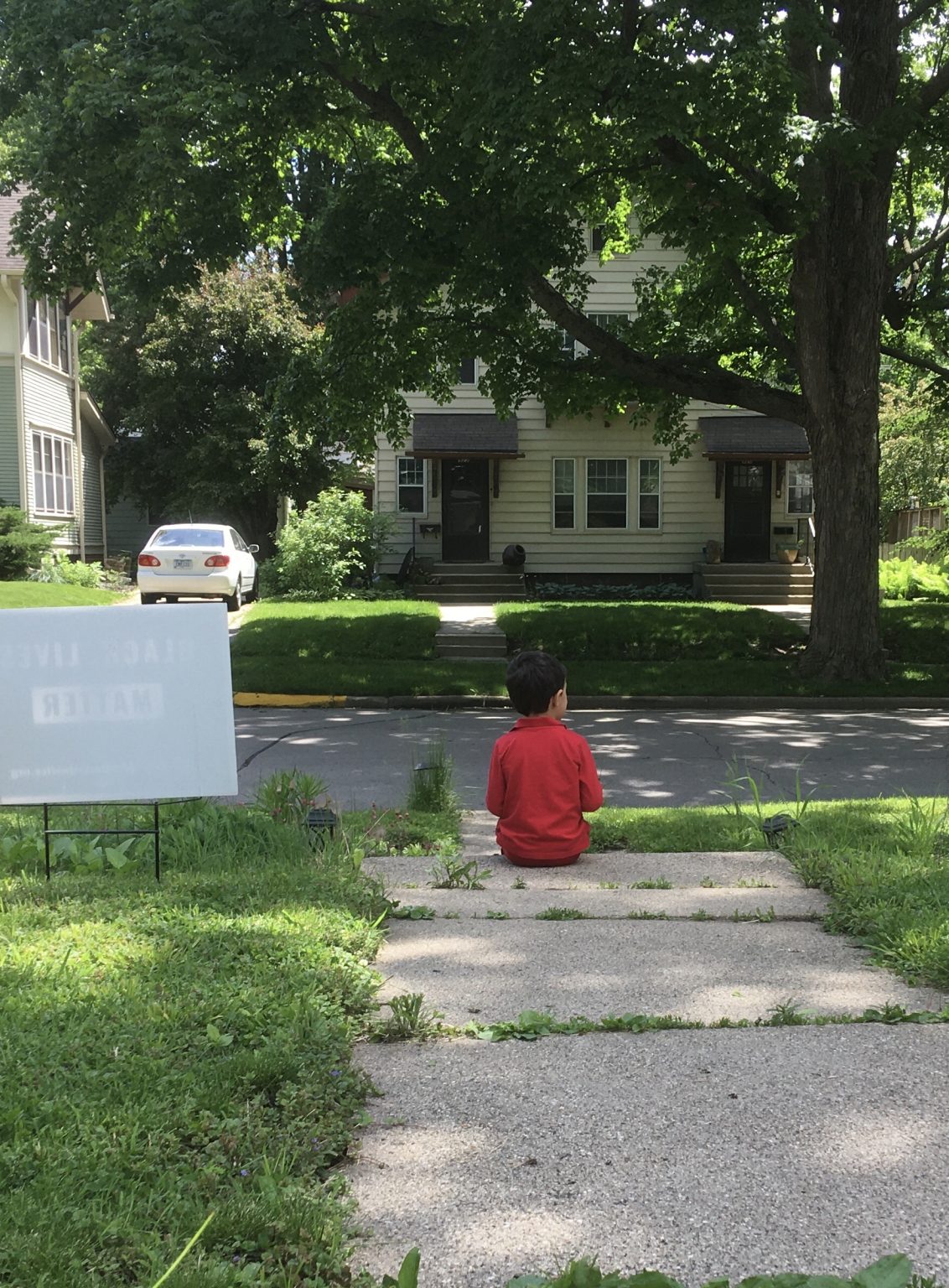
When choice is robbed from us, then the bedrock out of which our ethical behavior follows, I believe, is seriously eroded.
We can learn to develop choice at any age, and in any moment. The concept of “No self”, which the Buddha taught has amazing ramifications for anyone who chooses to delve deeper into comprehending this concept. No self means that there is no continuity to the self, that runs from the present into the past. While we cannot deny that we have a birth and come from a particular blood lineage, no self is asking us to look deeper at this belief and to see that every moment we are born again. If we take this teaching to heart, then every moment is an opportunity to make a genuine choice in how to proceed. We need not fall into constrictive habit patterns.
While these opportunities to choose are available to us moment by moment, if one has not practiced making choices, or had choice robbed from them, then one’s ability to do so may have atrophied. This is why in my offerings of Trauma Sensitive Yoga, and in my attempts to make Zen more trauma informed, I make it a point to give people opportunities to make a new habit – that of making choices.
We often unconsciously judge behaviors as right or wrong without consideration for the bedrock making it possible to know right from wrong: the exercise of choice. Choice is not something that we learn when we are adults or teenagers. It’s something that we do from the moment we are born – or even before birth. Some might say even before conception – especially if you have an understanding of reincarnation. Regardless of our beliefs around when choice is available, we can test our beliefs in any moment. Using our own life in this moment as a laboratory, we can become more aware of the choices available to us, rather than settling for old habits. In our interactions with our family – those younger and older, we can offer them choices, try to better understand their preferences, and be willing to be a servant to them, without condoning or facilitating choices that may be harmful.
I admit that offering choices to adults – or those older than us – is challenging unless they are willing to learn or are already open to perspectives other than their own. I find it easier to work with children who are much more mentally malleable. They are our future, and we need a future of people who not only are able to make ethically solid choices, but are able to critique the status quo of our society and know that there are many ways to live with integrity.

I lost my father less than a year ago. I am who I am because he was who he was.
I lost my father less than a year ago. I am who I am because he was who he was. I could not be me without the example of my father. I feel for those who grew up without a father or lived with an abusive or neglectful one. This writing may not seem relevant to such folks, and for that, I apologize. In many ways, my father was an exemplar of fatherhood. He never once struck me and was slow to anger. He provided intellectual support throughout my schooling, particularly in math and science. He had a love of the material universe that he passed on to me, which I later developed as I integrated science with religion and spirituality. As a child, I thought my father knew everything about the world, and I mistakenly assumed that all fathers were like him in that regard. He took me to swim practice regularly and showed up at all of my major swim meets, playing an encouraging role throughout my childhood and into adulthood in both sports and education.
Though he is no longer with us on the material plane, he occasionally shows up in my dreams. He’s there with his warm blue eyes lovingly showering me with attention. How lucky am I?
When I entered the path of Zen Buddhism and began training as a priest, my father struggled to understand my decision because, in his world, there was no space for spiritual endeavors unless it led to a high-paying and respectable job. In my early 20s during my Zen training, I had to learn to let him go because I could see that his possessiveness of me and his expectations of who I ought to become were getting in the way of my own maturation process.
The Lotus Sutra helped me in this letting-go process, particularly the “Lifespan Chapter.” In it, a distinction appears between the historical Buddha, who lived some 2500 years ago, and the cosmic Buddha, who is always present in our lives, here and now. The sutra makes the point that even though the historical Buddha is gone, the cosmic Buddha is always present, and it is this cosmic Buddha that helps us to mature.
The Buddha shares a parable to make his point. He talks about the “good” physician who had unruly children that would not listen to him. He came back from a day’s work to find his kids had become delirious from improperly consuming medicine reserved for his patients. He quickly produced remedies for the delirium, but while some recovered, others were so delirious that they refused to take the remedy.
As a father, I sometimes have to face this dilemma. As parents, we find ourselves in the difficult situation of our guidance going unheeded and our children continuing with their bad behavior despite our warnings. In the parable, the good physician finds a way to cure his delirious children. He leaves home and goes to a foreign country, then sends word back to his family that he has died. In their regret for not listening, the children take the appropriate remedy and are then cured.
Sometimes, as a parent, we need to walk away from situations that are beyond our control. I don’t advise abandoning our young kids, but the story makes the strong point that sometimes love can be shown not through our presence but through our intentional absence. The Buddha goes on to describe himself like the good physician and even refers to himself as the “parent of the world.” In the same way as the physician, he needs to be absent for people to appreciate his presence; otherwise, his students grow arrogant. However, the Buddha appears to those who seek him with sincere hearts. Similarly, I have come to more deeply appreciate the role my father played in my life now that he is no longer here.
My own father struggled with allowing me to mature without his continual guidance, and I could see that thanks to the Lifespan Chapter of the Lotus Sutra. I felt compassion for him and was able to forgive him for that, and he later accepted my chosen path into adulthood.
The Abrahamic faiths sometimes refer to God as a Father because our spiritual maturation requires the falling away of earlier created concepts about God. A good father is there for us in our early development and gradually lets go as we grow. In the same way, in our early spiritual development, we might have very fixed ideas of who or what God is, but as we mature, have non-dual experiences of reality, and come to understand the way the world works, our earlier ideas of God naturally drop away. We come to understand God differently. God may even become absent, as it is for many who are atheist or agnostic. The “resurrection” of God also comes as we continue to mature on our spiritual path, but this resurrected God is not the same as the earlier concepts of God that we held. In this respect, the cosmic Buddha described in the Lotus Sutra is similar to the resurrected God found in the New Testament. My suggestion is not to take these stories found in the Bible or the Lotus Sutra literally. Rather, they can help us understand the psychological shift that takes place within us through the experience of non-duality, which Zen practice aims to foster.
The Buddha’s own father was the best example of what not to do. He kept his young son away from the realities of birth, old age, sickness, and death, and did everything in his power to prevent his son from seeking spiritual truth. He was shallow and spiritually immature. He couldn’t let go of his ideas of what his son ought to become. Too many fathers fall into this trap—seeing their offspring as extensions of themselves and controlling what their kids do. We need fathers who are present for their kids in their early years, who see fatherhood as a path to their own spiritual development—learning when to hold on and when to let go—and who allow their children to seek truth for themselves. This, I believe, is the message of Zen to fathers.
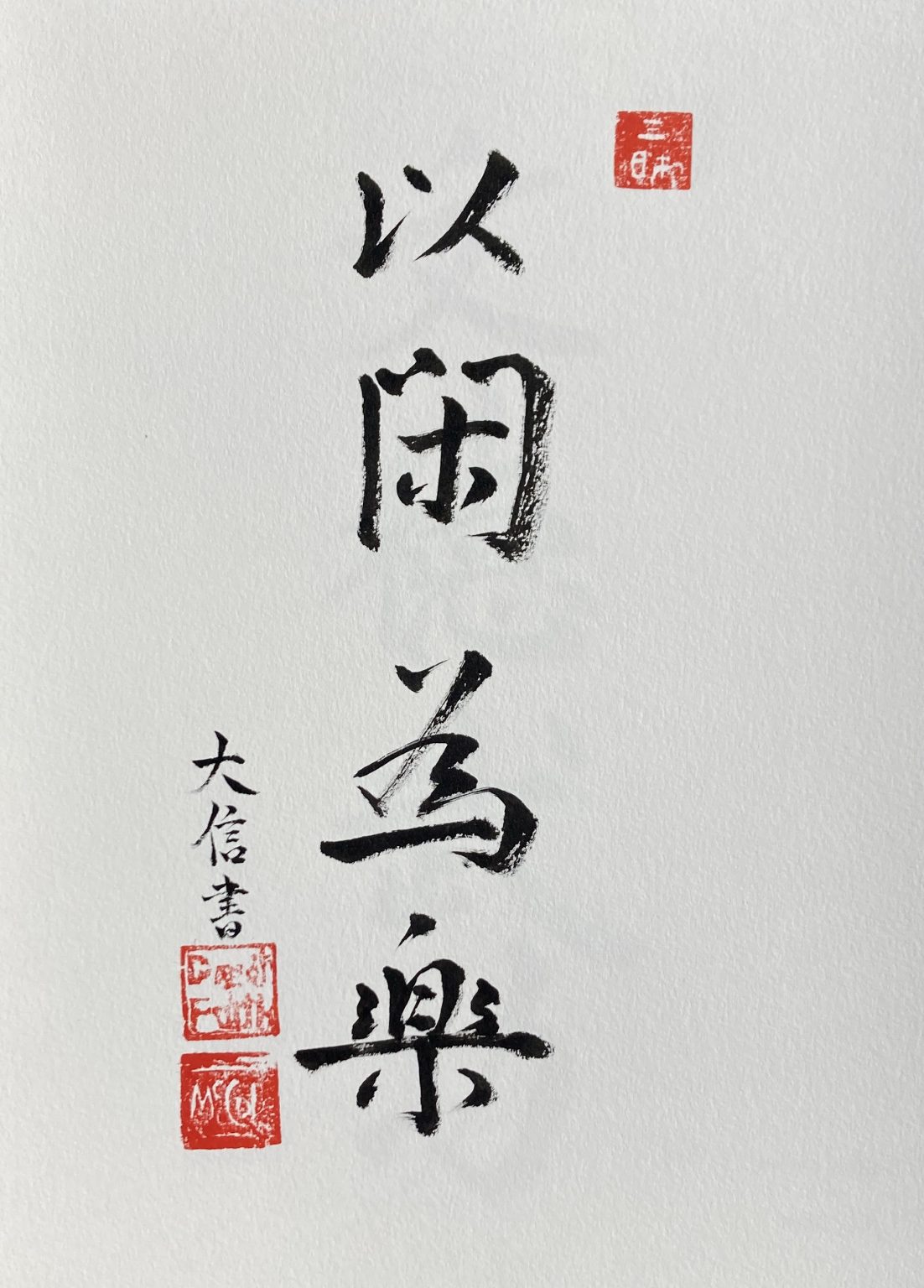
Finding Joy in Leisure
As a Zen priest, father, and husband sometimes I’m so busy that I feel guilty about taking rest or finding pleasure in quiet moments by myself. 以閑為楽 means, to find pleasure in leisure, or to find pleasure in a quiet place removed from the concerns of the world. On the surface it seems obvious that we should find joy in leisure time, but I find the statement to be a personal challenge from the universe to wake up to the joys of life all around us, even when we are totally stressed out.
I’d like to use the concept of leisure to segue into Zen perspectives on rest, specifically sleep. While finding joy in leisure is not the same as sleeping, there are certain parallels between the two. Both, for example, are sometimes considered luxuries, and perhaps not something to be taken seriously by the majority. To demonstrate my point, I recently heard a sportscaster ask a professional basketball coach how he slept at nights before a tournament. He said that he gets something like 2 hours of sleep at night and that, “sleep is over-rated.”
Similarly, when I was training with my teacher and asked her how she worked without taking breaks she responded, “You have to rest in the work.” No doubt this can be a useful and practical attitude to have for many endeavors, one’s that you feel passionate about, or there’s an urgency to something, or it’s a matter of life and death. Zen does teach that each moment is a matter of life and death. However, sustaining that attitude all the time can lead to extremism at worst or perhaps burn out, and disregards the moderation or “middle way” that Zen also upholds.
To be honest, Zen teachings on sleep are quite ambiguous. Many cast a dark shadow on the subject. Sleep is considered one of the five hindrances to awakening. There are stories of a monk who cut off his eye lids so that he would not sleep. Another is of the Buddha admonishing a sleepy monk to wake up. The monk was so ashamed of his practice that he vowed never to lie down to sleep. He consequently went blind. These stories are held up as noble ways to wake up. Zen Master Dogen is said to have had an awakening when his teacher hit the sleeping monk next to him. While the historicity to such stories is questionable, they nonetheless generate anxiety about sleeping within a Buddhist context.
It wasn’t until my health began to wane due, in part, to lack of adequate sleep that I began taking sleep more seriously. While this change of habits and ideas of sleep happened over a decade ago, I can’t help but think how difficult it is to prioritize sleep. I’m not alone in this.
I heard a recent podcast that featured sleep expert Dr. Gina Poe on “The Huberman Lab.” Dr. Andrew Huberman is a professor of neuroscience at Stanford University, and he continually encourages his listeners, not just in this one episode, to get adequate sleep. There is mounting evidence that many of us in America are sleep deprived and it is having health consequences including rising levels of anxiety and depression.
During the podcast, Dr. Poe gives us a road map about what happens inside the brain and body when we get a full night sleep, and makes recommendations for how to improve sleep hygiene. While I encourage those that are interested in learning more to watch the show, in what follows I’ll attempt to summarize some of the salient lessons.
A typical night of 7 – 9 hours of sleep consists of 4 or 5 “sleep cycles.” Within each cycle, from what I could glean, there are roughly 4 stages – 3 that are non-REM (Rapid Eye Movement), and 1 that is REM. Each cycle lasts somewhere around 90 minutes and is followed by REM.
The first stage is equated with gamma, or fast, brain waves. It’s what happens when we have the feeling of dosing or when we first begin to fall asleep. The second stage is somewhere between wakefulness and a deep state of sleep, but not yet dreaming.
The third stage is characterized by slow brain waves, is deep sleep and it has the function of “cleaning” the brain and restoring us. When someone is in this third stage they typically are very hard to wake. Consider how difficult it is to wake a small child out of a deep sleep. It’s probably because they are in this stage. Adults tend to spend less time in this third stage as we age.
Then there is REM sleep where our dreams are most active. When someone wakes from REM sleep, they usually remember what they were dreaming about before being woken.
The first REM period usually takes place 110 minutes after falling asleep, lasts about 10 – 15 minutes, and then the cycle begins again.
In a perfect night’s sleep there are between 4-5 cycles like this. During the first cycle there is a big boost of what’s known as growth hormone. This first cycle is associated with integrating memory, and I got the sense from Dr. Poe that it is crucial for our overall wellbeing. If we miss the first cycle we can’t make it up later because our bodies are on a circadian rhythm. If we go to sleep later than our usual bedtime we miss the boost of growth hormone that works at integrating memory.
Dr. Poe suggests having consistent sleep and wake times. A regular bedtime routine is the best marker for good sleep hygiene.
This conversation about the science of sleep made me delve a bit into affirmative teachings of sleep found in Zen literature. As I mentioned, Zen is quite ambiguous about sleep. Given our culture and time, drawing on those aspects of the Zen tradition that cast a positive light on sleep seems most appropriate. I’ll briefly outline three teachings on sleep, the first being a story.
A student asked a Zen master how they should practice the Way. The master replied, “When hungry eat, when tired sleep.”
The student was surprised by this response and asked, “Doesn’t everyone do that?”
The master responded, “Most people entertain a thousand desires while they eat and untie a thousand knots while the sleep.”
In other words, most people are not really paying close attention to their body. Their mind is on other things. They are not eating nor resting properly.
Secondly, in the Soto tradition, Dogen regards sleep as a practice. He tells his assembly to rise up and lay down at the same time. When the monks get up, everyone gets up. When the monks go to sleep, everyone goes to sleep. In other words, pay attention to what people around you are doing. Don’t try to stick out like a sore thumb. Don’t stay awake meditating into the night when everyone else has fallen asleep. Don’t think that you are better for not following the crowd.
This admonition goes against everything I was taught by family and society: Be yourself. Don’t follow the crowd. Be independent.
These ways of being – the way of individualism – is not wrong or bad, but it misses the mark when it comes to harmonizing one’s body with the bodies of others. Thus, in the West, Zen practice often becomes a “personal” practice that excludes what the Japanese call “Daishu Ichi Nyo” or “Being one with the great assembly.” There is benefit, in other words, to attempting not to stick out, to being a part of the group, to not creating waves.
Lastly, in the monastery where I trained, Shogoji, we were told to sleep on the right side of our body with legs slightly bent at the knees and our right hand under our pillow to support our head. This is the Nirvana pose of the Buddha and is said to stimulate the parasympathetic nervous system, that part of us that initiates rest and relaxation. One of my teachers knew how difficult it is to spend the entire night on your right side, so he suggested to at least begin the night on your right side and then move as needed. I found this instruction helpful, as I could never sleep in one position the entire night, and it also helped me to find comfort as I entered Nirvana pose, knowing I was embraced by the Buddha both while awake, sitting zazen and in everyday activities, and while going to sleep.
There is also a gatha I recite while going to sleep in the Nirvana pose:
“As I go to sleep this evening may all beings calm all things making the mind clear and untainted.”
I’m not going to pretend to suggest that I sleep fine all the time now. Indeed, there are times when I struggle to go to sleep or stay asleep. But here are a few things that I do to help me get a good night’s rest:
Yoga Nidra, or the practice of deep relaxation, has been clinically proven, according to Dr. Huberman, to have beneficial effects on stimulating the parasympathetic nervous system. I’m happy to share that we practice Yoga Nidra as a part of the yoga classes that I teach at Zen Fields, and I strongly recommend learning this practice.
In conclusion, 以閑為楽 means, to find joy in leisure. If I’m being totally honest, this is difficult for me for reasons mentioned above. I take it as a challenge to my practice, and suggest that if we are serious about Zen, we find ways to not just increase our sleep time, but to find pleasure in so doing.
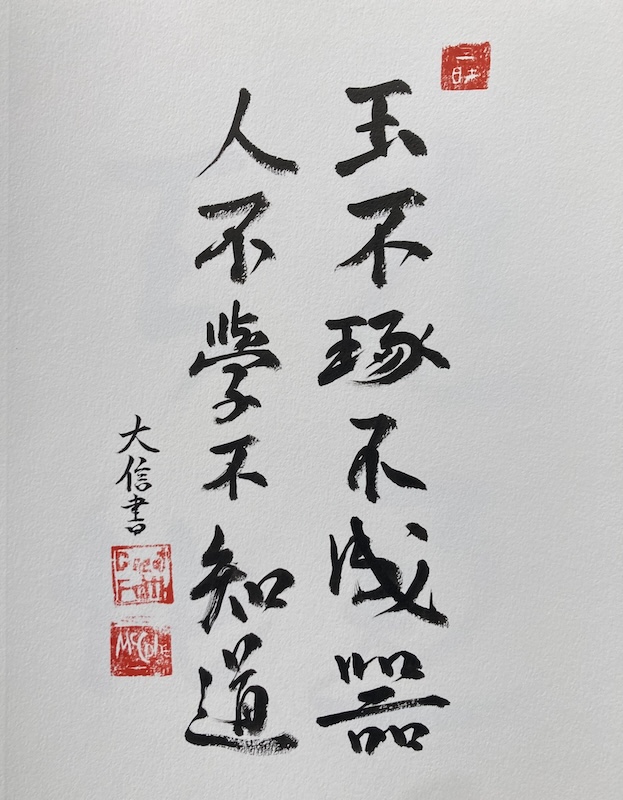
Zazen is already perfect, yet eight life habits, from food to play, help us sit more fully.

"You are perfect as you are, and there's plenty of room for improvement."
Shunryu Suzuki Roshi
I hate thinking about what I need to do to improve myself, because there’s too much to do! I’d rather focus on zazen and the teaching that practice and Enlightenment are one, that when I sit and meditate, I am Buddha. Or that when I sit zazen all the precepts are held perfectly. In other words, in sitting zazen, no ethical mistake can be made.
Zen also teaches that the experience of the person doing meditation for thirty years is no different from a person who just started practicing meditation. In other words, there’s no gain to be found in practicing zazen. Zazen affirms that we are perfect just as we are, and the more that we sit and meditate, the more we can see the truth in that.
But Zen practice doesn’t let us rest in our innate perfection. Moreover, we often don’t “feel” like we’re perfect. For those of us who have studied the Buddhist precepts, we know how difficult they are to live by. If you study at a Zen temple, there are all sorts of practices that you’ll be introduced to that demand study, learning, and mastery. This includes such mundane activities as washing the face before morning meditation, brushing the teeth, and using special bowls for eating meals. The quality with which we practice the precepts and these other daily activities in our life will influence the quality of our meditation practice.
At Its heart, Zen is about self-cultivation, about getting better about how we do anything. It’s about taking the best care possible of what we’ve been gifted. It’s about improving our functioning in the world we live in. When it comes to zazen, it’s about taking good care of our posture, and not attaching to anything.
If we want to grow a garden, we can’t just “do nothing” in an absent-minded sort of way. We need to think about the seeds we want to plant, where we want to plant them, how we are going to plant them, and then how we are going to take care of them once planted. Zen practice is no different than growing a garden.
My Zen teacher did not say, “just sit there.” She gave detailed instructions of how to comport my back, legs, arms, hands, fingers, eyes, and tongue. She gave instructions on what to do with my mind. “You can enjoy your sitting. You can enjoy your breathing. You can enjoy your life.” These were her instructions, as transmitted to her by her teachers. This is Mahakashapa’s subtle smile. However, if we do an intensive meditation retreat (sesshin) we might question whether we can actually enjoy our practice, especially when our back is in pain, our legs are sore, and we just want to go to sleep. The point of sesshin, though, is to turn our mind towards the reality of our life so that we can wake up to what really matters.
For many people who come to meditation practice, though, the instructions on what to do with your body and mind are not enough because we are imbedded in social networks and a culture that influences how we feel in our body and mind, how we perceive the body/mind, and how our perceptions influence what is perceived. We can’t expect the Zen center or our practice to unilaterally affect change in us without simultaneously working on other fronts of our life.
What follows are points that I have found through my own personal experience to have helped me not just optimize shikantaza (seated meditation), but to live an overall better life. I say this with the caveat that these are points that I have found to help, and I would encourage my reader to explore these points for themselves and see if they work for you. These points are not made to shame anyone for not doing enough, but to inspire you to look for ways to do more to lessen the suffering in your life and to increase your overall sense of well-being, as that is the heart of the Buddha’s message to humanity.
Furthermore, keeping these points in mind does not guarantee success in perfect health and happiness. They are guidelines, and as our life continually changes, we need to reexamine our present habits from time to time to make sure they are realistic for where we are. There is a dynamic balance we all need to keep in mind, and the relative attention given to these points should change depending on circumstances.
The Points are:
Discussing such subjects is dangerous. Merely thinking about exercise and nutrition induce shame in many of us. So, please take what I write with a grain of salt and do the best you can within your own circumstances. This writing is only to encourage a “beginner’s mind” with regards to a subject that is repeated all too often in other contexts.
We’ve heard the need to pay attention to these things by our doctors and by society at large, but so many of us fail miserably at them, as attested by an epidemic of obesity. We might feel that we don’t have enough money or time to eat well and to exercise. But if we really begin to pay attention to the present moment, we’ll see that we can find many ways of exercising that don’t require us to go to a fancy gym, and many ways to eat that don’t require purchase of expensive organic foods. For Zen practice, exercise and nutrition are an integral part to the way one lives in a temple, not something extra that we need to make time for. Learning how to integrate exercise without separating it out from the rest of our life is key. The same is true of nutrition. When it comes to nutrition, I won’t be talking too much about what to eat, as important as that is. I will, however, discuss how to eat, based on the teachings of Zen Master Dogen.
My own teacher, Dai-En Roshi, was formerly a professional classical ballet dancer. She has a deep appreciation for the body, and was enamored by the way she and others move through space on stage and in front of an audience as a ballet professional. Until her mid-thirties she danced regularly, practicing several hours a day. Her lifestyle dramatically changed soon after becoming a nun, yet she brought mindfulness of the body, as learned in ballet, into action in monastic life. When I first met her, I will never forget how she comported herself, particularly her spine, and the way I felt in her presence. Her effortless attention to the detailed movements of her body when bowing and when walking, as well as when sitting to meditate, was a sight to behold, like witnessing the Buddha on the verge of attaining Enlightenment under the Bodhi tree. She was 100% present to her environment.
She lived to dance. Her job allowed her to do what she loved. She prioritized dancing and didn’t let anyone distract her from that love. As a thirteen year old, her parents tried to dissuade her from becoming a dancer, and they contrived a plan to do so by their minister. One Sunday the minister told the congregation that, “dancers go to hell.” When Dai-En Roshi heard this she never returned to the church again. Though her parents wouldn’t pay for her lessons, she found ways to earn money so that she could dance.
This may be an extreme example of taking care of the body through exercise, but I share it to inspire us to not make excuses. Where there is a will, there is a way. If the will is not there, we won’t do it. Exercise, and all of the 8 points for that matter, needs to have a deep-seated desire at its foundation.
Dai-En Roshi’s teacher, Noda Daito Roshi, also had a very body-based approach to Zen. He practiced shorinji kenpo, a Japanese form of kung fu. He played taiko drums and encouraged the formation of Taiko groups. Taiko drumming is physically oriented and requires not just muscle strength, but also cardiovascular effort. Moreover, Daito Roshi has a multi-acre garden on the temple grounds that grows all sorts of vegetables. He once told me that they rarely go out to eat, and that if someone wants to eat something at his temple they need to go out to the garden, pick a vegetable and cook it up themselves. There’s a saying in Zen, “A day without work is a day without food.”
If you were to visit a Japanese training temple you would probably not see monks doing meditation unless you arrived well before dawn. You would probably witness them doing physical activities such as cleaning and cooking or bowing. This video of Sojiji, one of two Head temples of Soto Zen in Japan, gives examples of the life of Zen monks.
But most people reading this will probably never have an opportunity to train like a monk in a temple. Therefore, exercise needs to be fun, age-appropriate, and sensitive to one’s health history or any limiting conditions, otherwise it won’t be long lasting. What is it that helps you move your body in a way that is enjoyable? Dancing? Running? Swimming? Volleyball? Making the time each day for some form of vigorous movement – for most adults that’s a minimum of 20 minutes – can release loads of pent-up energy, a consequence of our already sedentary society, not to mention the discharge of the endorphin dopamine that gives us that feeling of a natural high.
Historically, monks and nuns walked great distances before sitting down to meditate. They were physically active. Monks in Japan spend a good deal of their days cleaning – scrubbing floors, digging ditches and other manual labor.
In 1994, before the advent of the internet, I had been swimming almost daily for several years. When I learned there was a meditation teacher nearby, I walked to the place she was and then I sat down. My point is that today, we find meditation by sitting down and looking at a flat screen. We don’t have to move our bodies to learn anything. We read some words and our bodies are left out of the equation, as if what we do with them prior to meditation is irrelevant.
It’s thanks to the fact that I was physically active not only immediately prior to my first meditation experience, but that I had been swimming daily for years that allowed me to sit with a certain degree of stillness.
I encourage whenever possible a moderate degree of exercise prior to a period of sitting. Meditation practice can be, if one so desires, incorporated into one’s exercise routine, perhaps just five minutes at the end of exercise, and to cool down. Meditation can be a way to down regulate one’s emotional state especially after stimulating the sympathetic nervous system through exercise. In this way the sympathetic and parasympathetic nervous systems come into balance.
“We are what we eat.” This cliché is often invoked but seldom understood, because if it was, people would look more closely at the relationship between food and mood. While I’m not advocating for becoming vegetarian, we can’t expect to eat a half a pound of beef and then sit quietly in meditation for 30 minutes. Red meat gives very sedentary people much more energy than they need even if they don’t have a sitting practice. There’s a reason why the Brahma’s Net Sutra forbids the consumption of meat. A vegetarian diet (not vegan) helps a practitioner to calm down, and also assists in the development of compassion towards all living beings.
Yet, the original Buddhist precepts don’t forbid monks from eating meat. They only forbade monks from eating meat if it was expressly killed for them. But this was in a society and in a time where the monks were totally dependent on lay practitioners for food offerings. The monks were forbidden to cook anything or cultivate the ground. In our times, most of the Zen monks I know don’t live the way monks did in the time of the Buddha, or if they do, they do so in the spirit of the law. Some grow their own food, many have jobs outside of a temple, and some have families to support. They are just like any other person in society that has to work for their food. They can’t depend on begging for their sustenance the same way the Buddha did in ancient India.
Because many if not all Zen monks go out to a grocery store to purchase their own food, they are fully responsible for the choices they make. For years I worked as the Tenzo, Head Cook, at the temple I trained at. I had the temple checkbook and it fell on me to purchase the food we needed for retreats and daily living. As Zen practitioners, keeping the Bodhisattva Precepts in mind, we need to consider how our food was processed as we make choices at the grocery store. In our meal chant we recite, “Innumerable labors have brought us this food. We should know how it comes to us.”
Where does our beef come from? Our chicken? Our vegetables? Our fruits? Our grains? Can we trace it back to its origins and learn something about how what was once living was treated during its life and before becoming food for us? How do we feel about what we learn? Is there any connection between how an animal was treated during its life and how we feel after eating it? Can we look at the food in front of us – whether it’s meat or vegetables, or fruits, or dessert, with the eyes of the Dharma?
However, something must shift once the food is on our plate and we’re about to eat. While there is the practice of noticing where food comes from, in the end we may as well say that it comes from celestial beings, because if we look deeply enough the source is unfathomable. Thus comes a point where we stop noticing the source and simply eat. Letting go of the source, how do we eat the food?
Zen Master Dogen wrote, “Just let Dharma be the same as food, and food be the same as Dharma.” To equate the physical manifestation of food with the teaching of the Buddha itself is to give it the highest respect. This is a challenge to Zen practitioners living in modern day America because we have an unprecedented abundance of food, so we don’t think twice about throwing it away. Would we treat a book on the Buddha’s teaching the same way? Would we throw away a teacher (metaphorically speaking) the way we would throw out the extra green beans on our plate? In our consumerist culture it’s easy to treat people like things to be used, and once done, there’s no relationship. We need to be careful on this point. The way we treat food is a mirror of the way we treat each other, if what Dogen says is true.
If the food is already on our plate, regardless of how it got there, as important as that process is, there’s really only one attitude to express: gratitude. There’s a Zen saying, “A monks mouth is like an oven.” In other words, we don’t judge the food that we’ve been given to eat. Regardless of how “pure” it is or how it came to us, the fact that it’s in front of our eyes is profound. Yet, we are often highly critical of the taste of the food, or how it was prepared, or where it came from. Again, food is the Dharma, and the Dharma is food. Yet how often do we think of Dharma as something a teacher says, or words written in a book? Can we see the plate in front of us as filled with the Dharma?
Practice in the context of food has to do with noticing our preferences, our likes and dislikes, and eating everything before us with some degree of gratitude. We should try to feel a sense of gratitude for the food and verbalize that gratitude to those who prepared it and to those beings who gave their lives for us. If we like the food, that’s extra. The stomach refuses no nutrition.
In the same way that we choose what to purchase at the grocery store, we also choose how much food lands in our bowls. The Zen practice is to eat everything we’ve taken so that nothing is thrown out. A lot of people struggle with this when they first practice eating Zen style with oryoki (Zen bowls). The word “oryoki” translates as, “enough.” We do our best to take only what we need, and not more. There’s a Japanese saying, “Hara hachi bu.” It translates as, “stomach 8 parts.” It’s what people say when they are full, but not over full. 8 parts means that our stomach is filled to 8 parts out of 10. We try our best not to over eat, and to leave a little bit of space empty.
Zen eating is a challenge because many of us are not used to listening to when we’ve had enough to eat, and we’re also accustomed to scraping uneaten food off our plate and into the trash. In Zen eating we don’t do that. What we take we are responsible for finishing. Every morsel of food is scraped out of the bowl and into our mouth. The bowls are washed with water, and that rinse water is also drunk. This is the way we demonstrate our gratitude for the food.
This may sound extreme, but we have to remember that even in modern times there are many places and people that don’t have enough food to eat. My own teacher suffered from malnutrition in Japan in the 1970’s. To completely eat our food, regardless of our preferences, is to embody an awareness of those who don’t have enough food to eat.
However, it’s tricky to teach this. We also need to be sensitive to the many people who come to a Zen Center in the United States who may not be aware of this gap – between the haves and have nots – and not to shame or guilt them when it’s brought to their attention. Shaming people into eating everything on their plate is not only unskillful, it can create a lot of suffering unnecessarily. Everyone has their own time frame for waking up. While Zen can facilitate that awakening, forcing it may prove counter-productive in some cases.
Buddha was an adept yogi of his day. He knew all the postures of that time and settled on four: sitting, standing, walking, and lying down. Modern day yoga is the combination of Indian philosophy including the wisdom of the Upanishads, of ancient physical postures used to assist yogis to sit more comfortably in meditation, and of British calisthenics. The Yoga Sutras are a compilation of pithy statements that some scholars believed were inspired, in part, by Buddhism. If one were to read these sutras, they would not know the difference between Buddhism and Yoga.
Yoga Sutra 1.2 reads, “Yogas Chitta Vritti Nirodhah,” or “Restraint of the modifications of the mind-stuff is Yoga.” This sutra is referring to the fact that the mind is originally calm, and it is our thoughts that make it otherwise. The sutras go on to describe the way the mind works and how to return to our original peaceful state. The only thing in the sutras that give a hint of yoga as we understand it today is one word: asana. Asana means “posture” and is used liberally in modern yoga classes. But in the sutras it is referring to only one posture: sitting upright in meditation in order to observe the mind.
Zen is a form of Yoga. If Yoga is defined as a technique to bring the mind back to its originally peaceful state, the Soto Zen practice of Shikantaza fits right into this definition. Shikantaza is sometimes referred to as the “method of no method.” One might argue that there is “no method” or technique in Soto Zen meditation, as you “just sit.” You don’t try to do anything with your attention. I would argue differently. Shikantaza is restraining the mind, just as Yoga Sutra 1.2 reads. However, whereas the Yoga Sutras give the practitioner multiple options for possible focus, in Shikantaza we restrain the mind from choosing any particular object of meditation, be it the breath, the body, thoughts, the environment, etc.
In both the Yoga Sutras and Zen Master Dogen’s “Universal Instructions for Meditating” we find an emphasis on correct posture. Dogen asks us to put our legs in either a full or half lotus position, to sit upright, and to exhale fully. These are yogic techniques. Asana, in the Yoga Sutras, was often assumed to mean a lotus posture, although the Yoga Sutra doesn’t specify the form. It simply defines asana as, “any comfortable steady posture.” But the key is finding a comfortable and steady position to maintain. For most of us, that’s impossible for longer than a few seconds.
This is where Hatha Yoga enters the scene. Yogis found difficulty in maintaining comfort and ease in their posture. The theory developed that this is due to toxins in the body. They developed the hatha yoga postures as we know them today as a means to rid the body of physical toxins so that they could maintain comfort and ease in the body. Here’s where Yoga, as it is understood today, can be of benefit to our Shikantaza practice.
In Japanese Soto Zen training monasteries it’s expected that one sits in either full or half lotus. Many people can’t do this, so they have to find a way if they want to train. My teacher insisted that I learn how to practice zazen in full or half lotus. She knew of a monk who tied bricks to his legs in order to get his knees to go down in a lotus posture. She herself struggled with one knee up in the air for several months until her hip muscles softened enough to allow the knee to come down.
Her teacher, Noda Daito Roshi, was asked to be the training master at Sojiji, one of the two main temples for Soto Zen in Japan. This was just after he was in an accident and on crutches. He refused the job because he wasn’t able to sit full lotus. Itabashi Zenji, the then Abbott of Sojiji didn’t accept his refusal and told him, “You can heal while you teach.” So Daito Roshi looked for ways to sit in full lotus. He eventually discovered that if he reversed his legs – put the left foot on the right thigh first – that he could sit full lotus without a problem.
In American Zen temples there is no insistence on sitting full or half lotus for zazen. While this makes good sense, something got lost. Many people come to Zen practice with the same challenges the rest of our society has in terms of poor posture from years of sitting on comfortable chairs. There’s nothing wrong with sitting on comfortable chairs, it’s just that they prevent the muscles of the back to become strong. Until the 1950’s Japanese society largely didn’t use chairs. They sat on the floor without spinal assistance to sitting upright. Nowadays most Japanese struggle just as much as Americans in finding good posture when meditating, due to the introduction of chairs.
It’s not necessary to become an adept Yogi of modern times to practice zazen. However, I can’t overstate how important it is to learn how the body functions in meditation – the spine, the hips, the knees, the shoulders, the neck, the head, and the breath. Fine tuning our awareness of these physical aspects of our posture is absolutely essential. While regular attendance of yoga classes isn’t everyone’s cup of tea, still, paying loving and mindful attention to the body can’t be ignored. The Buddha did that. Dogen writes about it in his universal instructions.
Just sitting isn’t going to happen magically without taking time to learn about posture. My teacher often said that zazen is like using a butter knife to carve an ice sculpture. We have to develop great patience and a deep commitment to constantly working at it.
Like exercise, meditation can be incorporated into yoga, usually at the beginning or the end of a class.
The Integral Yoga that I practice and teach has basically 7 parts to it:
When I teach, I encourage people to focus on their own physical experience as opposed to looking at my body and attempting to copy what I do. Focusing on our own experience means that we listen to how our body is feeling from moment to moment and adjust accordingly. When we experience pain, such as a sharp or pointed feeling in a joint, that is probably a sign to back off a bit. If we listen to our body, it can be our teacher, letting us know where and when to push ourselves and when to back off.
I also encourage deep relaxation throughout the class. It is through relaxing the body that the muscles naturally stretch. Forcing them to do so is counterproductive. Moreover, through the more gross yogic postures we are studying our self and becoming sensitized to the way our body feels. This is an especially valuable tool to have while studying the self in zazen.
Zen Master Dogen says in his “Genjo Koan,”
To study the Way is to study the self.
To study the self is to forget the self.
The study of the self through yoga is never a selfish practice. In the process of studying the self we are letting go of self-consciousness of our body. Self-consciousness is one of the biggest impediments to self-improvement as one becomes hyper-judgmental of their body and may have unrealistic expectations. Rather, the more tuned into our body that we become, the greater our self-confidence becomes (regardless of our image), and the clearer we are about who we are and what we need to do in this life. It’s never a waste of time to practice yoga.
We underestimate the value of getting a good night’s rest. However, when we can sleep well, we feel refreshed and clear-headed at the start of the day. It’s absolutely essential that we practice good sleep hygiene. This means we develop rituals at the end of the day that help us to down-regulate and to open the window for sleep.
I’ve found, for example, that watching action movies at the end of the day often stimulate me, as does vigorous exercise. If I’m trying to stay awake, then that’s fine. However, if I make a habit of watching something exciting in the evening I inevitably feel tired the next morning, as it negatively impact my ability to rest well.
Personally, I’ve found it more effective to read a paper book (as opposed to an online book) for 30 minutes prior to going to sleep, as reading the printed word takes mental energy and helps me to feel tired. Sometimes I’ll also make myself a cup of hot tea like chamomile that induces sleepiness. I share this not because I think everyone should follow what I’m doing, but only to encourage others to look at their own behavioral patterns around sleep, to study themselves and how refreshed they feel the next morning, and to connect evening rituals with morning vitality, and morning zazen.
Our first chant began the moment we exited the birth canal—a raw, authentic cry of the world. Since then, we’ve been refining it, striving to harmonize with the sounds of all beings. The formal practice of chanting consciously polishes our cry, transforming our voice into a healing balm.
The first chant in a traditional Soto Zen morning service is the Avalokiteshvara Bodhisattva chapter of the Lotus Sutra. Avalokiteshvara is the Sanskrit name; in Chinese, she is called Guanyin, and in Japanese, Kanzeon or Kanjizai. This chapter praises Kanzeon, the Bodhisattva of Compassion, whose name means “The one who sees the cries of the world.” While it may sound strange to say we can “see” sound, this reflects the Buddhist view that our senses intersect. We see with our ears and hear with our eyes.
“Kan” means to see, not with ordinary eyes, but with the heart’s eye. “Ze” means world, and “On” means sound or cry. A compassionate person can see these cries and respond appropriately, much like a mother hearing her baby’s cry and tending to his needs. Infancy is where we first learn compassion—we cry and are comforted.
When a caregiver responds promptly and appropriately to a child’s cries, they lay the foundation for that child to become a compassionate adult. According to Attachment Theory, an infant whose needs are met learns to see the world as safe and develops a sense of agency over their environment. A person who perceives the world as good and loving is more likely, as an adult, to want to protect it in gratitude for the kindness received early on. Conversely, an infant whose needs are not met consistently and who is subjected to violence or neglect learns to view the world as chaotic, significantly hindering the development of compassion into adulthood.
We continue crying into adulthood and old age, though our cry becomes more refined over time. In many ways, a baby’s cry is the most authentic and raw expression of emotion. Adults have learned to mask their true feelings with words. However, we can unlearn this process, and this is what Zen practice is about—acknowledging the reality of suffering in the world. We start by recognizing our own suffering, our own cry. When we can truly hear that cry, we become capable of hearing the cries of others and can become skilled at helping them.
Adults learn compassion from their children every time they soothe a crying child. Parents use various skillful means to pacify their child—singing, cleaning, feeding, playing, reading, and more. Through these successes, the child learns what compassion feels like and carries this knowledge into adulthood, often refining the practices of their own parents. Thus, compassion is passed down through generations, evolving over time.
This lineage is present in the fauna around us. All primates demonstrate compassion by keeping their young close until they are mature enough to navigate their environment independently. Mammals also exhibit compassion; think of cats and dogs grooming each other and washing their young with their tongues. Mother bears respond to the mild distress of their cubs with comforting grunts.
Many people who practice zazen don’t realize that, traditionally, meditation is just one small part of a monastic’s day; much more time is devoted to chanting sutras. In the Japanese monasteries where I trained, several hours a day were dedicated to reciting sutras. Only on special occasions, such as celebrating the Buddha’s enlightenment, did meditation practice surpass chanting practice. Chanting in a Japanese Zen temple is profoundly beautiful. The harmonizing of sound with other monks nourishes the heart, and contemplating the meaning of the sutras provides context for sitting practice. This context—the teachings of the Buddha—is often lacking among Westerners. Many start with meditation but know little about the Buddha’s teachings and are reluctant to learn from a teacher. It’s perfectly acceptable to learn meditation this way. However, the sutras can inspire sitting practice and reaffirm why we practice in the first place.
Chanting practice offers numerous benefits. It nurtures our devotional side. In secular American society, rational thought is often overvalued to the detriment of our devotional nature. Yet we all share a devotional impulse that connects us to something greater than ourselves, whether we call it “God,” “Buddha,” or another name, fostering a sense of belonging to each other and the world. Our devotional nature becomes apparent especially in times of sickness or death. In Japan, monks spend considerable time visiting donors’ homes and conducting memorial services that involve chanting for departed loved ones. Chanting helps these families ritually remember their deceased, providing closure and making tangible what may otherwise seem like a dream—did these people really exist? Honoring the deceased through rituals largely composed of chanting also connects us to a stream of life that includes those who came before us, both recently and in distant history.
In the United States, however, many practitioners new to Zen misunderstand or undervalue chanting practice. When I first came to Zen, I focused on meditation; chanting seemed like an extra activity. I was hesitant to chant but did so because my teacher did, and I respected her. Through practice, I learned to appreciate chanting and found it healing to chant alongside Japanese monks.
Meditation is highly valued outside Japan, perhaps because of the extensive scientific evidence supporting mindfulness-based practices. This makes meditation easier to discuss and justify with curious family and friends. However, when it comes to matters of the heart and invoking something beyond our senses through chanting, it becomes harder to explain to loved ones. This realm may be perceived as quasi-reality by those deeply embedded in secular culture, or as an adjunct to the “real” practice of meditation, as I once believed.
When sangha members must choose between meditation and chanting, they often opt for meditation. For example, in my online morning program, I include a brief morning service with a sutra chant after zazen. If I have seven or eight people for zazen, perhaps only one or two remain for the chanting ceremony that follows. While I accept this as normal, I also recognize it as a misunderstanding and undervaluation of chanting. Often, teachers present chanting as a form of meditation to encourage their students to participate.
Most non-Asian-based sanghas are comfortable reciting the Heart Sutra. However, many are unaware of chapters like the Life Span Chapter and the Universal Gateway of Avalokiteshvara Chapter from the Lotus Sutra, despite these being chanted by Soto Zen monks and nuns for centuries. The Heart Sutra is easier to grasp intellectually because of its focus on wisdom teachings—form is emptiness, emptiness is form. Shunyata, or emptiness, aligns well with modern-day quantum physics.
In contrast, the Lotus Sutra’s parables have a mystical dimension akin to miracle stories in the Bible. Readers may be reminded of their Christian background and, unfortunately, be put off by it. To understand its imagery—such as being saved by evil men, or becoming like the sun after being thrown from a mountain or transforming a pit of fire into a pool of water simply by chanting Avalokiteshvara Bodhisattva’s name—one must engage in mental acrobatics.
Our challenge in the modern secular age is to read religious texts not literally but symbolically, grasping their underlying meanings. Most readers approach ancient religious texts with only two possible reactions: complete acceptance or outright rejection. Complete acceptance requires suspending rational thought but risks disconnecting from reality. Complete rejection, while aligned with rationality, overlooks the rich symbolism that imbues these stories with meaning. For instance, transforming a raging fire into a peaceful pool symbolizes taming the untamed mind. The sutra suggests that through mindful invocation of Avalokiteshvara’s name, we can calm our turbulent thoughts. Therefore, it is crucial to relearn how to interpret ancient religious texts so they resonate with modern, predominantly secular people.
Creating a designated “altar” at home where one can chant a sutra for just five minutes daily can help practitioners balance rational thought with their devotional nature. Chanting aids in maintaining mental equilibrium. It allows us to integrate rationality with devotion, rather than favoring one over the other.
Chanting can be a powerful practice when performed before or after meditation. Before zazen, it prepares the mind and body for silent contemplation. Chanting bridges the gap between the secular and spiritual realms. Conversely, chanting after meditation helps transition from silence to verbal communication.
If chanting feels daunting, start by chanting the Heart Sutra alone once a day. It takes only five minutes for most people. By dedicating the merit of chanting to loved ones, we remind ourselves that zazen practice benefits not only ourselves but others as well. Concluding with a simple dedication shifts our focus from self-consciousness to interconnectedness. Dedicating our chanting to others embodies a sense of agency in a world where many feel powerless to help others. Chanting encourages us to act effectively while relinquishing attachment to outcomes. Ultimately, chanting orients us towards a life of service—the heart of Zen practice.
None of us is the same. No two snowflakes are alike. We each have a unique contribution to offer the world. Yet we are often dismissive of our own talents or downplay our role, especially when we see someone else do better than us at the same job. Yet, we must believe in ourself and that we have something to offer that no one but us can give to the world. Meaningful work starts from this premise.
Right livelihood is an essential element on the eight-fold path of the Buddha. We can’t ignore our livelihood and think that our meditation practice will magically improve. What we do to earn money affects our consciousness. We take our consciousness with us into zazen.
Buddhism believes that our mind is made up of eight kinds of consciousness:
The first five layers are associated with the five senses that are easily recognized in western science. Eye consciousness is the awareness that is born when the eyes meet an object, such as a chair. The same is true for the other four consciousnesses.
The 6th layer, mind consciousness, is our working mind. This is what we usually associate with mind.
The 8th layer, store consciousness, is roughly equivalent to Carl Jung’s idea of the unconscious. Within the store consciousness are all the “seeds” of the mind: anger, love, cruelty, kindness, hate, compassion, greed, generosity, patience, etc. Some schools of Buddhism say there are 52 “mental formations” that are possible within the mind. They remain either in a dormant or an active state. When active, they are working in mind consciousness. When dormant, their seed remains in store consciousness. When the conditions are right, they grow into a “sprout” or a “plant” and start to work in the upper layers of consciousness, like mind consciousness.
Manos is that aspect of the mind that creates the idea of a separate self. It may be loosely defined as our ego self.
In any case, wherever we go, whoever we interact with, whatever we are doing, specific seeds – love, hate, jealousy, faith, etc – in store consciousness are either being watered or not. If we spend time with individuals who are caring and loving, then the seeds of care and love within us get watered. The reverse is also true. Spend time with people who use drugs, then the unwholesome seeds of destructive desire get watered.
Our work climate affects our mind. The kinds of people we work with and the environment in which we work, too, all affect the way we think and behave, and we take this with us into meditation. Therefore, it is essential that we take seriously the environments in which we work, and choose carefully, if possible, who to be with and where to work, as they will affect how we meditate.
By seeing clearly our own unique calling in life and then making the small choices to move us in that direction – including paying attention to where and with whom we work – we will fine fulfillment. Our zazen will resonate more deeply with the sound waves of the universe, and we become like the Bodhisattva who surfs the ups and downs of life while saving all sentient beings.
If we don’t get this one right, it can completely undo our practice. I’ve painfully witnessed too many enthusiastic meditators give up practice because of the misunderstandings of their spouse. If you’ve recently discovered the wonders of Zen, my advice is to contain yourself around family. Don’t talk about it… embody it. If you really understand practice, simply clean your home, including the messes of your family. At the same time, learn to draw boundaries that protect your precious time for sitting meditation, and find compassionate ways to foster personal responsibility in the members that sit around the dinner table with you every evening. If you do this well and remain patient, eventually family will notice your practice and how much you benefit them because of it. They may even start coming to you for advice – but don’t hold your breath for that, just quietly do your own practice without seeking anything whatsoever.
Practice is never about converting everyone in the household to Buddhism. If they come, that’s of their own accord and not because an adult or spouse pressures them. One need not be a Buddhist to support the other’s practice. The Buddha said that our enemies are our greatest teachers. If this is the case, then surely our own family members, whom we love but nonetheless agitate us at times, can assist us in waking up.
Forcing others to meditate, especially children, backfires. In one of my first jobs as a 5th grade elementary school teacher at St. Marks in Hyattsville, Maryland, I attempted through force to have my class of 10-year old’s slow down and meditate on their breath. The problem with this, beside the fact that it was near impossible for any of them to be still and quiet without it coming across as a punishment, is that I, myself, didn’t understand what meditation was, so trying to teach it to others was seriously problematic. Even though I had some positive experiences with meditation, I was too new to practice to share it successfully with others. Zen Master Keizan says we ought to let moss grow around our lips before speaking the Dharma to others. In other words, don’t talk about the practice until you are more mature.
My own teacher, Dai-En Roshi was told by her teacher, Noda Daito Roshi of Kappa Zen Dojo in Takamatsu City, Japan, that the conditions for her becoming a nun was that she not give any Dharma talks for ten years. The reason being that she needed to deepen her understanding of the Dharma and embody it before attempting to share it with others. We often think we know what meditation is when we have a few good experiences. Or we think we don’t understand meditation when we have bad experiences of meditating. Neither of these perspectives is helpful. It may take years before one has both the intellectual understanding as well as the sitting experience to be able to skillfully transmit the Dharma to others. Even the Buddha had to practice for six years before teaching. Bodhidharma, the teacher that transmitted Buddhism from India to China, took nine years before teaching, and this was after he had already been studying for years in India.
More importantly, teaching is not limited to what we say with our mouths, and this is the important point when it comes to transmitting the Dharma to family. We teach through our actions. Our children learn from our “backs.” In other words, they are watching what we do. They’ll copy our actions before they carry out what we ask of them. Therefore, it’s imperative that we not expect anything from anyone in our families but, instead, be the example we would hope others, especially our children, may one day follow. Being aware of chores – taking out the trash, washing the dishes, fixing the bed, etc. – and carrying them out without hesitation has more “volume” than anything one can say about impermanence, no self, or zazen.
Short rituals can also be a wonderful way to introduce children to the Dharma. Having a home altar with a Buddha statue, a candle, a place to offer flowers, water, and incense, and to ring a bell is enough. Small children love to fill little cups with water and offer them at the foot of a Buddha statue. They enjoy being a part of lighting or blowing out a candle, as it reminds them of celebrating a birthday party. They also love ringing bells. The Dharma enters their 8 layers of mind through the sense gates of eyes (through the Buddha imagery), ears (through the sound of bells), nose (through the smell of incense), tongue (through making food offerings to the Buddha), body (through physical gestures like gassho or bows), and mind (through simple teachings such as respecting the toys of others).
When children see their parent meditating, they may come and sit on their lap because they are sensing the parent’s contentment and they want to be a part of that. Or it may simply reassure them that everything is okay and that they can be free to be themselves. The point is that we can practice anywhere, including within our family. In fact, whether we know it or not we are always practicing, we are always in process of waking up. When our family members disturb us it’s simply the finger of the Buddha ringing the doorbell of our heart, asking us to let him in the door.
There’s a Chinese Zen story of a young man who wanted to meet the Bodhisattva of Compassion, Avalokiteshvara. He left his mother’s house in search for her. He walked for several days until he came across an older gentleman who asked him what he was looking for. The young man told him he was looking for Avalokiteshvara, and the gentleman said he could do better by showing him the Buddha. The young man attentively listened, as he was eager to see the Buddha even more than Avalokiteshvara. The gentleman told him to return home and that the person answering the door will have a shawl over their shoulders and their shoes will be on the wrong feet; that will be the Buddha.
The young man enthusiastically rushed back home. As he approached the door late that evening, his mother, groggy but excited to meet her son at the other end, grabbed a shawl and put it around her shoulders and, because she was in a hurry, accidentally put her slippers on the wrong feet. The young man was Enlightened upon meeting his mother!
Sesshin is the Zen Buddhist version of the Sabbath. We don’t have a special day of the week that we dedicate to taking a rest. Rather we dedicate anywhere from one to seven days at certain times of year to severely limiting our activity through concentrated “sitting” in meditation. Sesshin is where we refrain from physical and mental activity. By being still over long periods of time throughout much of the day, we stop our physical activity in a very literal way. We don’t go anywhere in a car. We don’t go out to eat. We’re not watching videos. We simply refrain from all but essential activity such as cooking, cleaning, eating and sleeping.
We also refrain from mental activity. Our mind comes to settle. We don’t try to focus or concentrate on any one point. Through sitting, the mind naturally comes to rest without force.
Yet, sesshin defies all expectations. Perhaps the best we can expect is that it is mentally disruptive and physically exhausting. Our society is in a constant state of busy-ness and, as a result, we are often not capable of resting, stopping or reflecting. To put ourselves in such a position can be jolting to body and mind if not done with great discretion. If we expect something other than mental or physical discomfort, we’ll most likely quit after a day or so. This begs the question: why even do it?
First of all, what is Sesshin? Sesshin literally means “touch the heart,” and is an extended period of meditation lasting from an all-day sitting to seven or eight days of straight meditation with little else to distract you. Mornings begin at the crack of dawn, anywhere from 5am or earlier, and include 30-50 minutes of zazen and 10-15 minutes of walking meditation, hour after hour. Some temples incorporate chanting services in the morning and evening. One of the hallmarks of sesshin is eating with oryoki bowls, a way of consuming meals that is both efficient and also vexatious in that the mind needs to pay constant attention on purpose to the activity of eating and doing so on pace with others. Usually, a sesshin ends mid evening around 8 or 9pm so that everyone can rest and be prepared to wake the next day and begin again. There is little or no access to phones, computers, books or anything that may distract one from meditation.
This kind of practice is not for the faint of heart. Those with serious mental or physical health issues should first consult their doctor before attempting sesshin, and certainly let their teacher know about any conditions that may be exacerbated by prolonged intensive sitting. Some Zen Buddhist centers offer accommodations such as the use of a chair instead of a floor cushion, or the opportunity to lie down or stretch as needed. While this may make the practice of sesshin physically doable for almost anyone, the constancy of being in the same space with the same people – both those you like and those you don’t like – and refraining from extraneous activity still make this practice taxing.
If someone is suffering from PTSD, practicing sesshin warrants further caution. Many Zen teachers are not sensitive to students with PTSD. While in training with my teacher I witnessed people with PTSD, as well as the inadvertent insensitivities or ignorance teachers had around such people. Sometimes their ignorance to PTSD was welcomed by a survivor, but not always. Until I formally trained in understanding trauma, I was ignorant about some of the possible effects of early childhood trauma on people later in life, especially those with addiction issues. In earlier times I would have written off such people as unsuitable for sesshin. Today I think otherwise. Helping practitioners with PTSD understand their window of tolerance is crucial for creating a schedule that may be conducive to not just dealing with trauma but using sesshin to heal from it.
The activity of sesshin should always be a choice by the practitioner, not an imposition by a teacher. However, consulting with a teacher as to how often one should do it to optimize their practice is important. Everyone’s life situation is different, and sesshin should never be used to escape real life problems. I’ve witnessed too often people using sesshin as an escape from some issue they are dealing with, and many of these people end up leaving sesshin earlier than they intended, partly because whatever issues they’re dealing with surface during sesshin. They often leave feeling as though they have failed themselves and others, and then never show up for any future activities. Therefore, sesshin should be undertaken with great care and only at times when one is able to commit to such a practice without it being a burden to their life.
It’s also imperative that the line of communication with the teacher and the sangha stay open during sesshin. Many people are not equipped to deal all by themselves (nor are they expected to) with the level of pressure they feel in such an intense event. Yet, because of the strict adherence to silence and perhaps a lack of trust in others, some don’t feel they can share their difficulties with anyone. Sesshin assumes a certain level of trust. Teachers are often willing to stop what they’re doing in the moment to consult with students as needed and in appropriate ways. Communicating one’s needs to others in the sangha is crucial, and one should consider doing that before they decide to leave early. Leaving early without notice is often disruptive to the practice because those that remain are left wondering, in silence, what happened to the person who left early? Are they okay? As a teacher I often feel responsible for a student’s early departure.
All this difficulty begs the question; why do sesshin in the first place? It doesn’t sound like much of a sabbath. But hold on! The positive aspects of sesshin include improved concentration, a strong sense of mental settling, clarity about a particular situation or of one’s life in general, a safe environment to process grief, and a feeling of belonging that extends beyond any one community. Sesshin can help the practitioner affirm that they’re on the right path in life, help them to accept a seemingly unlivable situation, or to give them the courage and insight to leave or change a situation that is no longer serving them or others.
The level of presence one gains from prolonged sitting is unparalleled. Post sesshin I find myself personally able to give my full attention not only to those I love, such as family, but to also stay more present in conversation with those I work with, such as the patients at the hospital where I chaplain. There is a deep concentration that one can tap into in the aftermath of sesshin that was hitherto inaccessible.
Naturally, one’s zazen improves because the body has become accustomed to longer sittings. There is a strong desire to continue the sitting practice every day even if it’s for shorter periods, and there is a deepened faith in the power of zazen to help one through any difficulties encountered in life.
Sesshin also makes us more sensitive to the pain and grief that have been suppressed, and as a result we becomes more sensitive to what ails others around us, naturally becoming more caring. This results in improved relationships as we learn to “hear” what people leave out of our conversations with them. If nothing else, sesshin gets us in touch with the pain of the world reminding us that we’re not alone in our difficulties but share them with all beings. To be clear sesshin does not romanticize pain. It helps us to wake up to what is already there so that we take greater responsibility for that pain, doing what we can to alleviate it, as this is the heart of the Buddha’s teaching – to end suffering. Sesshin, as the name implies, is the most authentic way to “touch the heart” of all beings, as it transforms us, through no effort of our own than simply showing up and resting in the present moment by sitting down, and becoming the eyes, ears, and heart of the world.
Fun has to be factored into our Zen practice, otherwise we’ll quit, especially when we get too serious. No one can hold a stern focus for long without impoverishing the practice. In the time of the Buddha there was a monk named Punna who practiced too strenuously. The Buddha knew that this monk played a stringed instrument before his life as a monk so asked him, “Punna, what would happen if the strings were too loose?” Punna replied, “My lord, if I strum them no sound will come out.” So the Buddha then asked, “Punna, and what would happen if the strings were too tight?” Punna responded, “My lord, if I strum them they would break.” The Buddha said, “In the same way, your practice should neither be too lax nor too serious.”
Can fun be a part of our practice, or is it something we consider outside the realm of practice?
In a recent zoom call with my teacher, I told her that I’m looking forward to the time of attaining complete perfect enlightenment. She pulled me back and said, “Whoa. Slow down a second. Don’t forget about the ‘boy-ing’ [sound]! That ‘boy-ing’ is what we need to bounce back from hard times.” We have to know that there is a ‘boy-ing’ coming whenever we get pushed down really low, and to have faith in that ‘boy-ing’ when we don’t see it.
“Work hard, play hard” was a motto that my teacher lived by. While the path of Zen helps one to take their life seriously, taking life too seriously has bad side effects. Doing things that are enjoyable and fun, as long as they are harmless to self or other, helps to balance out the serious side of practice. Historically, after deep training in a monastery monks would go out and wander on pilgrimage, not being tied to one particular place, and keeping their senses open to wonder. Wonder and joy are natural to humans. Just look at a baby’s face to witness how normal it is. As we age and become educated it’s very easy to lose our sense of wonder.
There’s a story of an interaction between student and teacher as the student was leaving the temple after months of training and lots of meditation. The master asked, “Where are you going?” The monk said, “I’m going out on pilgrimage.” The master asked, “What is your destination?” The monk said, “I don’t know.” The master said, “Not knowing is most intimate.”
In the Zen tradition not knowing our destination is of primary importance to keep in mind. So much of our life we are guided by our ends. We go from one point to another and it keeps anxiety at bay to know where we are headed. From an early age we are instructed by our elders to have a plan and do what we need to do to get there. The message that, “Not knowing is most intimate” is in opposition to the impulses of a society that constantly has to know what’s next.
To not know isn’t just about a geographical destination, or an educational destination, or a workplace destination, or a family destination. Not knowing can be a part of all these typical destinations. However, to not know is really about keeping our minds open in the present moment, to take everything into our senses, and be guided by what catches our attention most, even if it seems to take us in the opposite direction that we are headed. To not know is to be open to the wonder of being alive in every moment, open to all possibilities, and putting aside our prejudiced notions towards our family, friends, and even, as hard as this might sound, our enemies. We think we know our spouse, our children and our parents, but in reality, we just have a partial view of them. We can’t possibly see the whole picture. To not know is to understand that we don’t have the full picture of anyone and to be open to learning something new and potentially insightful from or about them.
This kind of not knowing can give great joy and a sense of freedom. We are just spinning within a blue-bronze sphere, and we have little idea of where we are within the vastness of our Universe, and that is our real state of being. All other ideas are just temporary ways of keeping our fundamental anxiety associated with not knowing at bay. Zen encourages us, rather, to acknowledge that not knowing is our foundational way of being, and that we are meant to be repositories of wonder.
Having fun and playing is a way to connect with this wonder. We take a break from our usual schedules and do something that we enjoy doing, instead of getting bogged down in discipline and in work. We don’t have to go on a pilgrimage to another country in order to do this. We could find it in our own backyard if our mental antennae are pointed in the right direction.
My teacher once told me, “When you are mindful about the present moment, you don’t need a vacation. You just put your feet down and feel them pressing into the soft earth after a good rain.” We can be on vacation wherever we are.
When it comes to adults, the thing about play is that it scares many of us to break from our usual routines unless we plan it in advance. But play as I’m describing it does not necessarily have to include planning. It’s simply stopping whatever we’re doing in the moment and paying attention to our senses to see what is calling us most strongly, and then having the courage to follow that pull, even though it may appear to be irresponsible or unproductive in the moment.
These eight points are meant to be guidelines for practice. I recommend working closely with a teacher and within a sangha to make certain that practice doesn’t become egocentric. Practice is never simply about making things better for our own selfish reasons, but on ending the suffering of all beings. My suggestion for using the eight points is to keep them posted somewhere and review them from time-to-time, maybe once a week, to see where we could improve. They can be especially helpful if you are finding that your zazen is just tanking and doesn’t feel alive. Some teacher’s might say that every state of mind is an opportunity to practice, even those that appear on the surface to be dull or lifeless. This is true. However, there’s always room for improvement and none of us needs to stay stuck in an old habit pattern unnecessarily, nor in the name of non-judgment. We also need to be our own judge for practice and see how we might optimize our zazen.