Here you’ll find reflections, teachings, and writing from the Zen Fields sangha, gathered over the years. Topics range from meditation and Buddhist philosophy to parenting, yoga, social and ecological justice, interfaith connection, and the places where Buddhism meets science. Browse by category below, or start with the most recent post and follow what draws you in.

One way of bringing the Dharma to someone behind bars.
I recently received a letter from a man in prison requesting guidance on the Buddhist path. He didn’t have specific questions other than a request for help. His letter stated that he’d been in prison for seven months.
I can’t imagine the hardship of being pulled apart from my family, however dysfunctional it may be, and landing in a place of confinement that may not feel safe enough to mature, or understand the workings of my own karma. I’m sharing my response to the man who sought my advice here. You can consider it one possible way of working with this sort of situation. You might also find it helpful to consult Nebraska Zen Center sangha members who work with inmates at facilities in both Omaha and Lincoln.
As a practice, how can we think of the incarcerated with greater compassion? The United States imprisons more people per capita than any other nation in the world. And if we take Buddhist teachings seriously, then we know that concentrated suffering anywhere, even if it involves appropriate punishment for wrong actions, results in increased suffering for all of us. It is in our best interest, even if we are appalled by the past actions of the incarcerated, to educate and to help them find relief from suffering. Meditation is a powerful practice for all of us, maybe even more so for the incarcerated. Some of the best students are behind bars, as they lean on and listen more intently on every word you say.
As Zen practitioners we strive to be bodhisattvas, or awakening beings, who vow to awaken others before ourselves. Zen master Dogen, the thirteenth-century founder of our Soto Zen school, describes the Four Activities of a Bodhisattva as Giving, Kind Speech, Loving Action, and Cooperation. As you read through my letter to the man who requested my help you might recognize these four activities at play. Keep in mind, too, that the first person to read this letter will probably be a prison guard or facility worker whose job it is to review the content of all inmate communications. My letter is as much for that person as it is for the inmate.
If you are interested in helping out with this inmate, please contact me, Daishin.
Dear R.,
Thank you for reaching out to Zen Fields to request guidance and support from a Buddhist perspective. It’s during times of great hardship that we look to religion for guidance. All religions have something important to teach us, but we can’t always hear the message. So, if we can’t find wisdom in the religion of our birth, it doesn’t mean it’s not there, but that there may be some obstruction that stops us from receiving the message. What’s the message?
You are worthy of love, compassion, and forgiveness. You have access to unconditional love right now and always. Unconditional love means that you are worthy to receive love immediately regardless of your past mistakes.
Christians might put it like this: Jesus loves you now and always beyond your comprehension.
Buddhists might say it like this: Your value is not based on what you have done, or will do, or are doing now, but on your very existence. Every breath you take is a blessing from the universe.
I have included a piece of Japanese calligraphy. There is a famous Buddhist saying: “No mud, no lotus.” This means that just as the flower blooms thanks to the mud that it’s planted in:, so, too, Enlightenment and suffering are never apart from each other. Conditions don’t have to be your idea of perfect for you to grow spiritually. You just need to see the great opportunity you have right now for awakening.
Going forward, I recommend a daily meditation and prayer practice. Are there books or people you have access to that can help you to do that?
If so, learn as much as you can from them. Then, if you have questions that are more specific, don’t hesitate to share them with me. Meanwhile, learn how to meditate and pray. I don’t care what kind of religion you draw from to do that, so long as you come to peace in yourself.
May God and Buddha bless you always,
Daishin
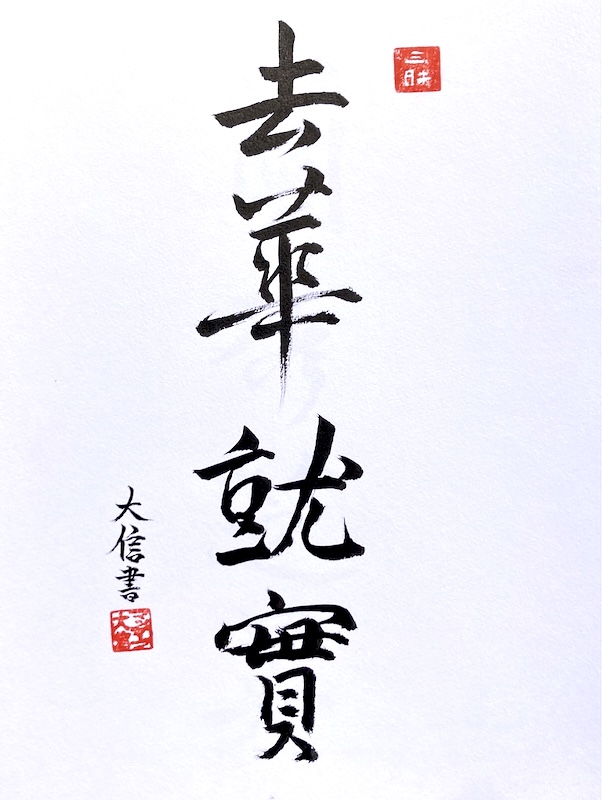
Enlightenment is the start of practice: as flowers fall, the universe awakens to itself as us.
In pre-modern times, it was a given that fruit would be local and eaten in season. It would be unheard of to have blueberries in the winter. These days, however, eating food that is locally grown and in season is truly precious and rare, at least where I live. I had the recent good fortune to taste mouthwatering strawberries from my mother-in-law’s backyard in June, after having eaten non-local, out-of-season strawberries through the late winter and early spring. While it’s amazing what technology and modern transportation has done for us, there was no comparison between in-season and out-of-season strawberries. Though my mother-in-law’s berries were smaller, they were packed with sweetness, unlike the others that tended to be dry and borderline sour.
In my own garden, the grapevines are bursting with bundles of tiny green bulbs that will eventually become grapes later this summer. My aronia berries (native to the Midwest) are abundant too, and though these black-colored berries are astringent, they are chock-full of antioxidants and give a beautiful deep purple hue when blended with other fruits in a smoothie.
A sangha member gifted me two dwarf fig trees, and I eagerly anticipate their fruit. They remind me of my recently deceased father. Dad planted what became a gigantic fig tree in his own yard that continues to give. My pear and plum trees have been struggling to produce flowers the past several years. I’m grappling to understand why. No flowers, no fruit, unfortunately.
Flowers and fruit also take on symbolic meaning in spiritual writings, such as Zen Master Dogen’s ‘Genjo Koan,’ where he writes, “Flowers fall even though we love them. Weeds flourish even though we dislike them.” “Flowers” may represent spiritual experiences that eventually fade away with time, yet we chase after the past, hoping to preserve the good times. My teacher, Dai-En Roshi, often warned us not to chase after previous experiences, saying, “Do you have the experience, or does the experience have you?” This is important to keep in mind as we enter a world where the traditional four seasons continue to lose their integrity. With the climate becoming unpredictable, we may find ourselves yearning for the past when nature was in greater balance. But here we are.
Creating an “Ecological Civilization,[1]” one where human beings allow the more-than-human beings to exist and even flourish, is now imperative. We Buddhists vow to accomplish the impossible because it gives us the strength we need in difficult times. We don’t know what the future holds, and there’s no going back to the past. Now, we can’t afford to forget the four great vows. These great vows provide the kind of vision that humanity needs to rise to the challenges that face us for generations to come.
This saying, “Flowers fall, fruit emerges,” reminds me that enlightenment is not the endpoint of my practice, but the beginning. Seeing the universe as Self is enlightenment, and it is also our practice. Moreover, enlightenment is not the purview of a few select people; it’s up to ordinary people to attain, and it’s a means to usher in an ecologically sensitive era that sees humans as one among many species, with all species having an integral part of life that goes beyond human use.
We begin practice when we are gripped by the self that sees itself. When we look out at the hackberry trees, the chipmunks, the clouds, the sun, and the fox and see them as our ancestors, as what has given birth to us humans,[2] we are gripped by our self. The squirrel that sees you is nothing less than your evolutionary ancestor viewing its descendants. From the moment of Enlightenment onward, it becomes our responsibility to practice that insight in everyday life.
Just as an infant lacks the ability to form coherent words to communicate with her parents and lacks the intellectual capacity to articulate their relationship with adults, we humans are similarly like infants in relation to the Earth and the infinite array of species. Our groping to understand ourselves in relation to the universe, too, manifests as the wondrous Dharma.
Our daily practice, both in the meditation hall and in the world, can be seen as the fruit of an initial Enlightenment experience. However, this fruit must always remember its flower. We must recall that humans evolved through processes spanning billions of years—no flower, no fruit. The flower gives birth to the fruit, which is an ongoing awakening fostered by skillful, everyday, moment-to-moment practice.
This everyday, ordinary practice-enlightenment (fruit-flower) has a rippling effect around the planet where we humans activate our role among all the other species, as that aspect of the universe that has the ability to reflect on itself, or, as Dogen Zenji puts it in ‘Genjo Koan,’ “That you go forth and experience myriads of things is delusion. That myriad things come forth and experience themselves is Awakening.”
[1] For more on Ecological Civilization, see the embedded link. Dr. Mary Evelyn Tucker, professor emeritus at Yale Divinity school articulates what is already happening in various countries in Asia.
[2] It may sound strange to say that foxes and other creatures gave birth to humans. I’m speaking from a deep-time perspective. Modern humans evolved more recently on our planet – some two to three hundred thousand years ago. It’s thanks to the creatures that have preceded us that we exist. From this perspective, they “gave birth” to us.
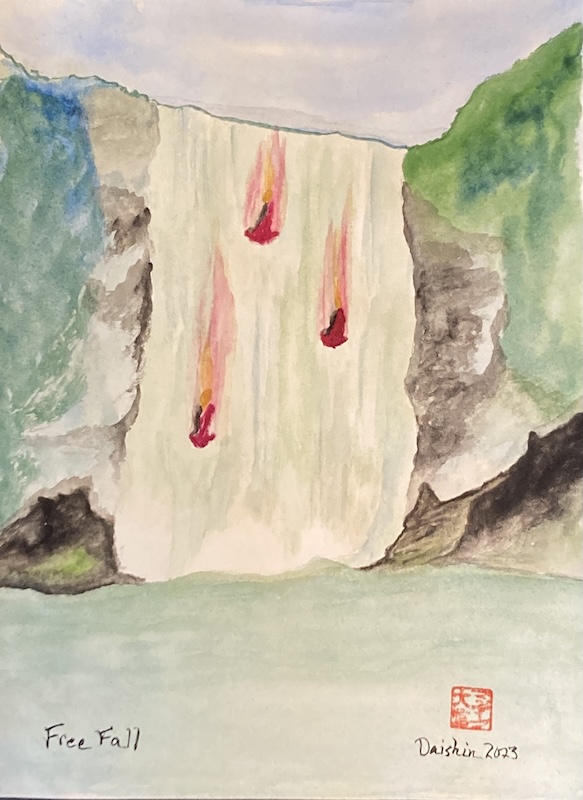
Each view is partial; doubt and beginner’s mind help us see zazen as a free fall.
Zazen as Freefall
Zen Master Jingqing asked one of his students, "What's that sound outside?" The student replied, "It's the sound of the rain." The master said, "All beings are upside down: they lose themselves in pursuit of things.... I am the sound of the rain!"
Accidentally dropping into a Zen temple, one may perceive those doing shikantaza (whole-hearted sitting) as stillness of body. One may stumble into a room full of bald-headed monks, sitting on raised platforms wearing robes and facing a wall and think, “why are they sitting so still, and how come nobody is talking, and what the hell are they wearing?” Or, “How could (or why would) anyone do that for any length of time?”
Anyone looking from the outside in at someone else’s practice is, by definition, caught in a spider’s web of thought. In other words, they are not in touch with true reality, but trapped in a one-sided view of what they perceive as reality. They don’t realize that they can’t perceive reality fully with their senses. Or they are ensnared by the belief that the fullness of reality can be comprehended through acquiring intellectual knowledge or data.
All of us, whether we know it or not, are tangled up by our particular views, and mistake them as the whole of reality. We have views of religion, of science, of our friends, of our intimate partners, of our children, of our politicians, and of the Oak tree in the yard, to name but a few. Forming views is the nature of our mind, and we all do it. The problem is that we conflate our particular view with the whole of reality. We say, “My child is like ____X_____.” Or, “My spouse always does it like ‘this’.” Or, “My religion sees the world like ‘such and such’.” Meanwhile, someone else may see a totally different aspect of that same child, that spouse, or that religion that is unknown to us. It’s not that one view is better than the other, but that they are both form a small piece of the whole picture.
Dogen Zenji poetically illustrates the multifaceted nature of reality in describing water in his, “The Mountains and Waters Sutra”:
In general, then, the way of seeing mountains and waters differs according to the type of being [that sees them]. In seeing water, there are beings who see it as a jeweled necklace…. Some see water as miraculous flowers, though it does not follow that they use flowers as water. Hungry ghosts see water as raging flames or as pus and blood. Dragons and fish see it as a palace or a tower…. [Others] see it as woods and walls, or as the Dharma nature of immaculate liberation, or as the true human body, or as the physical form and mental nature.
(The Mountains and Waters Sutra, p. 29 Okumura Translation)
While we may get thrown by terms such as “hungry ghosts” or “dragons,” we need to keep in mind that, first, these are mythical beings personifying certain qualities found either in humans or in nature, and, second, we need to be careful not to lose the overall point – water is seen differently depending on who or what is looking at it. Fish see water as humans see air. Some people see water as drinkable, others see it as swim-able, still others see it as hydro-electric power. It all depends on the situation.
Our fundamental problem as human beings is, in any situation we find ourselves, we often mistake what we perceive in the present moment as 100% reality. I was listening to a famous scientist, Neil deGrasse Tyson, being interviewed by Joe Rogan on his youtube channel (see https://youtu.be/g5mAm5BgvVE) about everything from the Big Bang to how we humans are more genetically related to mushrooms than we are to plants. Joe proceeded to ask Neil if he had ever taken psychedelic mushrooms. Neil’s response to this question was quite revealing. He had never eaten magic mushrooms because he didn’t want anything to distort how he was seeing reality. Neil further stated that there is an “objective” truth that can be verified, and that when we take a mind-altering drug, we miss the objective reality.
Regardless of what one feels about taking mind-altering substances, Neil’s mistake, and ours, is that we, in this age characterized by faith in scientific methods and empirical knowledge, believe an “objective” reality exists, can eventually be known in its fullness, and is slowly being revealed to us.
I deeply respect Neil’s knowledge and his disillusionment with mushrooms, and my mind is often blown by the discoveries of science – such as learning our genetic relation to mushrooms – because to me these verify what Buddhism has been teaching all along – everything is related. Science has been able to show this empirically through DNA.
The mistake of our modern period, however, is this idea of an objective reality. It has the tendency to dismiss multiple views, and to erase circumstantial wisdom. There’s a belief that the rational view is far superior to the artist’s view, or other views, for example. Our glaring blind spot is summed up by Dogen Zenji.
Given that what different types of beings see is different, we should have some doubts about this. Is it that there are various ways of seeing one object? Or is it that we have mistaken various images for one object?
The Mountains and Waters Sutra
I love that Dogen Zenji has us raise doubt about what we see. Doubt is essential for deepening our practice. It allows us to not assume what we know or see, to be absolutely true. It leaves room for other possibilities. As Shunryu Suzuki said, “In the expert’s mind there are few possibilities. In the beginner’s there are many.” Aoyama Roshi says we need to have “Kindergarten mind.” When we are stumped by something, or angered by the way someone is living their life, being stumped or angry is an indicator that we don’t have the full picture. We have to watch ourselves carefully and act with great caution in such circumstances.
Returning to the opening scene of the monks sitting zazen facing a wall, what are they doing? What are they thinking? What are they feeling? From an outsider’s perspective they appear to be doing nothing at all, or “just” sitting there, perhaps bored out of their minds. But what of the subjective experience of the monks? How might they be experiencing zazen? What might happen if someone tries zazen for the first time and sincerely engages with it? I’ll suggest that there are those beings who see zazen as nothing but free fall.
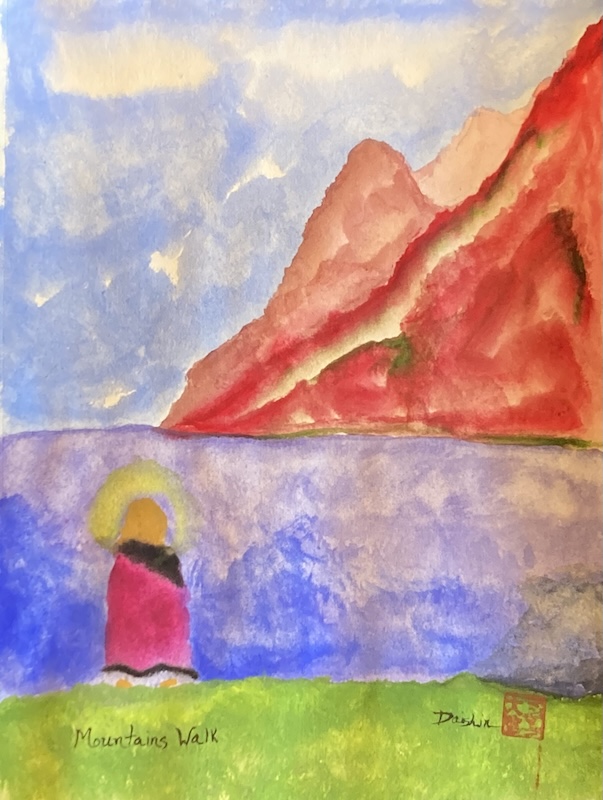
Dogen’s walking mountains teach deep time: even Iowa’s flat prairies are walking.
“Mountains do not lack the qualities of mountains. Therefore, they abide in ease and always walk. You should examine in detail this quality of the mountains’ walking.”
Dogen Zenji in "The Mountains and Waters Sutra"
It’s strange to be writing about mountains in central Iowa, one of the flattest regions of the country. Formerly tall grass prairie and teeming with wildlife, Iowa’s present land is a pale reflection of what it once was. Replaced by corn and soy crops in the Spring, Summer and Fall, it lies bare in the Winter months with little covering to support preexisting flora and fauna.
There is growing awareness of the need to “save the soil” through cover crops and prairie strips, and some farmers are taking this call seriously. Like many things, change is slow and requires a level of perseverance that few may be prepared to enact. The monocropping of the land doesn’t change the reality that I can drive for hours through cornfields that are as flat as a pancake. It also affirms a way of seeing the ground that, while having served humanity in terms of food production, is utilitarian. In other words, the land is not viewed as sentient and therefore (in our utilitarian oriented minds) entitles humanity to use it as we see fit. While proper stewardship of the land is a responsibility we cannot escape, I’d like to call into question the idea that land is dead or insentient. While some may argue right out of the gate that it is not inert because it grows corn and soy, I’d like to counter that by saying I find corn and soy fields largely uninspiring to look at. It’s not that they’re bad, nor are the farmers who put in a lot of hard work to cultivate the land, but my soul thirsts for diversity.
Where I trained in central Pennsylvania there is a very similar land ethic to Iowa, however, the terrain is quite different. There the soil is red, unlike the black soil of Iowa that has been singed by centuries of prairie fires. Perhaps the most striking distinction to the casual observer is the appearance of mountains. I could walk out the door of Mount Equity Zendo and see the mountains. Bald Eagle Mountain range was just off in the distance beyond the horizontal corn and soy fields. The level fields connected to the rising mountains in this area no doubt contributed to “Mount Equity Road” after which the Zendo was named.
Bald Eagle Mountain range was not named after the bird, as I once thought, but a leader within the Lenape (better known as the Delaware) tribe, a community of indigenous people that still exists today. This tribe has three clans within it, one of which is known as the “Muncy.” In the 1800’s the Lenape were pushed west by the expansion of the United States, and we find evidence of this westward movement by place names such as “Delaware,” “Muncy” (in Pennsylvania), and Muncie (in Indiana). The Lenape are perhaps better known for their “ceding” of what is now New York city and the surrounding Islands to settlers for a minimal price, yet their distinction from other indigenous tribes is often erased by the term “Indian.”
Bald Eagle Mountain range and other mountains like it comprise what is known as the Appalachian Mountains which span from Alabama all the way up to southeastern Canada. The Appalachian Mountains are considered older than the Rocky Mountains. Scientific studies of plate tectonics and sedimentation have revealed that these creatures (the mountains) were born some 480 million years ago and were once just as tall as the Rocky’s are today. Now, they are like old men and women with their hunched backs illustrating the Buddha’s teaching that no one can escape old age, not even a mountain. Yet to the common observer it may seem as though the mountains have always been the way they appear today.
Zen Master Dogen, in the 13th century on the mountainous Island nation of Japan, exhorted his students to observe the mountains “walking.” He was not privy to the extensions of the senses that technology has afforded modern humans. Meditation, rather, enabled him to see deeply into the nature of impermanence. Knowing that “mountains walk” with the intellect is not the same as penetrating it in the way that Dogen poignantly describes in his writing. Practice is seeing that we are those mountains walking. Dogen says:
If you doubt mountains’ walking, you do not know your own walking; it is not that you do not walk, but that you do not know or understand your own walking.
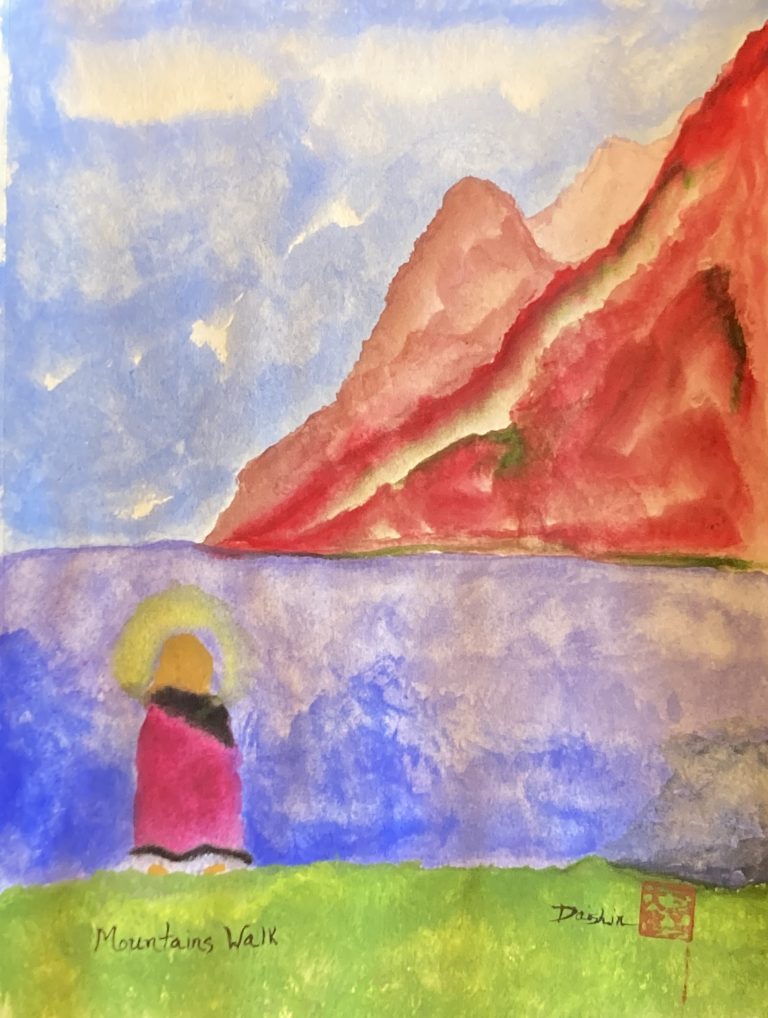
The monk in this image is standing on the bank of a river (or maybe a field) and is contemplating the mountain walking. This requires a deep time view. It requires that we keep alive the question, what was here before any of us was alive? Or perhaps, who was here before us? Who was here before our great grandparents? The Zen koan that invites us into a deep time view is, “What is your face before your parents were born?”
Returning to central Iowa, nestled between the two mighty rivers – the Missouri on the western border and the Mississippi on the eastern side – and to the Midwest sanctioned by the Rockies on the western bank and the Appalachians on the eastern edge, I find it imperative that I invoke my imagination to see with deep time eyes, that these two mountain ranges have been playing a tug of war with each other as they rise and fall, and thanks to them our prairies, too, walk.
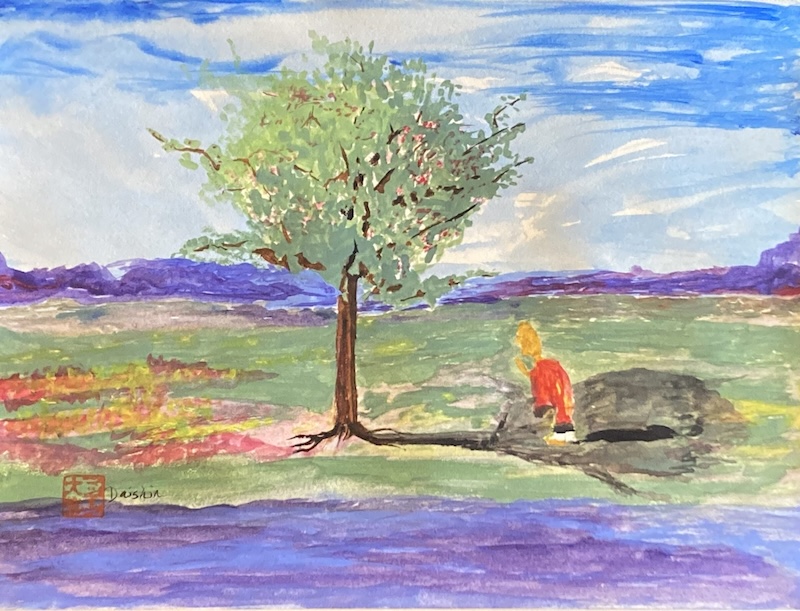
Zen’s lineage chant names only humans; what if trees, rivers, and animals were ancestors too?
Sitting at the edge of a small, sparsely wooded area on my college campus, the trees and grasses all around me brightened, as I could feel an immediate sense of intimacy with matter, with atoms, that was, until that moment, foreign. The realization: I share some of the same DNA as those trees and grasses. They were my ancestors, as was every dancing atom around me.
Almost 3-years later I entered a Zen monastery because, in part, I found a religious form where, through ritual, I could celebrate my relation to all living beings on Earth. In the Zen monastery, for example, I daily chanted the “Four Vows” which proclaim, “Beings are numberless, I vow to free them.” As someone who was a biology major studying endangered species like the Red Hills Salamander, this particular verse contained within it the spiritual inspiration I needed. If species are going extinct, a religious vow that says that the number of species are numberless and that we should do all that we can to free or save them seemed particularly relevant to me. It’s as if the Buddha is saying, “Do everything you can to prevent the mass extinction of species.” This seems to be an impossible vow – how could I single handedly save all beings? Yet, I am nonetheless vowing to do the impossible.
Since then, I’ve come across many more resources within the Zen tradition that affirmed my connection with the entirety of the natural world. The Buddha, in one sutra, says that there are no beings – from ants to zebras – that have not at one time been our mothers. Therefore, we should treat everything respectfully, as it continues to open us to the life energy that is us.
Zen Master Dogen, one of the founders of Soto Zen, further taught that “mountains walk just like people walk.” Dogen’s religious naturalism is infused throughout his writing. While I could go into greater depth on any of the aforementioned teachings, I would like to focus on a particular ritual found within the Zen tradition that I find, both problematic and encompassing tremendous potential for deepening our awareness of our animal and plant ancestors. This ritual is the chanting of the Buddhas and Ancestors lineage. I’ll begin with a description of the ritual, then talk about how it is problematic, and then how it may be “greened” or practiced such that it weaves us into a deep connection with the natural world.
A traditional Soto Zen morning chanting service begins by reciting the Lotus Sutra followed by the Great Compassionate Mind Dharani, and Heart Sutra. Sometimes other sutras and ancient Zen poems are included. Each of these sutras has its own separate and distinct dedication. The chanting of the sutras generates an invisible energy called “merit” which can then be directed through the dedication of that merit to a specific purpose. It’s the Zen way of soliciting help from forces beyond our understanding, but with the caveat that there are no expectations for a specific outcome. The outcome is beyond human control. The point is that the practitioner shifts their mind from preoccupation with ego-self to a concern for the welfare of others.
Following the chanting of the Heart Sutra is the recitation of two Chinese Zen poems called “Harmony of Difference and Equality,” and “Precious Mirror Samadhi.” The dedication for these two poems is the Zen ancestral lineage. In other words, we dedicate the merit generated by reciting these poems to all the teachers, including our present-day teachers, the Buddha, and the 7 Buddhas before Shakyamuni buddha, that came before us. It’s, first, a way of remembering the transmission of the Dharma throughout the ages, and of developing gratitude for those who have dedicated their lives to passing it on for our sake. Second, in reciting their names each ancestor becomes present in spiritual form, here and now, or, at least, the practitioner imagines them to be so. In dedicating the merit to the Zen ancestors, some feel that the ancestors can in turn help us in our present life.
It’s believed in the Zen tradition that, while from a historical angle Shakyamuni Buddha is the “founder” of Buddhism, and the original teacher, there were many awakened people before him that deserve credit and are thus symbolized in chanting the names of the seven Buddhas before Buddha. It is agreed upon that, within the Zen tradition, these seven Buddhas are not historical people. It’s important to note that the lack of empirical evidence for the existence of the people named in the lineage is irrelevant to most people who chant it. In fact, many Buddhist scholars believe that the lineage post Buddha was also largely fabricated in order to make Buddhism more adaptable to Chinese cultural norms.
To destroy any species is to destroy our own Enlightenment.
In any case, Shakyamuni Buddha’s name is chanted, followed by all the Buddha Ancestors in India, including Bodhidharma who carried the Dharma flame to China, then all the Chinese ancestors up to Great Teacher Tendo Nyojo Daiosho, who then passed on the Dharma to that first Japanese Great Teacher Eihei Dogen who carried the flame to Japan, and then all the Japanese ancestors up to my Dharma grandfather, Great Teacher, Noda Daito, then to my immediate master, an American, Great Teacher Daien Bennage. Obviously, many of the more recent generations of ancestors are not fictional characters. I and all my Dharma brothers and sisters who trained with and received the precepts from Daien Roshi are a part of the spiritual lineage of masters that extends not only to the Buddha Shakyamuni, but to the 7 Buddha’s before Buddha.
Every day I chanted these names in a monotone key, offering candlelight, sandalwood incense, water, food, and bowing to them, my whole body and mind reverberating with the vibration of these teachers, like bees swarming in their hive. I learned, further, that there were stories of Enlightenment attached to each of these ancestors. I continue to be nourished by these stories and by the ritual of chanting the names of the ancestors, as it has been emotionally moving for me, personally. However, I will now turn to two problems I see in it and consider initial ways to rethink it.
The first issue I take up is that, aside from my teacher, Dai-En Bennage Roshi, all the teachers in the lineage are male, and the second is that they are all human. The fact that they are all, but one, male, denotes the patriarchal nature embedded within Buddhist ritual. The fact that we limit our “spiritual” ancestors to human beings betrays an anthropocentric bias.
In response to the first problem, some Zen centers, including my teacher’s, have resorted to including a second list of names comprised of notable female Zen ancestors that are chanted after the male names. For many women and some men this has been a deeply meaningful addition, as it affirms the capacities for all genders to attain Enlightenment. However, in a male dominated culture, historically, women have mainly been marginalized, and this chanting of all men’s names is one way that has been woven into ritual and institutionalized. In Japan, for example, male clergy far outnumber female clergy. In the United States, too, if we include Asian-American practitioners, the number of men that are playing the role of priest/clergy/monk/teacher far out-number the women who play that same role. Not to say there aren’t women practitioners, just that their roles are marginalized in the form of “support” for the teacher. Thus, chanting the female ancestors has been a way to address the way women have been made invisible in Zen history through the lineage, and it has empowered many people to work for and realize gender parity.
The second problem is that of anthropocentrism. While, as mentioned previously, Zen teachings go above and beyond our western religious sensibilities with regards to feeling an intimate connection with the natural world, the Zen lineage falls into the same trap as the Abrahamic traditions because it stops short at human Enlightenment. It is the humans and their Enlightenment that are memorialized in the ceremony, not that of frogs, stars, or bees. This, to me, is a short coming that, like the addition of female ancestors, can be improved upon. Just as the ritual of reciting the names of the Buddha and Ancestors has helped me feel a deep connection with these amazing teachers and their Enlightenment, and that I too am part of that flow, including non-human ancestors may also help us to establish that Enlightenment is not just the purview of humanity, but that it extends to all creatures. To destroy any species is to destroy our own Enlightenment.
There are countless stories within the Zen tradition that affirm the Enlightenment of both sentient and non-sentient beings. As such, even walls and pebbles can be a teacher. In Dogen Zenji’s, “Self Fulfilling Samadhi,” he states,
The trees, grasses, and land involved in [realization] all emit a bright and shining light, and preach the profound and incomprehensible dharma, and it is endless. Trees and grasses, walls and fences expound and exalt the dharma for the sake of ordinary people, sages, and all living beings. Dogen Zenji
Furthermore, the Buddha was Enlightened under the Bodhi tree. Upon seeing a star, he attained Enlightenment. Buddha was born in a forest and died in a forest. What if, as a way to “green” this ritual, the names of these beings were incorporated into our lineage? Can we imagine the chanting the name, Great Teacher Bodhi tree? Should not the star (or planet) the Buddha saw at the moment of Enlightenment also be considered our ancestor? What about the grass that the Buddha sat and walked upon? How about the deer in the park where he resided? What about the Ganges River that he lived nearby? Could they not also be included in our sacred lineage?
These questions are meant to stimulate further discussion and envision possibilities as to the greening of our lineage ceremony. What or who might this lineage include one hundred years from now? Could we not include the names of our local region – the Des Moines River – and animals – the Red Fox – and trees – the Cottonwood? What or who might our lineage include 1,000 years from now? How about 10,000 years? 100,000 years? 1,000,000 years?
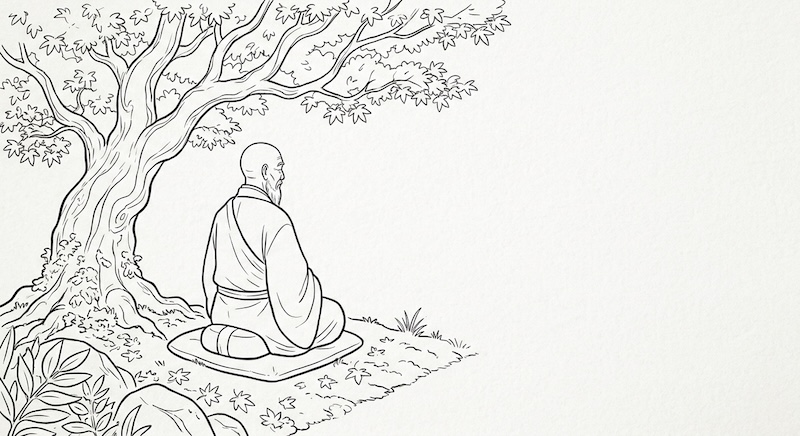
Trauma survivors heal through choice, so Zen teachers should invite, not instruct.
One mark of a well-polished Zen monk is the ability to accept any situation as it is, without trying to change anything. The first line in the ancient Zen poem, “Faith in Mind” reads, “The Great Way is not difficult for those who do not pick and choose.” A good chunk of Zen training – whether or not you are a monk – is learning to let go of picking and choosing, and simply accepting what you receive. One who can do this finds the Great Way easy.
In my own experience, when I finally realized that my teacher – Dai-En Roshi – was less interested in my opinions and more interested in me dropping my agendas and simply listening to her, my relationship with her began to improve quickly. I was no longer burdened with having to prove myself. My job as her student was to be an open ear. My teacher described this phenomenon by making the analogy of pouring water from a full vessel into an empty vessel. This is “shiho” or Dharma Transmission. In order to receive from the teacher, we need to empty our self.
Aoyama Roshi in, “Zen Seeds” writes, “A monk’s mouth should be like an oven.” In other words, just as an oven does not refuse what goes into it – cooking everything without discrimination – so too should a monk accept what comes to him or her without showing preference for one thing or another. This applies not just to monks, but any Zen practitioner.
I remember hearing a story from my teacher about a Japanese Zen monk who tied bricks on to his knees in order to force his legs into kekkafuza (full lotus). Monks and laypeople alike, in Japan, are expected to sit hankafuza (half lotus) or kekkafuza if they want to practice zazen at a temple. Recently, I received a letter from Eiheiji, our head temple in Japan, inviting myself and my students to do a four day sesshin. One of the requirements was the ability to sit hankafuza or kekkafuza for “a long time”.
When my teacher practiced in Japan at a Rinzai Zen temple, she was expected to sit at least hankafuza, even though one knee resisted touching the tatami. It took several months before the muscles in her hips softened enough for her knee to touch the ground. I remember her saying that the only reason she did not quit was because the pain in her heart was greater than the pain in her knees. If the ratio had been the other way around, she would have ended her practice.
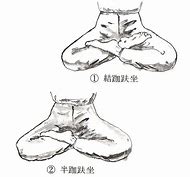
Forcing one’s legs into a lotus position may sound really harsh. Most American teachers that I know encourage their students to sit in ways that work for their body, including in chairs. I personally feel grateful to my teacher for requiring that I learn to sit hankafuza or kekkafuza. If she did not have the faith in me that I could do it, I would not have attempted it. There is something about sitting in a lotus posture that is quite grounding for me and really helps me to focus my attention. But I also understand that this is not for everyone, and I would never force my students to sit in this way. If their body was limber enough, however, then maybe I would encourage it.
While most Western teachers tend to be less rigid when it comes to how you sit, you nonetheless can find yourself sitting in stillness and silence anywhere from 20 minutes to 7 days. This requires anyone to have the ability on some level to let go of picking and choosing. This is how the Great Way becomes easy. When we let go of what we want and learn to accept the situation as it is, peace comes to the mind.
Zen Master Dogen’s “Universal Instructions for Zen Meditation” claim to be universal. Anyone should be able to do it. They only need to follow his instructions carefully, dedicate themselves, and be still. But can his instructions be applied to everyone?
For some people new to Zen, and even those who have been sitting a long time, expecting someone to sit for a long time without moving – regardless of posture – may be inappropriate, especially for those with a history of early childhood trauma, PTSD, or belonging to a marginalized community.
For a trauma survivor having the ability to choose is the pathway to healing. Not allowing choice can actually exacerbate trauma symptoms.
Trauma is defined as, “extreme lack of choice by an individual in a chronic way” (David Emerson, author of Overcoming Trauma Through Yoga). Trauma includes not only having one’s physical body hurt at a particular time, but also systemic forms of violence such as what the African American and Native American communities are presently facing as a result of the historical oppression they continue to experience. The recent “Stand up for Standing Rock” and the “Black Lives Matter” movements serve as testimonies to a systemic form of trauma.
One dimension of trauma that has been well documented in trauma survivors is a poor ability to make choices. Brain scans reveal, among other things, an under stimulated pre-frontal cortex in the brains of trauma survivors. The pre-frontal cortex is where the executive function operates. This is the place in the brain that is stimulated when decisions are made.
People with addictions (addiction often being the by-product of early childhood abuse or systemic trauma), have poor ability to make clear choices. “Just say no”, or asking someone with an addiction history to be self-disciplined may be unrealistic. Repeated lack of choice from an early age, or being constantly denied agency in one’s destiny has prevented the development of the ability to make sound judgements based on necessities or desires.
Part of the path to healing for trauma survivors is having opportunities to make choices, rather than being forced to drop choice.
If a trauma survivor shows up at a Zen center that is not trauma informed, and is told to do things “this way and that way” and to let go of their choosing, they risk having old wounds reopened. Furthermore, a teacher who is not sensitive to how trauma effects a survivor, may, at best, prematurely give up on the student, and at worst, re-traumatize them.
Dr. Judith Herman, author of Trauma and Recovery, writes, “No intervention that takes power away from the survivor can possibly foster her recovery, no matter how much it appears to be in her immediate best interest.” For a survivor, it is deeply hurtful to be told what to do.
That is why, in the context of a trauma informed Zen class, the teacher commits to empowering the students by not telling them what to do. Rather, they use invitational language and offer suggestions. Power is given to the students to decide, based on their own felt experience, what works and does not work for them.
Prior to studying Trauma Center Trauma Sensitive Yoga, as a Zen and Yoga teacher, I pretty much expected that serious students would simply follow what I ask them to do. I assumed that the student was not ready if they could not do what I asked them to do. It was a major bodily and mental shift for me to begin teaching in a way that empowered the students to make decisions for themselves. I clearly remember a palpable shift in my body-center when I gave a student of mine a choice for how to proceed. I was no longer in control of the situation. I was not in control of the student. It was liberating not only for the student, but for me, too!
In the past, because of my lack of understanding around trauma, not being in control would frustrate and seriously aggravate me. I would feel imprisoned. My thoughts were, “Hey! I learned to do this. I learned to drop my own ego. That’s what this practice is about. Why can’t you do it?! Just let go of having an opinion!” Of course, I was not able to verbally articulate this, and I probably wouldn’t have even if I could.
Once I understood that people with trauma are suffering in the present moment because of earlier childhood experiences or systemic forms of trauma that remain lodged in their body, my heart opened up. I realized that it doesn’t do any good to make a survivor conform to my will. The kind response, rather, is to offer opportunities, within the student-teacher relationship, for making choices. I empower the trauma survivor to create their own destiny, as opposed to me trying to shape it for them.
Given the widespread prevalence of trauma [1], my studies of the way trauma effects people have caused me to reflect on the way I teach Zen and the way that I’ve seen it taught in the United States. Is a blanket way of teaching meditation helpful for everyone? Do we know the signs of trauma in our students? Are we truly “liberating all beings” when we are not sensitive to those that come to us with a trauma history? Are we causing more harm than good as Zen teachers when we do not take into account an individual’s trauma, or the trauma caused by systemic forms of trauma (e.g. racism)?
Are we fulfilling our calling to teach the Dharma when we turn away those with trauma? Many Americans have some degree of trauma that goes unnoticed or diagnosed. How do we know, when a student offers resistance to a teaching, that this is because of their own ego? How do we know when a student’s resistance may actually be a sign of their own healing?
The Great Way is not difficult when trauma survivors get to pick and choose. However, for Zen teachers who are insensitive to trauma, the Great Way may be very difficult to teach effectively. Buddhist teachers offer meditation in prisons, mental health units, hospitals, to veterans, and to special needs populations, and to the marginalized. The prevalence of trauma in these circles is even higher than those of the general public. A minimal understanding of how trauma affects neurology, psychology, and community are absolutely essential for Zen teachers.
I learned about trauma thanks to my connection with yoga, and thanks to the encouragement of a friend who is a psychologist. I’m not presently aware of trauma education being offered for Zen teachers, so I feel an imperative to offer some of what I do know.
I have been teaching meditation in prisons for twenty years, and in Behavioral Health and Addiction Treatment centers for seven years. It’s only within the past two years that I have been actively studying trauma, and this has deeply affected how I teach Zen to those populations.
When I’m teaching to individuals that have PTSD I may remind them that it is their choice to be there or not, and if they need to leave for any reason it’s totally okay to return.
By beginning my classes in this way, I am immediately handing my power over to the participants. I’m empowering them to reaffirm their decision to be in the class, and if they change their mind, I see that as part of their healing process. The ability to say, “no” to a person with authority can stimulate healing if the person in power is open and accepting.
If the participants are in prison, then this empowerment through choice is even more precious. They don’t have the choice to leave their larger environment, and often they don’t have choices even within the many activities that they do. By making it clear that they choose to be doing meditation or not, I am letting them know they are in charge, and also not shaming them if they decide to leave.
When I teach meditation, I also incorporate choice into my instructions. While the Buddha’s life, itself, is a model of experimentation to see what works and what does not, this attitude is not clearly reflected in Zen Master Dogen’s, “Universally Recommended Instructions for Zazen”. Depending on the teacher, too, the degree of choices built into meditation instructions may be somewhat limiting for a trauma survivor. For example, Zen teachers often insist on practicing with eyes open. While having eyes open and noticing the external environment may actually be beneficial for addressing trauma, if it is done without choice it may become problematic. I may say something like, “Zen meditation is traditionally done with eyes open. You are welcome to close your eyes or have them open. That’s your choice. Feel free to try both ways and see which works better for you.”
Offering alternatives to posture can also be incorporated into meditation instructions. Students can be encouraged to change postures in the middle of meditation, to move to a chair, to walk, or even to lie down. The point is to allow opportunities for the development of agency, a feeling that one has control over themselves and their environment, and can change how they are relating to the situation. Expecting a survivor to “just sit” and not move does not foster agency unless that person chooses to do so.
Another way I foster agency in a prison setting is to hand the meditation bell over to the students. I ask if anyone would like to be in charge of ringing the bell to start and end meditation. I also have the students decide how long they will sit for. 10 minutes? 20 minutes? This way, they take leadership in their own environment, rather than me telling them a proscribed length of time and expecting them to do it. I am also conscious of the fact that whatever they decide in terms of the length of sitting may not be in their immediate best interest. It may be too long for some, and too short for others. Again, if I’m teaching from an empowerment model, this is not a problem
A trauma informed Zen class may look different from a “normal” Zen meditation group. “Daishu ichi nyo” means “everyone doing the same practice together.” It’s about living in harmony in a cloistered environment. Everyone meditates together when it’s time to meditate. They work together when it’s time to work. They sleep when it’s time to sleep. This is expected of anyone who practices at a Zen temple. To be lying down or doing walking meditation when everyone else is doing sitting meditation, for example, is not the practice of “Daishu.” In a recent meditation retreat I lead, I gave students the opportunity at any time during the sitting period to practice walking meditation, to lie down, or to take a break all together from the group.
While “Daishu ichi nyo” may be absent in a trauma sensitive setting, if the teacher is actively empowering the students to explore different ways of being, then there will remain intact a strong spirit of inquiry which may otherwise be lacking.
I myself am still exploring ways of creating a safe, stable, and transformative atmosphere for practitioners with trauma. The above are just a few examples of what I do, and I’m still very much learning ways of improving my approach, as every student is different.
I am grateful to ALL my teachers for offering ideas and options I would not have been able to see without them.
[1] According statistics found in David Treleaven’s, Trauma-Sensitive Mindfulness, one in five women in the United States will be raped, and it is estimated that every 28 hours a Black person is murdered by police, security guards, or State sanctioned vigilantes.