Here you’ll find reflections, teachings, and writing from the Zen Fields sangha, gathered over the years. Topics range from meditation and Buddhist philosophy to parenting, yoga, social and ecological justice, interfaith connection, and the places where Buddhism meets science. Browse by category below, or start with the most recent post and follow what draws you in.
Dementia can’t take enlightenment away: it goes nowhere, and every person deserves respect.

“Let go of Enlightenment.” - Zen Master Dogen in ‘Shobogenzo Daigo’ (Great Enlightenment)
Dementia sucks. When a loved one has it, we feel loss, though we might not fully understand why. If they were to have passed away there may be more clarity about the matter, but they’re still with us physically. Yet their presence triggers in us questions perhaps about our own identity. Memory gives us identity. Memories form who we are and who we become. Lose memory and we forget who we are. That is scary for most of us.
Our present actions, words and thoughts are largely determined by memories – both ours and others – of who they think we are, and who they think we are supposed to be. Our parents passed on to us everything they understood about life – based in their own past experiences – through memory. They pass on their memories verbally but more importantly non-verbally through their own actions and ways of being in the world. Our parent’s memories guide us, helping us avoid life’s pitfalls. But memories, if not questioned, can also lead to a false sense of self.
What happens when we witness memories fade or even vanish in a loved one? Does it not, on some unconscious level, shake our own identity?
Depending on how the past has been transmitted to us, maybe dementia doesn’t suck. Maybe it’s exactly the remedy some of us need to break free from mental prisons that others created for us – other people defining who we are. When those definitions – preserved in memory – go, it may be like the sound of a skeleton key turning to unlock our mental cage. We realize we’ve been wrongfully imprisoned, and we have an opportunity to redefine ourselves.
Is dementia good or bad, then? It’s a question worth asking, as we generally come down on illness one-sidedly. Zen practice doesn’t let us take a one-sided approach to anything, though. Rather, Zen has us hold the non-dual nature of the present moment. In other words, we hold these opposites – good and bad – lightly without coming down on one side or another.
I have had the privilege (not without sadness) to witness my teacher, Dai-En Roshi, suffer with dementia. While she is not my parent, she was like a spiritual mother to me. My memories of being in close physical proximity with her over the years, of hearing her teach, but more importantly, seeing her actions, is my own source of guidance today, even though I am now miles apart from her. Her own memories, how she got to be who she is, have become part of who I am – the many experiences she had living in Japan, including a phenomenal cross-cultural exchange I describe below – all shaped me.
Now that her memories are fading, I wish to preserve what I remember. I feel this deep loss; thus, I also feel a need to write down what she shared as I remember it so as not to lose these memories completely.
At one time, Dai-En Roshi recalled an experience she had with Belgian Catholic nuns who were part of the “East-West Spiritual Exchange” encouraged by Pope John Paul II. Catholic nuns from Belgium came to Japan for one month dressed in full habits with iconic head gear and sat cross-legged on cushions facing a white wall for zazen in the Buddhist temple. A couple years later Japanese Zen Buddhist priests then lived for one month in a Catholic monastery in Belgium singing hymns, listening to the Gospels, and receiving Eucharist. The exchange took place over several years beginning in the late 1970’s. During one such exchange, Catholic sisters had been deeply impressed by the style and manners of a particular Japanese Zen master. The old Zen master had them laughing and impressed them all with his insight into reality, as one might expect of an enlightened being.
A few years later the nuns returned to see old teacher but were dismayed to find him with dementia, not able to recall any of them nor their discussions from the past. They went to Dai-En Roshi and asked her, “Where did his Enlightenment go?” Dai-En Roshi responded without hesitation, “It’s right there. It didn’t go anywhere!”
In the “Daigo” (Great Awakening or Great Enlightenment) fascicle of Shobogenzo, Dogen Zenji offers an understanding that encompasses Dai-En Roshi’s response to the Catholic nuns. In Zen literature Daigo happens when a monk has a deeply transformative spiritual experience or insight into the nature of reality, often precipitated by a teacher-student dialogue. But Dogen has a different take on Daigo. He writes:
Therefore, great awakening is realized; and arriving at the way without awakening, observing awakening and playing with awakening, losing awakening and letting it go – these are everyday matters among the buddhas and ancestors.
We often believe that practicing meditation leads to a deeply transformative experience, and that experience – what we might think of as Daigo – is the goal of practice. It’s true that such experiences occur, and that they can be deeply transformative, but they are sometimes referred to as “small enlightenment” and confused with “great enlightenment,” and they are not the end goal of practice. “Great Enlightenment,” Dogen says, includes losing enlightenment. Perhaps we can say, forgetting about it completely. Satori experiences are not something to be held on to. Zen literature is very clear on this. In fact, many koan stories are about getting students unstuck from holding on tightly to previously transformative experiences. Thus, the absent-minded Zen Master’s “enlightenment” hadn’t gone anywhere. In other words, great enlightenment (Daigo) encompasses all states of mind. His dementia forces us to reconsider our narrow notions of enlightenment as a special or advanced state of mind, and to open ourselves up more deeply to the miracle of the present moment, regardless of our state.
Likewise, with dementia we are faced with losing our identity, or losing our loved one the way we once knew them. This loss, however, doesn’t change the fact that a person worthy of respect is still present, regardless of their state of mind, or regardless of our shaky identity.
Great enlightenment is not something to be gained or lost. It is eternally present. That a human being is worthy of respect based on the fact of their very existence (not on their illness), too, should be the basis of our interactions with those with dementia. Our idea of Enlightenment, however, often prevents us from seeing it within our self or another being. Similarly, our idea of the other person (or of our self) prevents us from seeing who they really are (or who our self really is). We are all of the nature to change, and there is no way to escape impermanence. In practicing Zen, if our eyes are clear and open to the Dharma, every moment, regardless of what presents itself or how we feel about it, is a moment of Enlightenment.
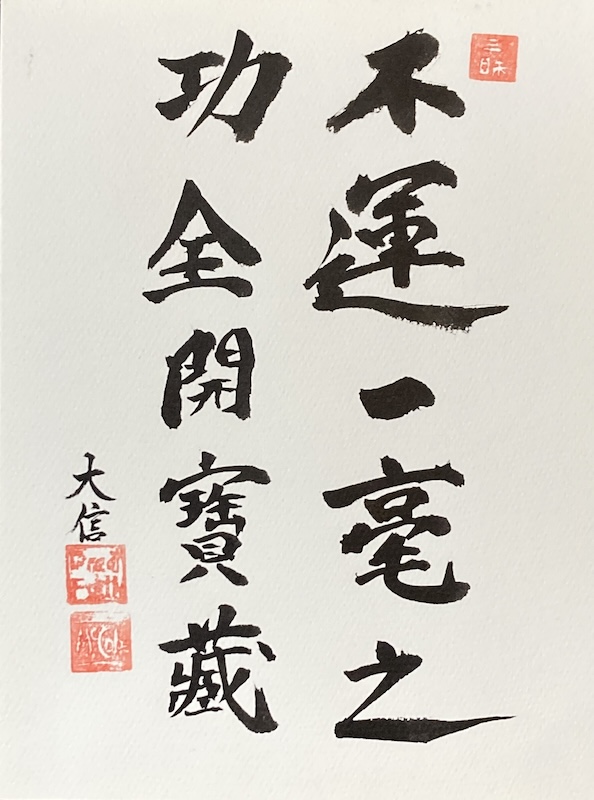
Mindfulness reveals there’s always enough, even in leftover popcorn; no effort needed.
"Without even the slightest effort one completely opens the treasure storehouse."
Zazen is simple. Just don’t put effort into doing it.
When deluded, our world turns upside down, right side up, and upside down again and again from the moment we get out of bed. That’s the price of seeking status and wealth. It’s the results of learning transactional love – “Do this and get that in return.” In other words, our self-worth is knit together with a condition. The condition being the degree, the promotion, the salary raise, the victory, the dream vacation, etc.
There’s nothing inherently wrong with striving for something. But when our identity becomes ensnared with the outcome of our pursuits, we’re in for a roller coaster ride for our emotions, or worse, our mental health gets easily derailed.
In the movie, “Gold” (loosely based on a true story) Kenny Well’s comes from a mining family. He’s about to lose everything his ancestors worked for when, after much effort, including a near death experience with malaria, he discovers gold in Indonesia. He starts thinking and living as a millionaire – planning the location of his dream home, going to extravagant parties, rubbing elbows with the wealthy, flirting with an attractive woman. As he’s about to get filthy rich with a 300-million-dollar contract, because his name was no longer included in the deal, he flushes the offer down the toilet and ends up losing everything he’s worked so hard for, including the only person who sees through the illusion – his girlfriend. His identity was coupled to his worth. He’s essentially saying, “My name is worth more than $300 million dollars.”
This is an extreme example of what most of us do with our name, and with words. We tie a value to them as if they are real, and then expect compensation equivalent to our ideas, completely oblivious to the reality right in front of us.
The movie is a graphic depiction of what the Buddha referred to as craving. Craving stems from a scarcity mentality, the thinking that we don’t have enough. But if there’s one thing I learned from how the monks in Japan used everything they were given, and myself being reminded again and again by my teacher that there’s always more, is that when we are not mindful, we see things out of habit. Or rather, because we live out of habitual ways of doing things, we don’t see what’s right before our eyes. When we break this habit through mindful observation of the present moment, then the universe opens up to us and reveals options.
As Dogen Zenji says at the end of his universal instructions for Zen meditation, “The storehouse opens of itself and you may use it freely.”
Some people might think that what I’m sharing can only be found after long hours of sitting meditation. I’d love it if people meditated more. But it ain’t gonna help none. Zen meditation doesn’t necessarily increase our mindfulness one iota outside of that one spot in the zendo.
Recently, I had two instances within a few hours of each other in my familial life where I was able to practice what I learned while living as a Zen monk. Neither was dependent on meditating. The first was with my 8-year-old son. He was trying to create a mini suspension bridge based on instructions in a book. One of the materials he needed was four flexible straws, the kind that easily bend so you can put your lips to it without damaging the plastic. But we didn’t have any straws, in part because my wife -thankfully – has been conscientious about reducing the amount of plastic we bring into the house. So, I told my son that we don’t have to do it the way the book says. We can find some bendable sticks out in the yard and use them instead. He was skeptical because we weren’t following the exact instructions of the book, and he reluctantly followed me outside where we found the necessary items in nature, without having to go out to the store to buy anything. It was interesting to watch his growing anticipation and excitement as the structure came together.
The second instance was with my one-year-old daughter, just a couple hours later. My wife had made popcorn that evening and my daughter had been enjoying it immensely, stuffing her mouth with handfuls of puffy white cloud-shaped popcorn. We had come to the end of the batch, and I was about to throw the unpopped kernels quickly into the compost because my daughter kept reaching into what I saw as an “empty” bowl, and I didn’t want her to accidentally eat or choke on those kernels. But then I looked more closely before dumping them and saw that there were still small bits of popcorn that most people would probably discard. I proceeded to pick out these tiny white puffed balls and hand them to my daughter who then eagerly snarfed them down, along with the nutritional yeast, oil, and salt that coated them. I remembered my teacher demonstrating how absolutely nothing is wasted in a Japanese Zen temple. The Tenzo’s would sometimes eat the remaining rice gruel that was stuck to the bottom of the pan after a meal, rather than throw it out or even compost it.
Just before we came to the very last little puff ball of popcorn I realized I could dip some small pieces of cheese into the bowl in order to coat it with the nutritional yeast and salt and see if she would continue to eat to her fill. Sure enough, she was more than happy to continue feeding, and although the popcorn was now well gone, cheese had replaced it and she was happy as a clam. Had I not had Zen training, I doubt I would have ever been mindful enough to see that there was plenty at hand. Rather, I would have been thinking out of scarcity complex.
While everyone should go to a Zen monastery in Japan and train for three months or longer, most people won’t. While everyone should immediately find a Zen teacher and desire to learn from them, most people don’t. While everyone ought to look me up and ask how they can do zazen effortlessly, my inbox and voicemail are mostly empty. The alternative here is to just be mindful of the present moment that you exist in right now. Then there’s no need for a teacher, a monastery or even for zazen.
However, I don’t know anyone who can live in the moment without some degree of training. As individuals we have too many blind spots, and we are too often unaware of our own egos. A monastery or temple, or simply practicing with several other people creates an atmosphere of attention that can’t be easily replicated when sitting by our self. For those that wish, a teacher can skillfully point out one’s blind spots in practice, but also encourage us to not give up.
In an ancient Zen story a monk was struggling to light a fire and finally gave up, telling his teacher that there was nothing to light the wood with. The teacher grabbed the tongs from the monk’s hands and reached deep into the fireplace ashes pulling out a glowing ember, demonstrating, one, that when we think we have run out of options, we’re not looking mindfully enough, and two, sometimes inspiration comes from outside. Reading what follows, for example, can be that inspiration we need for understanding better how to meditate.
In Chan Master Yongming Yanshou’s writing on the “Source Mirror” he says, “Without even the slightest effort, one completely opens the treasure storehouse.” This statement is totally in line with the gist of not wasting one morsel. If anyone puts themselves within the stillness of zazen for just one second and promptly gets this phrase of effortlessness, then there’s absolutely nothing more needed, wanted, nor desired. The “treasure storehouse” opens. Your Buddha nature becomes readily accessible. It’s not necessary to engage in some technique to discover the treasure. No need to dig for gold. No need to put effort into seeking something outside the immediacy of the moment. Just look and see all the potential, all the possibility. We might notice that there’s “more edible popcorn at the bottom of the bowl.” Yongming further writes, “When the spiritual jewel is in one’s hands, one is forever precluded from rushing around in search of it.”*
Well, most people unfortunately think the jewel is not in their hand, but in someone else’s, and they go around begging. But what if happiness and contentment required no effort whatsoever? What if happiness, rather, was a choice? The moment you wake from sleep tomorrow morning, ask yourself how you would like to live the next 24 hours. When we are mindful, options emerge. I wish my dear reader that upon waking you may see treasures popping up like popcorn all around you.
* These quotes come from Yongming Yanshou’s Conceptionof Chan in the Zongjing Lu, by Albert Welter. Oxford Press, 2011, page 236.
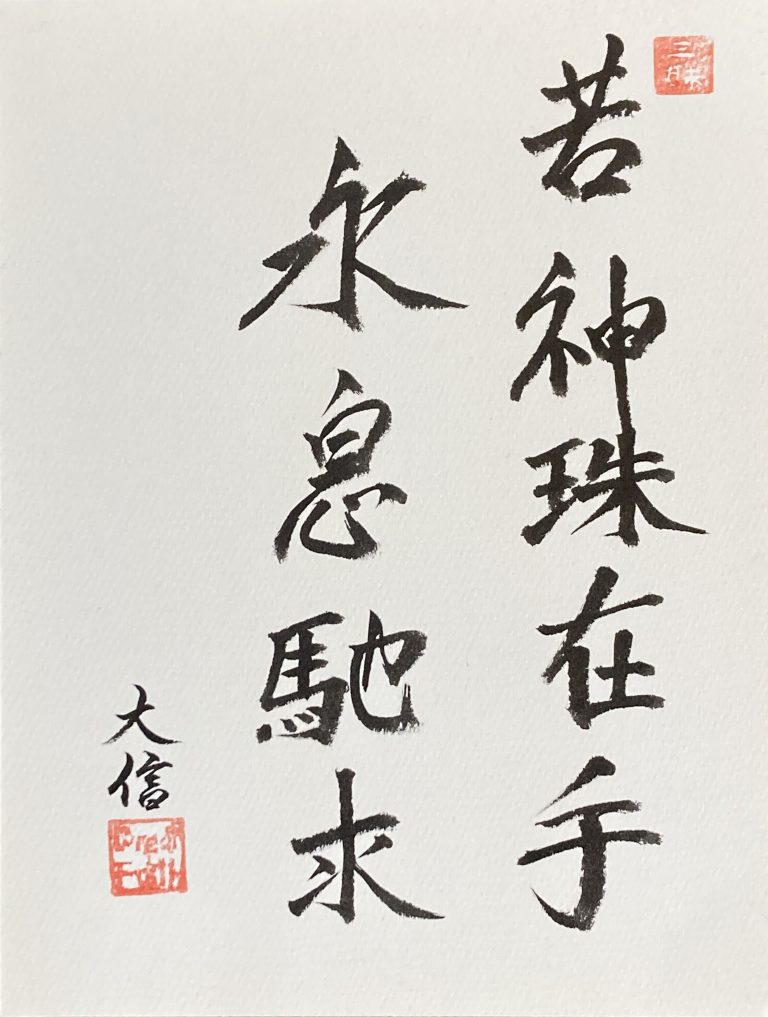
Neither blind faith nor total rejection is enough; even in Zen, doubt is part of the path.
A lot of people come to Zen because they have serious apprehensions about the religious path they grew up with. That was me. I thought Zen meditation was the answer to all my problems when I met my teacher. But my teacher never affirmed this idea. Instead, she said, “Zen doesn’t make you into a Buddhist. Zen aims to make us better at being ourself. If you are Christian, you’ll be a better Christian.”
Whoa! I didn’t expect to hear an affirmation of Christianity and of God coming from a Buddhist priest. For many people it seems almost heretical to doubt your faith tradition, or to find truth outside of it. As soon as you go down that road it’s as though you have “lost your faith.” So, we are presented, all too often, with only two choices when we start to have doubts about our faith: 1) Embrace it fully and never look back. 2) Reject it completely. Both these options, while important aspects of the spiritual journey, are not enough.
Both paths play into our own insecurities. For those who embrace their faith when encountered with doubt, there is a profound closed-mindedness that is easy to recognize from the outside. Such folks get heaps of criticism about being ultra conservative in their views. I’d suggest, however, that this stance is an important part of the spiritual path, not separate from it. It can be inspirational to meet people with such faith and certainty in a religion even when that religion may be highly criticized by outsiders. There is something to be said about sticking with something even in the midst of “fire.” There is the virtue of loyalty that is so often missing in our society. While criticism of any religion is warranted, respecting a devout person for firmly standing within their understanding of religion is also important.
Human development follows a similar kind of path. When we are children, we see everything in black and white. The words and admonishments of our parents are like God speaking to us. Parents teach us right and wrong, directing us for our own protection. Parents put up gates at the stairs, for example, so that the baby doesn’t tumble down accidentally. The gate is there to prevent the baby who is not yet ready to walk, from seriously injuring themselves. Just as we don’t disrespect babies for not having the ability to walk, we ought to be very careful about judging people who have firmly held religious convictions despite what may appear to us to be illogical. Those convictions may serve as a kind of “child safety gate,” and I don’t mean this pejoratively.
Yet eventually we learn how to walk, and the gate no longer serves its original purpose. In Buddhist terminology we say, “Once we get to the other shore, we can discard the raft that got us there.” We need a raft to get over to the other shore of Enlightenment. But once we are on the other shore, we need to let go of the raft. It’s served its purpose. (We might even need it in the future at some point to help others across). Strongly held beliefs serve a purpose for a person. We don’t know the kind of “troubled waters” such a person may be navigating through unless we get to know that person well.
The second path is far more common in modern times: the complete rejection of all religious paths. In its extreme form this may take the shape of addiction. The addiction has its purpose, though. The addiction fills the void in one’s life. The absence of feeling a connection to something greater than oneself, gets temporarily filled by the addiction. Excessive drugs, alcohol, and work are examples. There’s nothing wrong with these things in moderation. We are not unethical by choosing to use drugs, for example. What’s missing, however, is that innate, birthright of our continual connection with the divine or with love, or however you want to call it. We may feel we need to pay for something that was ours all along!
Many of us are implicitly taught that religion = certainty. As soon as some leaks are found in the raft, people “throw the baby out with the bathwater” without a second thought. I did that. If the religion has problems inside of it, then the whole thing must be wrong or have no relevance for my life.
This is part of the spiritual path, too, though. Rejection of religion is a religious path. It’s a start. There’s an acknowledgment of the importance of living our life without having the dictates of someone else to follow. These folks often have a hard time with the “rules” of a religion, and justifiably. If they are young, their body is telling them to seek out sensual pleasure or sex, but the religion says sex is bad outside marriage. There’s a disconnect between what the religion says and their physiological reality. They’ve chosen not to suppress basic desires and have, unfortunately, rejected religion in the process. Or, perhaps, their parents already rejected it for them, and they didn’t have the opportunity to make their own choice about it. In either case, while it’s a part of the path to reject religion either completely or in part, it stunts spiritual growth if we don’t (eventually) question that rejection.
There is another way to approach religion, however, that moves us to the possibility of deepening our understanding of the purpose of religion, and of a sense of meaning that goes beyond dualistic thinking. That is by giving primary attention to the things in the tradition that make sense and to disregard that which is not true to your own experience, regardless of what someone who calls themselves an “authority” says. Growth happens in “wrestling” with God, in questioning our ideas of God and purpose, and in having the confidence to respectfully doubt what the tradition has handed down to us, but to not completely abandon it under the guise of self-righteousness.
Even Zen Buddhism can be problematic in terms of not questioning authority. Yet we should question the authorities of the tradition, including Zen Master Dogen. Dogen says in his instructions for zazen, for example, “Do not doubt the true dragon.” This pithy saying in his “universal” instructions can be misleading. The “true dragon” is referring to zazen (or, perhaps, to a teacher). Should we never question or doubt the utility of zazen for our life nor how to do it? Nor his instructions?
The 16 Bodhisattva Precepts of the Zen path can also be problematic in some ways, and for us not to question them because we would be going against what is “good” and “ethical,” as if they were commandments, is falling into another trap. For example, the precepts say we should refrain from disparaging the Three Treasures – Buddha, Dharma, and Sangha, and from disparaging the wrongs of others. While the sentiment for such precepts is to keep our overly critical mind in check, sometimes it’s important to call out misbehavior in a sangha member. But for this, we need a sangha culture that does not punish people for speaking up about their misgivings nor about abuses of power.
In other words, even Zen, though it is a chosen path for most of us, needs to be critically evaluated and doubted. We need not enter the Zendo with blind faith in the attributes of zazen, the teachings, and the Sangha.
Furthermore, many people come to Zen from traumatic religious associations and need the space to doubt what they are being taught to think and act. Having sensitivity to this is part of becoming a mature sangha.
One place that I notice students having trouble is in distinguishing between the “rules” (or Zendo forms) of Soto Zen on the one hand, and ethical behavior (Bodhisattva precepts) on the other. The forms sometimes become conflated with ethics. So, for example, some new students may feel that if you don’t bow correctly upon entering the Zendo, then you will be punished in some way by a spiritual power, Buddha, God, or someone. Newcomers are presented with a host of instructions on how to walk, sit, bow, chant, and greet others. If they do these things “correctly” then they may come to feel they have attained some kind of salvation through these motions. If they do them “incorrectly” then they may act as though they need salvation, (I often listen to apologies for not ringing the bell correctly as if someone was hurt by their lapse of attention) or they outrightly reject the forms and never return to the Zen center again. This conflating of the Zen forms with more general ethical behavior such as “promote life,” “practice generosity,” or “be of service,” happens way too often and is sad to see.
A way forward from this conundrum is by seeing the forms as opportunities to deepen mindfulness. When they are not done “correctly” there’s no judgment involved. Rather, there is noticing an opportunity to generate mindfulness in that very moment. Bringing hands into shashu (folded hands), for example, is a way to call attention to what we are doing in that moment. It’s not a practice that leads to mindfulness. Rather, it is mindful activity (as long as it doesn’t get habituated and done mindlessly). We can use the shashu gesture as a way to become curious about our walking, our body, our feelings, and the external world, perhaps noticing something that we never noticed before. When practiced in this way, the forms are used as they were meant to be: to generate a collective mindfulness that has the possibility for true healing of the confused mind.
Lucky for us, doubt has always been an important part of the Zen path. It’s considered a positive mental state. Doubt has the power to raise the Beginner’s Mind. Doubt is promoted by the Buddha when he said in the Kalama Sutta, “Don’t do what I say just because I said it. Put what I say into practice to determine whether it is helpful for relieving suffering.” Then you can discard it if it’s not helpful. Doubts and questions should be brought forward in the process of investigating any Buddhist instructions that may be confusing or contradictory, or just don’t “feel” right. It’s alright to doubt the true dragon.

Heaven and hell are here on Earth; seeing interbeing in zazen turns this world into heaven.
The Way Courses Through Heaven and Earth
A lot of people associate religion with beliefs about where you go when you die. Many (not all) Christians, for instance, link good deeds and belief in Jesus with a heavenly afterlife. But even those who are not Christian, those that don’t espouse any religion, relate religion to belief in an afterlife. The difference is that they don’t necessarily believe it, they simply connect religious beliefs – Christian or otherwise – to a heavenly abode. What follows is a response to the second group of people – the non-religious – as well as to those entertaining ideas about going deeper into Buddhism.
Zen Buddhism is not immune to such concerns about afterlife. There’s the belief that we’ll return to this life after we die, just in another form, such as an animal, a plant, or maybe a human. There’s also references to going to the Pure Land which is codified in our liturgical dedications.
The difference between the more common thoughts about heaven and what Zen teaches is impermanence. Heaven is not a permanent place. The Pure Land is not permanent. Attainment of a special enlightened state of mind, too, is not permanent. Zen asks us not to get stuck in one absolute location. With study of the Dharma and the practice of meditation with a sangha and teacher, we can find further refuge not simply in a life beyond this one, but in the three treasures – Buddha, Dharma, and Sangha.
It’s okay to die in practice. When my teacher, Daien Roshi, was training in Japan, she asked her teacher, Daito Roshi, “What if I die here in these mountains?” Daito Roshi’s response was, “Don’t worry. You see all these pine trees that surround us? They have a blight. There will be plenty of wood with which to burn your body. We’ll recite the Heart Sutra for you.”
In the early stages of practice we care more about our individual lives, and we’re less aware of the greater life systems that surround us. As our practice matures, however, we become more concerned about the life systems and less so about our individual life. It’s not that the individual is not important. It’s just that we come to see ourselves as inseparable from everything and everyone. What happens “out there” happens to me. We just can’t ignore this.
At the present time we’re in a situation where life on the planet is seriously threatened, primarily by human beings. If the planet’s life systems are threatened, then so are we, not as individuals only, but as a species – along with the many other species that have already gone extinct in the last 100 years. Yet in our ignorance we don’t see this connection.
The most important thing we can do right now is to view life with the eyes of “Interbeing.” Worry about the future doesn’t help. Acting from a foundation of our profound connectedness with life is essential. It starts by changing the way we individually see. We meditate until our mind changes. When it changes, we continue to meditate to nurture that view, like growing new grass or a tomato plant. If we don’t continue, we’ll forget this insight and it will wither.
Once we establish interbeing, we move our awareness to our family and do what we can to bring peace, harmony and love to our children and parents. This is not an easy task. It requires tremendous effort. But it’s worth it. Without the foundation of a strong and caring family, how can we enter our jobs and be truly effective? The way we treat our co-workers reflects the way we treat our children.
Finally, as we commit ourselves to changing our minds from self-centeredness to one of interbeing, and of extending our influence in a positive way to our family, we come into alignment with The Way. We further cultivate Trust that The Way will move us to positions in society where we can make a positive impact on our world around us. Our job may not be perfect, but we start to see it’s essential that we play our particular role, however humble it may be. When we get lost or start to burn out, we return to ourself and to zazen, reaffirming that view of interbeing.
My great grandmother was not a Buddhist. She was a devout Catholic that immigrated in the early 20th century to the United States from Alto Fonte in Sicily. But her views were very similar to those of Zen. She said, “Life is what we make of it right now. We can create heaven or hell right here on earth.”
She is in alignment with the prayer of Jesus who said – “Thy Kingdom come on Earth as it is in Heaven.” It’s also in alliance with the story of Zen Master Hakuin and the Samurai.
Hakuin was asked by a Samurai, “What is Heaven and what is Hell?”
Hakuin asked, “What do you do for a living?”
The samurai said, “I’m a general.”
Hakuin asked, “What idiot made you a general?! You look more like a butcher to me.”
The samurai’s face reddened, he drew his sword from his scabbard and was about to slice Hakuin in two when Hakuin pointed at his now purple and shaking face, “That’s Hell.”
The samurai had an instant of recognition of the teaching. He put his sword away, his face totally relaxed, and he bowed to Hakuin saying, “I understand. Please forgive me.”
Hakuin pointed to him and said, “That’s Heaven.”
Heaven can be found here on Earth, and when we align ourselves with the Way, starting with the insight of interbeing in zazen, then this world transforms into the Pure Land of the Buddha or the Kingdom of Heaven.
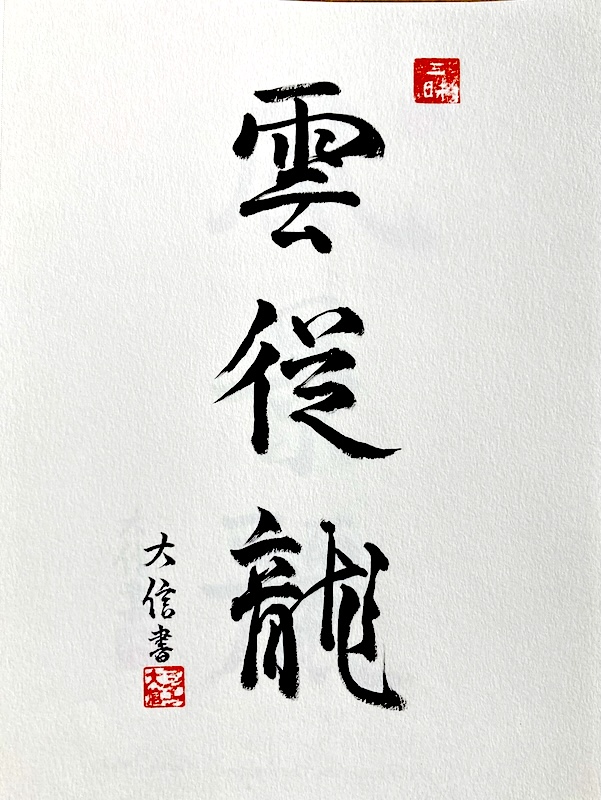
Like compost, our self-doubt and muck can turn into a jewel when we stay with it mindfully.
Self-doubt and a lack of confidence in the basic goodness of others seem to be perennial problems for many of us and for society as a whole. We doubt ourselves when we make mistakes or are called out for unskillful actions. Similarly, we have a hard time trusting our teachers, bosses, and political leaders. The wisdom of our parents or ancestors can sometimes appear shallow. So where do we turn?
Zen doesn’t ask us to get rid of these feelings as if they were problems, however. Instead, we study them, sit with them, and learn from them. In Zen, everything is practice, including our suffering. Zen’s basic premise is that everything is workable within our heart/mind, and not to turn away from the myriad ways in which we suffer.
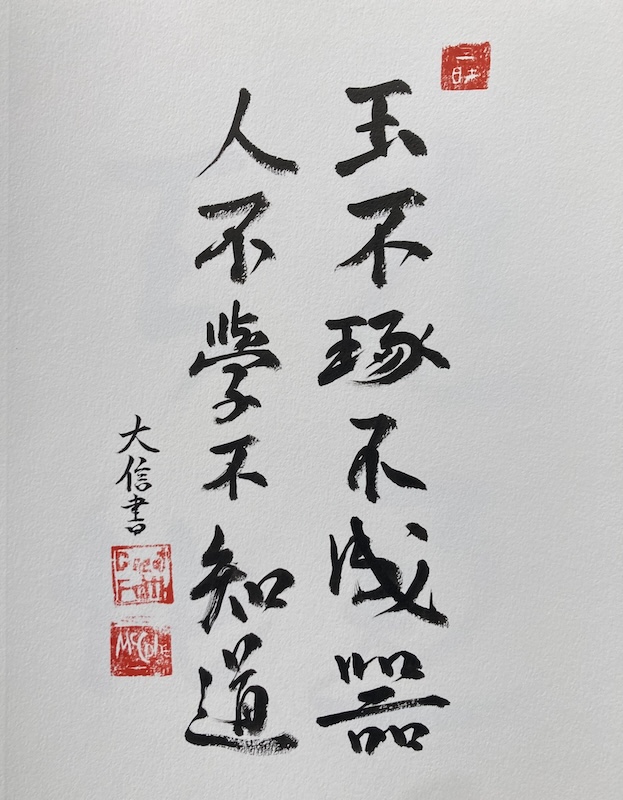
A Zen saying that brings this into focus is: 真玉泥中異, pronounced, “Shin Gyoku Dei Chu I.” It literally reads, “Real jewel mud center wonderful.” A more nuanced translation is “The true jewel wondrously appears in the heart of the muck.” Another possible translation is “The true jewel strangely appears in the heart of the muck.” While “wondrously” sounds more appealing in English, I prefer “strangely.” There is a strangeness that follows awareness of something valuable, like a jewel. For example, when digging in my compost I find black, rich, moist soil and wriggly worms next to rotted vegetables. It’s strange yet beautiful to witness this transformation of garbage into fertile soil.
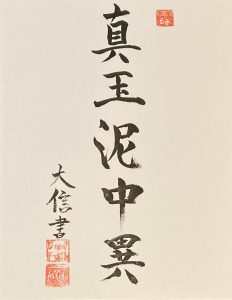
The muck of our lives is the last place we’d expect to see a “jewel” or something valuable, but there it is! In other words, if we stay with (not try to throw out) the negative circumstances of our life, and bring the additive of mindfulness (like adding soil to rotted veggies) we’ll come to notice something extremely valuable. Just as there are billions of microbes in the soil that can break down the veggies turning them into fertile earth, so too when we combine our mindful and loving attention to what appears to be negative, it transforms it into something useful.
The underlying worldview that gives rise to such concepts is important to notice, and can further deepen our understanding of Shin Gyoku Dei Chu I. A famous commentary on the first hexagram of the Yijing (Book of Changes) reads,
Like tones resonate together, like energies seek one another. Water flows toward moisture, fire moves toward dryness. Clouds follow the dragon, winds follow the tiger. Sages arise, and the ten thousand things take note. The heaven-rooted feel kin to above, the earth-rooted feel kin to beneath. Like this, each follows its own kind.
Translated from the Wenyen, one of the ten classical texts commenting on the Yijing. I’m indebted for this reference and translation to Nelson Foster’s, Storehouse of Treasures: Recovering the Riches of Chan & Zen (Colorado: Shambhala, 2024), 139.
The first part of this statement says the obvious: like gravitates toward like. Water flows towards moisture. If the ground is dry when there is a torrential downpour, the ground is incapable of absorbing the rain, and thus we have flooding. Water meets what is wet and is repelled by what is dry.
In the Zen poem “Sandokai” or “Harmony of Differences and Equality” we find a similar sentiment: “Fire heats, wind moves, water wets, earth is solid…. Thus with each and everything, according to the roots the leaves spread forth.”
This Zen poem and the preceding commentary on the Yijing are not just talking about the basic elements of fire, water and earth, but about human beings. Human beings who are happy gravitate towards those who are happy. Those who are sad likewise find resonance and attraction to those who are sad. The same can be said for any emotional state. The greedy gravitate toward the greedy and the generous gravitate toward the generous. We become more and more like the people we surround ourselves with and naturally move with them. We attract to ourselves those who are like us, just like water moves towards moisture.
Without the desire to awaken like the Buddha did as well as many other Zen ancestors, this process happens beyond our consciousness. We stay within certain circles naturally, within our respective silos of understanding and ways of being in the world. It’s difficult for us, without mindfulness, to see beyond our limited views because we evaluate the whole world through our tiny lens unable to appreciate other perspectives and ways of being.
The second part of the commentary on the Yijing reads, “Sages arise, and the ten thousand things take note.” This is a significant shift from the first part of the commentary because it is recognizing that when we meet someone of significant virtues – like Thich Nhat Hanh or Joanna Macy – something in us resonates deeply with their virtuous conduct. We see our own potential. We see that we, too, are capable of greatness.
When we look at the world in this way, we can see that even though our present state of mind may be one of self-doubt and low self-esteem, we are not fooled by our mental state. We go on, knowing not to be distracted. We find our jewel right in the center of the muck of our life. We do this by meeting teachers and meditating with teachers, not just by ourselves. Like fire gravitating toward dryness, we go to the teacher so that our own fire and zest for life lights up.
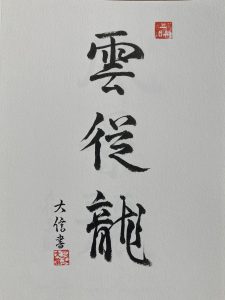
The middle part of the Yijing commentary reads, “Clouds follow the dragon.” The dragon, as I understand it, is symbolic for the great mystery which we circle around like clouds in a tornado. Something very strange gave birth to the insentient within us. Earth, water, fire and wind becomes sentient in the form of human beings and other creatures. We humans are the aspect of the earth that thinks, that is conscious of itself, that is capable of self-reflection. We are not independent entities floating about without a purpose or an anchor. We are, rather, bound together by a numinous power beyond our comprehension.
The Chinese characters for, “Clouds follow the dragon” are 雲従龍. The second character, 従, could have several possible translations. Some of them are as follows: to obey, to serve, to observe, to yield to. If we live for something greater than ourselves, and align our activities around that “dragon,” then we are on the path to sagehood. The muck, while a nuisance at times, doesn’t run us. We don’t revolve around the muck. We revolve around the mystery, or the strangeness of our life. The key is in recognizing that “dragon” in our life. Through Zen practice we can observe, marvel at and even, I dare say, obey the dragon. Zen Master Dogen writes in his Universal Instructions for Zazen (meditation), “Do not doubt the true dragon.” The dragon is always there. Are we mindful enough to recognize it everywhere?
While ideas of dragons may seem foreign to my western reader, I close with this poem by the great Christian mystic, Rainer Maria Rilke (1875-1926):
I live my life in widening circles that reach out across the world. I may not complete this last one but I give myself to it. I circle around God, around the primordial tower. I’ve been circling for thousands of years and I still don’t know: am I a falcon, a storm, or a great song?
Rilke, Rainer Maria. Anita Barrows and Joanna Macy, trans,1 Rilke’s Book of Hours: Love Poems to God (New York: Riverhead Books, 1997), 48.

An expanding universe illuminates Dogen’s Being-Time: the Big Bang is still happening now.
In 1924, exactly 100 years ago, Edwin Hubble peered through the darkness of the night sky using the most powerful telescope on the planet and discovered something that astonished the scientific community, including Einstein. Hubble was the first human to witness not just that there are multiple galaxies like our Milky Way, but that they are moving away from each other! This observation forever changed the way we see ourselves in relation to the world.
Prior to Hubble’s discovery we saw the universe as a static place. With Copernicus and Galileo that understanding began to shift about 500 years ago when we learned that Earth is not the center of the universe. However, we still largely understood ourselves as living in a universe that has always existed, relatively unchanged, from its inception.
Cosmogenesis is the revelation coming out of modern science that says the universe is not a place but an ever-evolving mystery that continually creates and recreates itself. While this is an amazing discovery, do we see it? Can we feel cosmogenesis in our bones? Most likely not, unless we take time to study this revelation and then meditate upon it.
What world are we meditating in and on? An unchanging static universe?
Are we sitting in a world of constant change? This is how the Buddha described it – all things are in flux. Nothing is fixed. Everything is impermanent and interdependent.
Are we sitting in a world that has an origin that reaches back 14 billion years to a singular point?
Our answer to these questions directs how we experience zazen!
The universe is expanding. That’s what Hubble saw through a telescope. This completely flies in the face of the cosmology that was most convincing at that time, namely that the universe is fixed, and that we live on a planet that has been around from the beginning in a Universe that has always been the way it is.
And, while the Buddha’s view is similar to the view of an expanding universe, the new understanding from science boggles the mind. We can get our heads wrapped around constant change, but not as easily around cosmogenesis, namely that the universe is not a place but a continual creative process that came from somewhere and is going somewhere, that is NOT directionless or pointless.
Charles Darwin, even earlier than Hubble, theorized the idea of evolution, that the creatures on earth, including us humans, are not fixed forms, but have evolved over vast periods of time, beyond what we can easily imagine.
Darwin, Hubble, and other scientists have rocked our worldview – literally and metaphorically! We’ve learned that we live in an expanding universe and that the human species is part of a world that is evolving, and that we – Humans – are also part of that evolution!
Pierre Teilhard de Chardin writes, “Has evolution … stopped in the human being …? Not at all. But without compromising what could be continuing to develop imperceptibly in the depths of nervous systems, since that date evolution has freely overflowed its anatomical modalities, to spread, or even perhaps emigrate, by what is most vital in itself, into the individual and collective zones of psychic spontaneity.” (p. 140 Human Phenomenon)
What world are we meditating in? Cosmogenesis and evolution are not simply thoughts among other thoughts that we need to let go of. They’re not simply more data or concepts. Rather, to see these processes active here and now is to live in a world that is strikingly different than the static world our ancestors assumed, and this has ramifications for our Zen practice.
Seeing through the eyes of cosmogenesis can help us understand, or perhaps interpret Dogen’s writings. Uji – “Being-Time” – hints at cosmogenesis. Knowing the empirical data of an expanding universe can give us great confidence in what Dogen intuited and wrote in Uji in the 13th century and can enliven our feeling for the expansion. The following quotes are from Dogen’s “Uji.”
“For the time being here means time itself is being, and all being is time.”
Time only comes into existence with being, and they are inseparable. There was no such thing as time before the big bang. Time came into being with the primordial flaring forth. It’s hard for us to see this because we’ve placed so much stock in clock time. But Dogen didn’t live in our world. He saw time in nature, in light and darkness, as well as in life and death, perhaps not too unlike our ancestors.
“Because the signs of time’s coming and going are obvious, people do not doubt it. Although they do not doubt it, they do not understand it.”
We need to bring doubt to our understanding of time. Time is not separable from being. There is no such thing as objective time. This is a human fabrication. While clock time is a useful tool in helping us organize our life, it also creates tremendous stress trying to squeeze ourselves into often unnatural rhythms. Consider how our ancestors moved and lived according to the seasons.
“The way the self arrays itself is the form of the entire world. See each thing in this entire world as a moment of time.”
Can we feel the world moving around us? Do we feel that this world is our Self moving, that we are the whole world, each one of us? My teacher, Daien Roshi, often said, “the only way we can see how much the world moves is for us not to.” If we’re really still, we can feel that movement. At this moment we’re moving 90,000 miles per hour around the sun. Can we feel it? Maybe we need to put our seatbelt on! The seatbelt is metaphoric for the Dharma, the teachings of the Buddha that help to ground us in the reality of impermanence.
“Know that in this way there are myriads of forms and hundreds of grasses [all things] throughout the entire earth, and yet each grass and each form itself is the entire earth. The study of this is the beginning of practice.”
Wow! The universe sets out in the Big Bang, everything is expanding away from everything else (the center is everywhere), and what happens in the human (itself a process of the universe) is that the universe becomes aware of itself. Thus Dogen says, “each grass and each form itself is the entire earth. This is the BEGINNING of practice.”
“When you are at this place, there is just one grass, there is just one form; there is understanding of form and beyond understanding of form; there is understanding of grass and beyond understanding of grass.”
Seeing things from an objective perspective misses the point. When we look at the universe objectively, we have not entered into reality completely. We become an outsider looking at an object that is not us. We’ve left ourselves out of the observation, as if this were possible. Zen practice, however, is about dissolving the subject-object dualism and entering fully into life as it is, including ourselves.
“Each moment is all being, each moment is the entire world. Reflect now whether any being or any world is left out of the present moment.”
We’ve got to enter into cosmogenesis, a worldview we’ve just learned about 100 years ago, but haven’t nearly digested. That’s going to aid us to see what Dogen says (and understood intuitively) that, nothing is left out of the present moment.
The big bang is not just something that happened 14 billion years ago, it’s continuing right now…. BOOM!
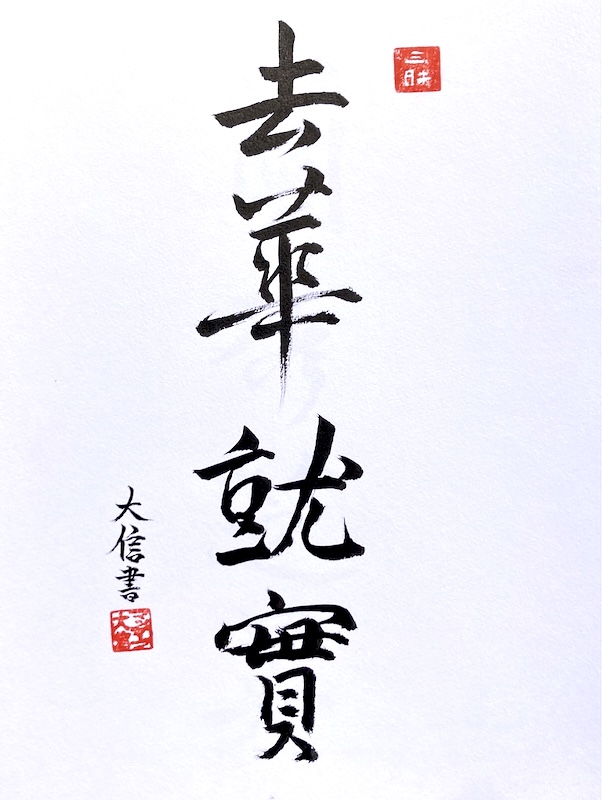
Enlightenment is the start of practice: as flowers fall, the universe awakens to itself as us.
In pre-modern times, it was a given that fruit would be local and eaten in season. It would be unheard of to have blueberries in the winter. These days, however, eating food that is locally grown and in season is truly precious and rare, at least where I live. I had the recent good fortune to taste mouthwatering strawberries from my mother-in-law’s backyard in June, after having eaten non-local, out-of-season strawberries through the late winter and early spring. While it’s amazing what technology and modern transportation has done for us, there was no comparison between in-season and out-of-season strawberries. Though my mother-in-law’s berries were smaller, they were packed with sweetness, unlike the others that tended to be dry and borderline sour.
In my own garden, the grapevines are bursting with bundles of tiny green bulbs that will eventually become grapes later this summer. My aronia berries (native to the Midwest) are abundant too, and though these black-colored berries are astringent, they are chock-full of antioxidants and give a beautiful deep purple hue when blended with other fruits in a smoothie.
A sangha member gifted me two dwarf fig trees, and I eagerly anticipate their fruit. They remind me of my recently deceased father. Dad planted what became a gigantic fig tree in his own yard that continues to give. My pear and plum trees have been struggling to produce flowers the past several years. I’m grappling to understand why. No flowers, no fruit, unfortunately.
Flowers and fruit also take on symbolic meaning in spiritual writings, such as Zen Master Dogen’s ‘Genjo Koan,’ where he writes, “Flowers fall even though we love them. Weeds flourish even though we dislike them.” “Flowers” may represent spiritual experiences that eventually fade away with time, yet we chase after the past, hoping to preserve the good times. My teacher, Dai-En Roshi, often warned us not to chase after previous experiences, saying, “Do you have the experience, or does the experience have you?” This is important to keep in mind as we enter a world where the traditional four seasons continue to lose their integrity. With the climate becoming unpredictable, we may find ourselves yearning for the past when nature was in greater balance. But here we are.
Creating an “Ecological Civilization,[1]” one where human beings allow the more-than-human beings to exist and even flourish, is now imperative. We Buddhists vow to accomplish the impossible because it gives us the strength we need in difficult times. We don’t know what the future holds, and there’s no going back to the past. Now, we can’t afford to forget the four great vows. These great vows provide the kind of vision that humanity needs to rise to the challenges that face us for generations to come.
This saying, “Flowers fall, fruit emerges,” reminds me that enlightenment is not the endpoint of my practice, but the beginning. Seeing the universe as Self is enlightenment, and it is also our practice. Moreover, enlightenment is not the purview of a few select people; it’s up to ordinary people to attain, and it’s a means to usher in an ecologically sensitive era that sees humans as one among many species, with all species having an integral part of life that goes beyond human use.
We begin practice when we are gripped by the self that sees itself. When we look out at the hackberry trees, the chipmunks, the clouds, the sun, and the fox and see them as our ancestors, as what has given birth to us humans,[2] we are gripped by our self. The squirrel that sees you is nothing less than your evolutionary ancestor viewing its descendants. From the moment of Enlightenment onward, it becomes our responsibility to practice that insight in everyday life.
Just as an infant lacks the ability to form coherent words to communicate with her parents and lacks the intellectual capacity to articulate their relationship with adults, we humans are similarly like infants in relation to the Earth and the infinite array of species. Our groping to understand ourselves in relation to the universe, too, manifests as the wondrous Dharma.
Our daily practice, both in the meditation hall and in the world, can be seen as the fruit of an initial Enlightenment experience. However, this fruit must always remember its flower. We must recall that humans evolved through processes spanning billions of years—no flower, no fruit. The flower gives birth to the fruit, which is an ongoing awakening fostered by skillful, everyday, moment-to-moment practice.
This everyday, ordinary practice-enlightenment (fruit-flower) has a rippling effect around the planet where we humans activate our role among all the other species, as that aspect of the universe that has the ability to reflect on itself, or, as Dogen Zenji puts it in ‘Genjo Koan,’ “That you go forth and experience myriads of things is delusion. That myriad things come forth and experience themselves is Awakening.”
[1] For more on Ecological Civilization, see the embedded link. Dr. Mary Evelyn Tucker, professor emeritus at Yale Divinity school articulates what is already happening in various countries in Asia.
[2] It may sound strange to say that foxes and other creatures gave birth to humans. I’m speaking from a deep-time perspective. Modern humans evolved more recently on our planet – some two to three hundred thousand years ago. It’s thanks to the creatures that have preceded us that we exist. From this perspective, they “gave birth” to us.
Zazen is already perfect, yet eight life habits, from food to play, help us sit more fully.
"You are perfect as you are, and there's plenty of room for improvement."
Shunryu Suzuki Roshi
I hate thinking about what I need to do to improve myself, because there’s too much to do! I’d rather focus on zazen and the teaching that practice and Enlightenment are one, that when I sit and meditate, I am Buddha. Or that when I sit zazen all the precepts are held perfectly. In other words, in sitting zazen, no ethical mistake can be made.
Zen also teaches that the experience of the person doing meditation for thirty years is no different from a person who just started practicing meditation. In other words, there’s no gain to be found in practicing zazen. Zazen affirms that we are perfect just as we are, and the more that we sit and meditate, the more we can see the truth in that.
But Zen practice doesn’t let us rest in our innate perfection. Moreover, we often don’t “feel” like we’re perfect. For those of us who have studied the Buddhist precepts, we know how difficult they are to live by. If you study at a Zen temple, there are all sorts of practices that you’ll be introduced to that demand study, learning, and mastery. This includes such mundane activities as washing the face before morning meditation, brushing the teeth, and using special bowls for eating meals. The quality with which we practice the precepts and these other daily activities in our life will influence the quality of our meditation practice.
At Its heart, Zen is about self-cultivation, about getting better about how we do anything. It’s about taking the best care possible of what we’ve been gifted. It’s about improving our functioning in the world we live in. When it comes to zazen, it’s about taking good care of our posture, and not attaching to anything.
If we want to grow a garden, we can’t just “do nothing” in an absent-minded sort of way. We need to think about the seeds we want to plant, where we want to plant them, how we are going to plant them, and then how we are going to take care of them once planted. Zen practice is no different than growing a garden.
My Zen teacher did not say, “just sit there.” She gave detailed instructions of how to comport my back, legs, arms, hands, fingers, eyes, and tongue. She gave instructions on what to do with my mind. “You can enjoy your sitting. You can enjoy your breathing. You can enjoy your life.” These were her instructions, as transmitted to her by her teachers. This is Mahakashapa’s subtle smile. However, if we do an intensive meditation retreat (sesshin) we might question whether we can actually enjoy our practice, especially when our back is in pain, our legs are sore, and we just want to go to sleep. The point of sesshin, though, is to turn our mind towards the reality of our life so that we can wake up to what really matters.
For many people who come to meditation practice, though, the instructions on what to do with your body and mind are not enough because we are imbedded in social networks and a culture that influences how we feel in our body and mind, how we perceive the body/mind, and how our perceptions influence what is perceived. We can’t expect the Zen center or our practice to unilaterally affect change in us without simultaneously working on other fronts of our life.
What follows are points that I have found through my own personal experience to have helped me not just optimize shikantaza (seated meditation), but to live an overall better life. I say this with the caveat that these are points that I have found to help, and I would encourage my reader to explore these points for themselves and see if they work for you. These points are not made to shame anyone for not doing enough, but to inspire you to look for ways to do more to lessen the suffering in your life and to increase your overall sense of well-being, as that is the heart of the Buddha’s message to humanity.
Furthermore, keeping these points in mind does not guarantee success in perfect health and happiness. They are guidelines, and as our life continually changes, we need to reexamine our present habits from time to time to make sure they are realistic for where we are. There is a dynamic balance we all need to keep in mind, and the relative attention given to these points should change depending on circumstances.
The Points are:
Discussing such subjects is dangerous. Merely thinking about exercise and nutrition induce shame in many of us. So, please take what I write with a grain of salt and do the best you can within your own circumstances. This writing is only to encourage a “beginner’s mind” with regards to a subject that is repeated all too often in other contexts.
We’ve heard the need to pay attention to these things by our doctors and by society at large, but so many of us fail miserably at them, as attested by an epidemic of obesity. We might feel that we don’t have enough money or time to eat well and to exercise. But if we really begin to pay attention to the present moment, we’ll see that we can find many ways of exercising that don’t require us to go to a fancy gym, and many ways to eat that don’t require purchase of expensive organic foods. For Zen practice, exercise and nutrition are an integral part to the way one lives in a temple, not something extra that we need to make time for. Learning how to integrate exercise without separating it out from the rest of our life is key. The same is true of nutrition. When it comes to nutrition, I won’t be talking too much about what to eat, as important as that is. I will, however, discuss how to eat, based on the teachings of Zen Master Dogen.
My own teacher, Dai-En Roshi, was formerly a professional classical ballet dancer. She has a deep appreciation for the body, and was enamored by the way she and others move through space on stage and in front of an audience as a ballet professional. Until her mid-thirties she danced regularly, practicing several hours a day. Her lifestyle dramatically changed soon after becoming a nun, yet she brought mindfulness of the body, as learned in ballet, into action in monastic life. When I first met her, I will never forget how she comported herself, particularly her spine, and the way I felt in her presence. Her effortless attention to the detailed movements of her body when bowing and when walking, as well as when sitting to meditate, was a sight to behold, like witnessing the Buddha on the verge of attaining Enlightenment under the Bodhi tree. She was 100% present to her environment.
She lived to dance. Her job allowed her to do what she loved. She prioritized dancing and didn’t let anyone distract her from that love. As a thirteen year old, her parents tried to dissuade her from becoming a dancer, and they contrived a plan to do so by their minister. One Sunday the minister told the congregation that, “dancers go to hell.” When Dai-En Roshi heard this she never returned to the church again. Though her parents wouldn’t pay for her lessons, she found ways to earn money so that she could dance.
This may be an extreme example of taking care of the body through exercise, but I share it to inspire us to not make excuses. Where there is a will, there is a way. If the will is not there, we won’t do it. Exercise, and all of the 8 points for that matter, needs to have a deep-seated desire at its foundation.
Dai-En Roshi’s teacher, Noda Daito Roshi, also had a very body-based approach to Zen. He practiced shorinji kenpo, a Japanese form of kung fu. He played taiko drums and encouraged the formation of Taiko groups. Taiko drumming is physically oriented and requires not just muscle strength, but also cardiovascular effort. Moreover, Daito Roshi has a multi-acre garden on the temple grounds that grows all sorts of vegetables. He once told me that they rarely go out to eat, and that if someone wants to eat something at his temple they need to go out to the garden, pick a vegetable and cook it up themselves. There’s a saying in Zen, “A day without work is a day without food.”
If you were to visit a Japanese training temple you would probably not see monks doing meditation unless you arrived well before dawn. You would probably witness them doing physical activities such as cleaning and cooking or bowing. This video of Sojiji, one of two Head temples of Soto Zen in Japan, gives examples of the life of Zen monks.
But most people reading this will probably never have an opportunity to train like a monk in a temple. Therefore, exercise needs to be fun, age-appropriate, and sensitive to one’s health history or any limiting conditions, otherwise it won’t be long lasting. What is it that helps you move your body in a way that is enjoyable? Dancing? Running? Swimming? Volleyball? Making the time each day for some form of vigorous movement – for most adults that’s a minimum of 20 minutes – can release loads of pent-up energy, a consequence of our already sedentary society, not to mention the discharge of the endorphin dopamine that gives us that feeling of a natural high.
Historically, monks and nuns walked great distances before sitting down to meditate. They were physically active. Monks in Japan spend a good deal of their days cleaning – scrubbing floors, digging ditches and other manual labor.
In 1994, before the advent of the internet, I had been swimming almost daily for several years. When I learned there was a meditation teacher nearby, I walked to the place she was and then I sat down. My point is that today, we find meditation by sitting down and looking at a flat screen. We don’t have to move our bodies to learn anything. We read some words and our bodies are left out of the equation, as if what we do with them prior to meditation is irrelevant.
It’s thanks to the fact that I was physically active not only immediately prior to my first meditation experience, but that I had been swimming daily for years that allowed me to sit with a certain degree of stillness.
I encourage whenever possible a moderate degree of exercise prior to a period of sitting. Meditation practice can be, if one so desires, incorporated into one’s exercise routine, perhaps just five minutes at the end of exercise, and to cool down. Meditation can be a way to down regulate one’s emotional state especially after stimulating the sympathetic nervous system through exercise. In this way the sympathetic and parasympathetic nervous systems come into balance.
“We are what we eat.” This cliché is often invoked but seldom understood, because if it was, people would look more closely at the relationship between food and mood. While I’m not advocating for becoming vegetarian, we can’t expect to eat a half a pound of beef and then sit quietly in meditation for 30 minutes. Red meat gives very sedentary people much more energy than they need even if they don’t have a sitting practice. There’s a reason why the Brahma’s Net Sutra forbids the consumption of meat. A vegetarian diet (not vegan) helps a practitioner to calm down, and also assists in the development of compassion towards all living beings.
Yet, the original Buddhist precepts don’t forbid monks from eating meat. They only forbade monks from eating meat if it was expressly killed for them. But this was in a society and in a time where the monks were totally dependent on lay practitioners for food offerings. The monks were forbidden to cook anything or cultivate the ground. In our times, most of the Zen monks I know don’t live the way monks did in the time of the Buddha, or if they do, they do so in the spirit of the law. Some grow their own food, many have jobs outside of a temple, and some have families to support. They are just like any other person in society that has to work for their food. They can’t depend on begging for their sustenance the same way the Buddha did in ancient India.
Because many if not all Zen monks go out to a grocery store to purchase their own food, they are fully responsible for the choices they make. For years I worked as the Tenzo, Head Cook, at the temple I trained at. I had the temple checkbook and it fell on me to purchase the food we needed for retreats and daily living. As Zen practitioners, keeping the Bodhisattva Precepts in mind, we need to consider how our food was processed as we make choices at the grocery store. In our meal chant we recite, “Innumerable labors have brought us this food. We should know how it comes to us.”
Where does our beef come from? Our chicken? Our vegetables? Our fruits? Our grains? Can we trace it back to its origins and learn something about how what was once living was treated during its life and before becoming food for us? How do we feel about what we learn? Is there any connection between how an animal was treated during its life and how we feel after eating it? Can we look at the food in front of us – whether it’s meat or vegetables, or fruits, or dessert, with the eyes of the Dharma?
However, something must shift once the food is on our plate and we’re about to eat. While there is the practice of noticing where food comes from, in the end we may as well say that it comes from celestial beings, because if we look deeply enough the source is unfathomable. Thus comes a point where we stop noticing the source and simply eat. Letting go of the source, how do we eat the food?
Zen Master Dogen wrote, “Just let Dharma be the same as food, and food be the same as Dharma.” To equate the physical manifestation of food with the teaching of the Buddha itself is to give it the highest respect. This is a challenge to Zen practitioners living in modern day America because we have an unprecedented abundance of food, so we don’t think twice about throwing it away. Would we treat a book on the Buddha’s teaching the same way? Would we throw away a teacher (metaphorically speaking) the way we would throw out the extra green beans on our plate? In our consumerist culture it’s easy to treat people like things to be used, and once done, there’s no relationship. We need to be careful on this point. The way we treat food is a mirror of the way we treat each other, if what Dogen says is true.
If the food is already on our plate, regardless of how it got there, as important as that process is, there’s really only one attitude to express: gratitude. There’s a Zen saying, “A monks mouth is like an oven.” In other words, we don’t judge the food that we’ve been given to eat. Regardless of how “pure” it is or how it came to us, the fact that it’s in front of our eyes is profound. Yet, we are often highly critical of the taste of the food, or how it was prepared, or where it came from. Again, food is the Dharma, and the Dharma is food. Yet how often do we think of Dharma as something a teacher says, or words written in a book? Can we see the plate in front of us as filled with the Dharma?
Practice in the context of food has to do with noticing our preferences, our likes and dislikes, and eating everything before us with some degree of gratitude. We should try to feel a sense of gratitude for the food and verbalize that gratitude to those who prepared it and to those beings who gave their lives for us. If we like the food, that’s extra. The stomach refuses no nutrition.
In the same way that we choose what to purchase at the grocery store, we also choose how much food lands in our bowls. The Zen practice is to eat everything we’ve taken so that nothing is thrown out. A lot of people struggle with this when they first practice eating Zen style with oryoki (Zen bowls). The word “oryoki” translates as, “enough.” We do our best to take only what we need, and not more. There’s a Japanese saying, “Hara hachi bu.” It translates as, “stomach 8 parts.” It’s what people say when they are full, but not over full. 8 parts means that our stomach is filled to 8 parts out of 10. We try our best not to over eat, and to leave a little bit of space empty.
Zen eating is a challenge because many of us are not used to listening to when we’ve had enough to eat, and we’re also accustomed to scraping uneaten food off our plate and into the trash. In Zen eating we don’t do that. What we take we are responsible for finishing. Every morsel of food is scraped out of the bowl and into our mouth. The bowls are washed with water, and that rinse water is also drunk. This is the way we demonstrate our gratitude for the food.
This may sound extreme, but we have to remember that even in modern times there are many places and people that don’t have enough food to eat. My own teacher suffered from malnutrition in Japan in the 1970’s. To completely eat our food, regardless of our preferences, is to embody an awareness of those who don’t have enough food to eat.
However, it’s tricky to teach this. We also need to be sensitive to the many people who come to a Zen Center in the United States who may not be aware of this gap – between the haves and have nots – and not to shame or guilt them when it’s brought to their attention. Shaming people into eating everything on their plate is not only unskillful, it can create a lot of suffering unnecessarily. Everyone has their own time frame for waking up. While Zen can facilitate that awakening, forcing it may prove counter-productive in some cases.
Buddha was an adept yogi of his day. He knew all the postures of that time and settled on four: sitting, standing, walking, and lying down. Modern day yoga is the combination of Indian philosophy including the wisdom of the Upanishads, of ancient physical postures used to assist yogis to sit more comfortably in meditation, and of British calisthenics. The Yoga Sutras are a compilation of pithy statements that some scholars believed were inspired, in part, by Buddhism. If one were to read these sutras, they would not know the difference between Buddhism and Yoga.
Yoga Sutra 1.2 reads, “Yogas Chitta Vritti Nirodhah,” or “Restraint of the modifications of the mind-stuff is Yoga.” This sutra is referring to the fact that the mind is originally calm, and it is our thoughts that make it otherwise. The sutras go on to describe the way the mind works and how to return to our original peaceful state. The only thing in the sutras that give a hint of yoga as we understand it today is one word: asana. Asana means “posture” and is used liberally in modern yoga classes. But in the sutras it is referring to only one posture: sitting upright in meditation in order to observe the mind.
Zen is a form of Yoga. If Yoga is defined as a technique to bring the mind back to its originally peaceful state, the Soto Zen practice of Shikantaza fits right into this definition. Shikantaza is sometimes referred to as the “method of no method.” One might argue that there is “no method” or technique in Soto Zen meditation, as you “just sit.” You don’t try to do anything with your attention. I would argue differently. Shikantaza is restraining the mind, just as Yoga Sutra 1.2 reads. However, whereas the Yoga Sutras give the practitioner multiple options for possible focus, in Shikantaza we restrain the mind from choosing any particular object of meditation, be it the breath, the body, thoughts, the environment, etc.
In both the Yoga Sutras and Zen Master Dogen’s “Universal Instructions for Meditating” we find an emphasis on correct posture. Dogen asks us to put our legs in either a full or half lotus position, to sit upright, and to exhale fully. These are yogic techniques. Asana, in the Yoga Sutras, was often assumed to mean a lotus posture, although the Yoga Sutra doesn’t specify the form. It simply defines asana as, “any comfortable steady posture.” But the key is finding a comfortable and steady position to maintain. For most of us, that’s impossible for longer than a few seconds.
This is where Hatha Yoga enters the scene. Yogis found difficulty in maintaining comfort and ease in their posture. The theory developed that this is due to toxins in the body. They developed the hatha yoga postures as we know them today as a means to rid the body of physical toxins so that they could maintain comfort and ease in the body. Here’s where Yoga, as it is understood today, can be of benefit to our Shikantaza practice.
In Japanese Soto Zen training monasteries it’s expected that one sits in either full or half lotus. Many people can’t do this, so they have to find a way if they want to train. My teacher insisted that I learn how to practice zazen in full or half lotus. She knew of a monk who tied bricks to his legs in order to get his knees to go down in a lotus posture. She herself struggled with one knee up in the air for several months until her hip muscles softened enough to allow the knee to come down.
Her teacher, Noda Daito Roshi, was asked to be the training master at Sojiji, one of the two main temples for Soto Zen in Japan. This was just after he was in an accident and on crutches. He refused the job because he wasn’t able to sit full lotus. Itabashi Zenji, the then Abbott of Sojiji didn’t accept his refusal and told him, “You can heal while you teach.” So Daito Roshi looked for ways to sit in full lotus. He eventually discovered that if he reversed his legs – put the left foot on the right thigh first – that he could sit full lotus without a problem.
In American Zen temples there is no insistence on sitting full or half lotus for zazen. While this makes good sense, something got lost. Many people come to Zen practice with the same challenges the rest of our society has in terms of poor posture from years of sitting on comfortable chairs. There’s nothing wrong with sitting on comfortable chairs, it’s just that they prevent the muscles of the back to become strong. Until the 1950’s Japanese society largely didn’t use chairs. They sat on the floor without spinal assistance to sitting upright. Nowadays most Japanese struggle just as much as Americans in finding good posture when meditating, due to the introduction of chairs.
It’s not necessary to become an adept Yogi of modern times to practice zazen. However, I can’t overstate how important it is to learn how the body functions in meditation – the spine, the hips, the knees, the shoulders, the neck, the head, and the breath. Fine tuning our awareness of these physical aspects of our posture is absolutely essential. While regular attendance of yoga classes isn’t everyone’s cup of tea, still, paying loving and mindful attention to the body can’t be ignored. The Buddha did that. Dogen writes about it in his universal instructions.
Just sitting isn’t going to happen magically without taking time to learn about posture. My teacher often said that zazen is like using a butter knife to carve an ice sculpture. We have to develop great patience and a deep commitment to constantly working at it.
Like exercise, meditation can be incorporated into yoga, usually at the beginning or the end of a class.
The Integral Yoga that I practice and teach has basically 7 parts to it:
When I teach, I encourage people to focus on their own physical experience as opposed to looking at my body and attempting to copy what I do. Focusing on our own experience means that we listen to how our body is feeling from moment to moment and adjust accordingly. When we experience pain, such as a sharp or pointed feeling in a joint, that is probably a sign to back off a bit. If we listen to our body, it can be our teacher, letting us know where and when to push ourselves and when to back off.
I also encourage deep relaxation throughout the class. It is through relaxing the body that the muscles naturally stretch. Forcing them to do so is counterproductive. Moreover, through the more gross yogic postures we are studying our self and becoming sensitized to the way our body feels. This is an especially valuable tool to have while studying the self in zazen.
Zen Master Dogen says in his “Genjo Koan,”
To study the Way is to study the self.
To study the self is to forget the self.
The study of the self through yoga is never a selfish practice. In the process of studying the self we are letting go of self-consciousness of our body. Self-consciousness is one of the biggest impediments to self-improvement as one becomes hyper-judgmental of their body and may have unrealistic expectations. Rather, the more tuned into our body that we become, the greater our self-confidence becomes (regardless of our image), and the clearer we are about who we are and what we need to do in this life. It’s never a waste of time to practice yoga.
We underestimate the value of getting a good night’s rest. However, when we can sleep well, we feel refreshed and clear-headed at the start of the day. It’s absolutely essential that we practice good sleep hygiene. This means we develop rituals at the end of the day that help us to down-regulate and to open the window for sleep.
I’ve found, for example, that watching action movies at the end of the day often stimulate me, as does vigorous exercise. If I’m trying to stay awake, then that’s fine. However, if I make a habit of watching something exciting in the evening I inevitably feel tired the next morning, as it negatively impact my ability to rest well.
Personally, I’ve found it more effective to read a paper book (as opposed to an online book) for 30 minutes prior to going to sleep, as reading the printed word takes mental energy and helps me to feel tired. Sometimes I’ll also make myself a cup of hot tea like chamomile that induces sleepiness. I share this not because I think everyone should follow what I’m doing, but only to encourage others to look at their own behavioral patterns around sleep, to study themselves and how refreshed they feel the next morning, and to connect evening rituals with morning vitality, and morning zazen.
Our first chant began the moment we exited the birth canal—a raw, authentic cry of the world. Since then, we’ve been refining it, striving to harmonize with the sounds of all beings. The formal practice of chanting consciously polishes our cry, transforming our voice into a healing balm.
The first chant in a traditional Soto Zen morning service is the Avalokiteshvara Bodhisattva chapter of the Lotus Sutra. Avalokiteshvara is the Sanskrit name; in Chinese, she is called Guanyin, and in Japanese, Kanzeon or Kanjizai. This chapter praises Kanzeon, the Bodhisattva of Compassion, whose name means “The one who sees the cries of the world.” While it may sound strange to say we can “see” sound, this reflects the Buddhist view that our senses intersect. We see with our ears and hear with our eyes.
“Kan” means to see, not with ordinary eyes, but with the heart’s eye. “Ze” means world, and “On” means sound or cry. A compassionate person can see these cries and respond appropriately, much like a mother hearing her baby’s cry and tending to his needs. Infancy is where we first learn compassion—we cry and are comforted.
When a caregiver responds promptly and appropriately to a child’s cries, they lay the foundation for that child to become a compassionate adult. According to Attachment Theory, an infant whose needs are met learns to see the world as safe and develops a sense of agency over their environment. A person who perceives the world as good and loving is more likely, as an adult, to want to protect it in gratitude for the kindness received early on. Conversely, an infant whose needs are not met consistently and who is subjected to violence or neglect learns to view the world as chaotic, significantly hindering the development of compassion into adulthood.
We continue crying into adulthood and old age, though our cry becomes more refined over time. In many ways, a baby’s cry is the most authentic and raw expression of emotion. Adults have learned to mask their true feelings with words. However, we can unlearn this process, and this is what Zen practice is about—acknowledging the reality of suffering in the world. We start by recognizing our own suffering, our own cry. When we can truly hear that cry, we become capable of hearing the cries of others and can become skilled at helping them.
Adults learn compassion from their children every time they soothe a crying child. Parents use various skillful means to pacify their child—singing, cleaning, feeding, playing, reading, and more. Through these successes, the child learns what compassion feels like and carries this knowledge into adulthood, often refining the practices of their own parents. Thus, compassion is passed down through generations, evolving over time.
This lineage is present in the fauna around us. All primates demonstrate compassion by keeping their young close until they are mature enough to navigate their environment independently. Mammals also exhibit compassion; think of cats and dogs grooming each other and washing their young with their tongues. Mother bears respond to the mild distress of their cubs with comforting grunts.
Many people who practice zazen don’t realize that, traditionally, meditation is just one small part of a monastic’s day; much more time is devoted to chanting sutras. In the Japanese monasteries where I trained, several hours a day were dedicated to reciting sutras. Only on special occasions, such as celebrating the Buddha’s enlightenment, did meditation practice surpass chanting practice. Chanting in a Japanese Zen temple is profoundly beautiful. The harmonizing of sound with other monks nourishes the heart, and contemplating the meaning of the sutras provides context for sitting practice. This context—the teachings of the Buddha—is often lacking among Westerners. Many start with meditation but know little about the Buddha’s teachings and are reluctant to learn from a teacher. It’s perfectly acceptable to learn meditation this way. However, the sutras can inspire sitting practice and reaffirm why we practice in the first place.
Chanting practice offers numerous benefits. It nurtures our devotional side. In secular American society, rational thought is often overvalued to the detriment of our devotional nature. Yet we all share a devotional impulse that connects us to something greater than ourselves, whether we call it “God,” “Buddha,” or another name, fostering a sense of belonging to each other and the world. Our devotional nature becomes apparent especially in times of sickness or death. In Japan, monks spend considerable time visiting donors’ homes and conducting memorial services that involve chanting for departed loved ones. Chanting helps these families ritually remember their deceased, providing closure and making tangible what may otherwise seem like a dream—did these people really exist? Honoring the deceased through rituals largely composed of chanting also connects us to a stream of life that includes those who came before us, both recently and in distant history.
In the United States, however, many practitioners new to Zen misunderstand or undervalue chanting practice. When I first came to Zen, I focused on meditation; chanting seemed like an extra activity. I was hesitant to chant but did so because my teacher did, and I respected her. Through practice, I learned to appreciate chanting and found it healing to chant alongside Japanese monks.
Meditation is highly valued outside Japan, perhaps because of the extensive scientific evidence supporting mindfulness-based practices. This makes meditation easier to discuss and justify with curious family and friends. However, when it comes to matters of the heart and invoking something beyond our senses through chanting, it becomes harder to explain to loved ones. This realm may be perceived as quasi-reality by those deeply embedded in secular culture, or as an adjunct to the “real” practice of meditation, as I once believed.
When sangha members must choose between meditation and chanting, they often opt for meditation. For example, in my online morning program, I include a brief morning service with a sutra chant after zazen. If I have seven or eight people for zazen, perhaps only one or two remain for the chanting ceremony that follows. While I accept this as normal, I also recognize it as a misunderstanding and undervaluation of chanting. Often, teachers present chanting as a form of meditation to encourage their students to participate.
Most non-Asian-based sanghas are comfortable reciting the Heart Sutra. However, many are unaware of chapters like the Life Span Chapter and the Universal Gateway of Avalokiteshvara Chapter from the Lotus Sutra, despite these being chanted by Soto Zen monks and nuns for centuries. The Heart Sutra is easier to grasp intellectually because of its focus on wisdom teachings—form is emptiness, emptiness is form. Shunyata, or emptiness, aligns well with modern-day quantum physics.
In contrast, the Lotus Sutra’s parables have a mystical dimension akin to miracle stories in the Bible. Readers may be reminded of their Christian background and, unfortunately, be put off by it. To understand its imagery—such as being saved by evil men, or becoming like the sun after being thrown from a mountain or transforming a pit of fire into a pool of water simply by chanting Avalokiteshvara Bodhisattva’s name—one must engage in mental acrobatics.
Our challenge in the modern secular age is to read religious texts not literally but symbolically, grasping their underlying meanings. Most readers approach ancient religious texts with only two possible reactions: complete acceptance or outright rejection. Complete acceptance requires suspending rational thought but risks disconnecting from reality. Complete rejection, while aligned with rationality, overlooks the rich symbolism that imbues these stories with meaning. For instance, transforming a raging fire into a peaceful pool symbolizes taming the untamed mind. The sutra suggests that through mindful invocation of Avalokiteshvara’s name, we can calm our turbulent thoughts. Therefore, it is crucial to relearn how to interpret ancient religious texts so they resonate with modern, predominantly secular people.
Creating a designated “altar” at home where one can chant a sutra for just five minutes daily can help practitioners balance rational thought with their devotional nature. Chanting aids in maintaining mental equilibrium. It allows us to integrate rationality with devotion, rather than favoring one over the other.
Chanting can be a powerful practice when performed before or after meditation. Before zazen, it prepares the mind and body for silent contemplation. Chanting bridges the gap between the secular and spiritual realms. Conversely, chanting after meditation helps transition from silence to verbal communication.
If chanting feels daunting, start by chanting the Heart Sutra alone once a day. It takes only five minutes for most people. By dedicating the merit of chanting to loved ones, we remind ourselves that zazen practice benefits not only ourselves but others as well. Concluding with a simple dedication shifts our focus from self-consciousness to interconnectedness. Dedicating our chanting to others embodies a sense of agency in a world where many feel powerless to help others. Chanting encourages us to act effectively while relinquishing attachment to outcomes. Ultimately, chanting orients us towards a life of service—the heart of Zen practice.
None of us is the same. No two snowflakes are alike. We each have a unique contribution to offer the world. Yet we are often dismissive of our own talents or downplay our role, especially when we see someone else do better than us at the same job. Yet, we must believe in ourself and that we have something to offer that no one but us can give to the world. Meaningful work starts from this premise.
Right livelihood is an essential element on the eight-fold path of the Buddha. We can’t ignore our livelihood and think that our meditation practice will magically improve. What we do to earn money affects our consciousness. We take our consciousness with us into zazen.
Buddhism believes that our mind is made up of eight kinds of consciousness:
The first five layers are associated with the five senses that are easily recognized in western science. Eye consciousness is the awareness that is born when the eyes meet an object, such as a chair. The same is true for the other four consciousnesses.
The 6th layer, mind consciousness, is our working mind. This is what we usually associate with mind.
The 8th layer, store consciousness, is roughly equivalent to Carl Jung’s idea of the unconscious. Within the store consciousness are all the “seeds” of the mind: anger, love, cruelty, kindness, hate, compassion, greed, generosity, patience, etc. Some schools of Buddhism say there are 52 “mental formations” that are possible within the mind. They remain either in a dormant or an active state. When active, they are working in mind consciousness. When dormant, their seed remains in store consciousness. When the conditions are right, they grow into a “sprout” or a “plant” and start to work in the upper layers of consciousness, like mind consciousness.
Manos is that aspect of the mind that creates the idea of a separate self. It may be loosely defined as our ego self.
In any case, wherever we go, whoever we interact with, whatever we are doing, specific seeds – love, hate, jealousy, faith, etc – in store consciousness are either being watered or not. If we spend time with individuals who are caring and loving, then the seeds of care and love within us get watered. The reverse is also true. Spend time with people who use drugs, then the unwholesome seeds of destructive desire get watered.
Our work climate affects our mind. The kinds of people we work with and the environment in which we work, too, all affect the way we think and behave, and we take this with us into meditation. Therefore, it is essential that we take seriously the environments in which we work, and choose carefully, if possible, who to be with and where to work, as they will affect how we meditate.
By seeing clearly our own unique calling in life and then making the small choices to move us in that direction – including paying attention to where and with whom we work – we will fine fulfillment. Our zazen will resonate more deeply with the sound waves of the universe, and we become like the Bodhisattva who surfs the ups and downs of life while saving all sentient beings.
If we don’t get this one right, it can completely undo our practice. I’ve painfully witnessed too many enthusiastic meditators give up practice because of the misunderstandings of their spouse. If you’ve recently discovered the wonders of Zen, my advice is to contain yourself around family. Don’t talk about it… embody it. If you really understand practice, simply clean your home, including the messes of your family. At the same time, learn to draw boundaries that protect your precious time for sitting meditation, and find compassionate ways to foster personal responsibility in the members that sit around the dinner table with you every evening. If you do this well and remain patient, eventually family will notice your practice and how much you benefit them because of it. They may even start coming to you for advice – but don’t hold your breath for that, just quietly do your own practice without seeking anything whatsoever.
Practice is never about converting everyone in the household to Buddhism. If they come, that’s of their own accord and not because an adult or spouse pressures them. One need not be a Buddhist to support the other’s practice. The Buddha said that our enemies are our greatest teachers. If this is the case, then surely our own family members, whom we love but nonetheless agitate us at times, can assist us in waking up.
Forcing others to meditate, especially children, backfires. In one of my first jobs as a 5th grade elementary school teacher at St. Marks in Hyattsville, Maryland, I attempted through force to have my class of 10-year old’s slow down and meditate on their breath. The problem with this, beside the fact that it was near impossible for any of them to be still and quiet without it coming across as a punishment, is that I, myself, didn’t understand what meditation was, so trying to teach it to others was seriously problematic. Even though I had some positive experiences with meditation, I was too new to practice to share it successfully with others. Zen Master Keizan says we ought to let moss grow around our lips before speaking the Dharma to others. In other words, don’t talk about the practice until you are more mature.
My own teacher, Dai-En Roshi was told by her teacher, Noda Daito Roshi of Kappa Zen Dojo in Takamatsu City, Japan, that the conditions for her becoming a nun was that she not give any Dharma talks for ten years. The reason being that she needed to deepen her understanding of the Dharma and embody it before attempting to share it with others. We often think we know what meditation is when we have a few good experiences. Or we think we don’t understand meditation when we have bad experiences of meditating. Neither of these perspectives is helpful. It may take years before one has both the intellectual understanding as well as the sitting experience to be able to skillfully transmit the Dharma to others. Even the Buddha had to practice for six years before teaching. Bodhidharma, the teacher that transmitted Buddhism from India to China, took nine years before teaching, and this was after he had already been studying for years in India.
More importantly, teaching is not limited to what we say with our mouths, and this is the important point when it comes to transmitting the Dharma to family. We teach through our actions. Our children learn from our “backs.” In other words, they are watching what we do. They’ll copy our actions before they carry out what we ask of them. Therefore, it’s imperative that we not expect anything from anyone in our families but, instead, be the example we would hope others, especially our children, may one day follow. Being aware of chores – taking out the trash, washing the dishes, fixing the bed, etc. – and carrying them out without hesitation has more “volume” than anything one can say about impermanence, no self, or zazen.
Short rituals can also be a wonderful way to introduce children to the Dharma. Having a home altar with a Buddha statue, a candle, a place to offer flowers, water, and incense, and to ring a bell is enough. Small children love to fill little cups with water and offer them at the foot of a Buddha statue. They enjoy being a part of lighting or blowing out a candle, as it reminds them of celebrating a birthday party. They also love ringing bells. The Dharma enters their 8 layers of mind through the sense gates of eyes (through the Buddha imagery), ears (through the sound of bells), nose (through the smell of incense), tongue (through making food offerings to the Buddha), body (through physical gestures like gassho or bows), and mind (through simple teachings such as respecting the toys of others).
When children see their parent meditating, they may come and sit on their lap because they are sensing the parent’s contentment and they want to be a part of that. Or it may simply reassure them that everything is okay and that they can be free to be themselves. The point is that we can practice anywhere, including within our family. In fact, whether we know it or not we are always practicing, we are always in process of waking up. When our family members disturb us it’s simply the finger of the Buddha ringing the doorbell of our heart, asking us to let him in the door.
There’s a Chinese Zen story of a young man who wanted to meet the Bodhisattva of Compassion, Avalokiteshvara. He left his mother’s house in search for her. He walked for several days until he came across an older gentleman who asked him what he was looking for. The young man told him he was looking for Avalokiteshvara, and the gentleman said he could do better by showing him the Buddha. The young man attentively listened, as he was eager to see the Buddha even more than Avalokiteshvara. The gentleman told him to return home and that the person answering the door will have a shawl over their shoulders and their shoes will be on the wrong feet; that will be the Buddha.
The young man enthusiastically rushed back home. As he approached the door late that evening, his mother, groggy but excited to meet her son at the other end, grabbed a shawl and put it around her shoulders and, because she was in a hurry, accidentally put her slippers on the wrong feet. The young man was Enlightened upon meeting his mother!
Sesshin is the Zen Buddhist version of the Sabbath. We don’t have a special day of the week that we dedicate to taking a rest. Rather we dedicate anywhere from one to seven days at certain times of year to severely limiting our activity through concentrated “sitting” in meditation. Sesshin is where we refrain from physical and mental activity. By being still over long periods of time throughout much of the day, we stop our physical activity in a very literal way. We don’t go anywhere in a car. We don’t go out to eat. We’re not watching videos. We simply refrain from all but essential activity such as cooking, cleaning, eating and sleeping.
We also refrain from mental activity. Our mind comes to settle. We don’t try to focus or concentrate on any one point. Through sitting, the mind naturally comes to rest without force.
Yet, sesshin defies all expectations. Perhaps the best we can expect is that it is mentally disruptive and physically exhausting. Our society is in a constant state of busy-ness and, as a result, we are often not capable of resting, stopping or reflecting. To put ourselves in such a position can be jolting to body and mind if not done with great discretion. If we expect something other than mental or physical discomfort, we’ll most likely quit after a day or so. This begs the question: why even do it?
First of all, what is Sesshin? Sesshin literally means “touch the heart,” and is an extended period of meditation lasting from an all-day sitting to seven or eight days of straight meditation with little else to distract you. Mornings begin at the crack of dawn, anywhere from 5am or earlier, and include 30-50 minutes of zazen and 10-15 minutes of walking meditation, hour after hour. Some temples incorporate chanting services in the morning and evening. One of the hallmarks of sesshin is eating with oryoki bowls, a way of consuming meals that is both efficient and also vexatious in that the mind needs to pay constant attention on purpose to the activity of eating and doing so on pace with others. Usually, a sesshin ends mid evening around 8 or 9pm so that everyone can rest and be prepared to wake the next day and begin again. There is little or no access to phones, computers, books or anything that may distract one from meditation.
This kind of practice is not for the faint of heart. Those with serious mental or physical health issues should first consult their doctor before attempting sesshin, and certainly let their teacher know about any conditions that may be exacerbated by prolonged intensive sitting. Some Zen Buddhist centers offer accommodations such as the use of a chair instead of a floor cushion, or the opportunity to lie down or stretch as needed. While this may make the practice of sesshin physically doable for almost anyone, the constancy of being in the same space with the same people – both those you like and those you don’t like – and refraining from extraneous activity still make this practice taxing.
If someone is suffering from PTSD, practicing sesshin warrants further caution. Many Zen teachers are not sensitive to students with PTSD. While in training with my teacher I witnessed people with PTSD, as well as the inadvertent insensitivities or ignorance teachers had around such people. Sometimes their ignorance to PTSD was welcomed by a survivor, but not always. Until I formally trained in understanding trauma, I was ignorant about some of the possible effects of early childhood trauma on people later in life, especially those with addiction issues. In earlier times I would have written off such people as unsuitable for sesshin. Today I think otherwise. Helping practitioners with PTSD understand their window of tolerance is crucial for creating a schedule that may be conducive to not just dealing with trauma but using sesshin to heal from it.
The activity of sesshin should always be a choice by the practitioner, not an imposition by a teacher. However, consulting with a teacher as to how often one should do it to optimize their practice is important. Everyone’s life situation is different, and sesshin should never be used to escape real life problems. I’ve witnessed too often people using sesshin as an escape from some issue they are dealing with, and many of these people end up leaving sesshin earlier than they intended, partly because whatever issues they’re dealing with surface during sesshin. They often leave feeling as though they have failed themselves and others, and then never show up for any future activities. Therefore, sesshin should be undertaken with great care and only at times when one is able to commit to such a practice without it being a burden to their life.
It’s also imperative that the line of communication with the teacher and the sangha stay open during sesshin. Many people are not equipped to deal all by themselves (nor are they expected to) with the level of pressure they feel in such an intense event. Yet, because of the strict adherence to silence and perhaps a lack of trust in others, some don’t feel they can share their difficulties with anyone. Sesshin assumes a certain level of trust. Teachers are often willing to stop what they’re doing in the moment to consult with students as needed and in appropriate ways. Communicating one’s needs to others in the sangha is crucial, and one should consider doing that before they decide to leave early. Leaving early without notice is often disruptive to the practice because those that remain are left wondering, in silence, what happened to the person who left early? Are they okay? As a teacher I often feel responsible for a student’s early departure.
All this difficulty begs the question; why do sesshin in the first place? It doesn’t sound like much of a sabbath. But hold on! The positive aspects of sesshin include improved concentration, a strong sense of mental settling, clarity about a particular situation or of one’s life in general, a safe environment to process grief, and a feeling of belonging that extends beyond any one community. Sesshin can help the practitioner affirm that they’re on the right path in life, help them to accept a seemingly unlivable situation, or to give them the courage and insight to leave or change a situation that is no longer serving them or others.
The level of presence one gains from prolonged sitting is unparalleled. Post sesshin I find myself personally able to give my full attention not only to those I love, such as family, but to also stay more present in conversation with those I work with, such as the patients at the hospital where I chaplain. There is a deep concentration that one can tap into in the aftermath of sesshin that was hitherto inaccessible.
Naturally, one’s zazen improves because the body has become accustomed to longer sittings. There is a strong desire to continue the sitting practice every day even if it’s for shorter periods, and there is a deepened faith in the power of zazen to help one through any difficulties encountered in life.
Sesshin also makes us more sensitive to the pain and grief that have been suppressed, and as a result we becomes more sensitive to what ails others around us, naturally becoming more caring. This results in improved relationships as we learn to “hear” what people leave out of our conversations with them. If nothing else, sesshin gets us in touch with the pain of the world reminding us that we’re not alone in our difficulties but share them with all beings. To be clear sesshin does not romanticize pain. It helps us to wake up to what is already there so that we take greater responsibility for that pain, doing what we can to alleviate it, as this is the heart of the Buddha’s teaching – to end suffering. Sesshin, as the name implies, is the most authentic way to “touch the heart” of all beings, as it transforms us, through no effort of our own than simply showing up and resting in the present moment by sitting down, and becoming the eyes, ears, and heart of the world.
Fun has to be factored into our Zen practice, otherwise we’ll quit, especially when we get too serious. No one can hold a stern focus for long without impoverishing the practice. In the time of the Buddha there was a monk named Punna who practiced too strenuously. The Buddha knew that this monk played a stringed instrument before his life as a monk so asked him, “Punna, what would happen if the strings were too loose?” Punna replied, “My lord, if I strum them no sound will come out.” So the Buddha then asked, “Punna, and what would happen if the strings were too tight?” Punna responded, “My lord, if I strum them they would break.” The Buddha said, “In the same way, your practice should neither be too lax nor too serious.”
Can fun be a part of our practice, or is it something we consider outside the realm of practice?
In a recent zoom call with my teacher, I told her that I’m looking forward to the time of attaining complete perfect enlightenment. She pulled me back and said, “Whoa. Slow down a second. Don’t forget about the ‘boy-ing’ [sound]! That ‘boy-ing’ is what we need to bounce back from hard times.” We have to know that there is a ‘boy-ing’ coming whenever we get pushed down really low, and to have faith in that ‘boy-ing’ when we don’t see it.
“Work hard, play hard” was a motto that my teacher lived by. While the path of Zen helps one to take their life seriously, taking life too seriously has bad side effects. Doing things that are enjoyable and fun, as long as they are harmless to self or other, helps to balance out the serious side of practice. Historically, after deep training in a monastery monks would go out and wander on pilgrimage, not being tied to one particular place, and keeping their senses open to wonder. Wonder and joy are natural to humans. Just look at a baby’s face to witness how normal it is. As we age and become educated it’s very easy to lose our sense of wonder.
There’s a story of an interaction between student and teacher as the student was leaving the temple after months of training and lots of meditation. The master asked, “Where are you going?” The monk said, “I’m going out on pilgrimage.” The master asked, “What is your destination?” The monk said, “I don’t know.” The master said, “Not knowing is most intimate.”
In the Zen tradition not knowing our destination is of primary importance to keep in mind. So much of our life we are guided by our ends. We go from one point to another and it keeps anxiety at bay to know where we are headed. From an early age we are instructed by our elders to have a plan and do what we need to do to get there. The message that, “Not knowing is most intimate” is in opposition to the impulses of a society that constantly has to know what’s next.
To not know isn’t just about a geographical destination, or an educational destination, or a workplace destination, or a family destination. Not knowing can be a part of all these typical destinations. However, to not know is really about keeping our minds open in the present moment, to take everything into our senses, and be guided by what catches our attention most, even if it seems to take us in the opposite direction that we are headed. To not know is to be open to the wonder of being alive in every moment, open to all possibilities, and putting aside our prejudiced notions towards our family, friends, and even, as hard as this might sound, our enemies. We think we know our spouse, our children and our parents, but in reality, we just have a partial view of them. We can’t possibly see the whole picture. To not know is to understand that we don’t have the full picture of anyone and to be open to learning something new and potentially insightful from or about them.
This kind of not knowing can give great joy and a sense of freedom. We are just spinning within a blue-bronze sphere, and we have little idea of where we are within the vastness of our Universe, and that is our real state of being. All other ideas are just temporary ways of keeping our fundamental anxiety associated with not knowing at bay. Zen encourages us, rather, to acknowledge that not knowing is our foundational way of being, and that we are meant to be repositories of wonder.
Having fun and playing is a way to connect with this wonder. We take a break from our usual schedules and do something that we enjoy doing, instead of getting bogged down in discipline and in work. We don’t have to go on a pilgrimage to another country in order to do this. We could find it in our own backyard if our mental antennae are pointed in the right direction.
My teacher once told me, “When you are mindful about the present moment, you don’t need a vacation. You just put your feet down and feel them pressing into the soft earth after a good rain.” We can be on vacation wherever we are.
When it comes to adults, the thing about play is that it scares many of us to break from our usual routines unless we plan it in advance. But play as I’m describing it does not necessarily have to include planning. It’s simply stopping whatever we’re doing in the moment and paying attention to our senses to see what is calling us most strongly, and then having the courage to follow that pull, even though it may appear to be irresponsible or unproductive in the moment.
These eight points are meant to be guidelines for practice. I recommend working closely with a teacher and within a sangha to make certain that practice doesn’t become egocentric. Practice is never simply about making things better for our own selfish reasons, but on ending the suffering of all beings. My suggestion for using the eight points is to keep them posted somewhere and review them from time-to-time, maybe once a week, to see where we could improve. They can be especially helpful if you are finding that your zazen is just tanking and doesn’t feel alive. Some teacher’s might say that every state of mind is an opportunity to practice, even those that appear on the surface to be dull or lifeless. This is true. However, there’s always room for improvement and none of us needs to stay stuck in an old habit pattern unnecessarily, nor in the name of non-judgment. We also need to be our own judge for practice and see how we might optimize our zazen.

Like gold, a life of practice stays pure and flexible; may you treasure yourself as gold.
Who doesn’t want to live a long life if they are healthy and happy? If we live with confidence in our self and in the world around us, if we have trust in the goodness of others, their Buddhanature,” if we do our best in each moment to be kind and generous (practice of the perfections), yet also hold fast to our values (the Bodhisattva Precepts), then we can live and die without regrets, grudges, and resentments. There is one element on the periodic table, number 79, that sums up these good qualities of life: gold. Gold is lustrous and attractive to the eyes and, yet, in its pure form doesn’t tarnish, it’s practically indestructible yet soft at the same time. These characteristics are analogous to a life well lived and loved into old age.
People can be likened to gold. Just as we are attracted to gold for its physical qualities, we are naturally attracted to those people with certain bodily qualities. Taking care of one’s external appearance is a vital part of Zen practice. Our external appearance gives an indication of our internal state of mind. We “brighten” our body by keeping it clean and pure, washing our hands when needed, eating foods that keep us in good health, exercising, cleaning our teeth, grooming ourselves, and dressing appropriately for the occasion. Practicing smiling is also an important part of the practice of a Buddha. Buddha transmitted the Dharma to his students through a smile.
Some people think that spiritual practice is not concerned with physical appearances. There’s the cliché that what’s inside of you that really matters. That’s not true. One who carries a disheveled façade, offensive smells, or a reluctance to smile because they don’t “feel” like it or don’t want to be “fake” misunderstands, in my humble view, what practice is. This is not to say that we avoid getting dirty or disheveled or wear a perpetual smile. I am continuing to learn about how to take care of my external appearance, especially in relationship to who I’m with. However, in the practice of Zen great efforts are made to take care of appearance, because it is the “face” we show the world and is the vehicle within which the Buddha transmits the Dharma. Our appearance tells other people how seriously we wish ourselves to be taken.
When I was a child, my mother was very strict in making sure I wore certain clothes to go to school. If I did not wear the “right” shirt or pants she would make me change them. They had to match. She also made sure that I cleaned my face, wore deodorant, and brushed my teeth so that I would not smell. I resented her for this at the time, as I felt it was excessively nagging. Consequently, I make sure to give my own son choices in what clothes to wear to school, trusting that he’ll figure it out. I insist on him being clean and eating well but am not overly demanding as my mother was with me. Today, however, I’m coming to appreciate my mother’s insistence on taking care of my appearance. Even monks are expected to keep themselves and their robes clean, to prevent robes from being disheveled, and, when sitting in meditation, to organize the placement of kimono, koromo (long sleeved black robes), and Buddha robe. In becoming a Buddhist priest, I learned to become mindful of my physical appearance, something my mother prepared me for long before. My teacher said that with Zen we start from the outside and work our way inside.

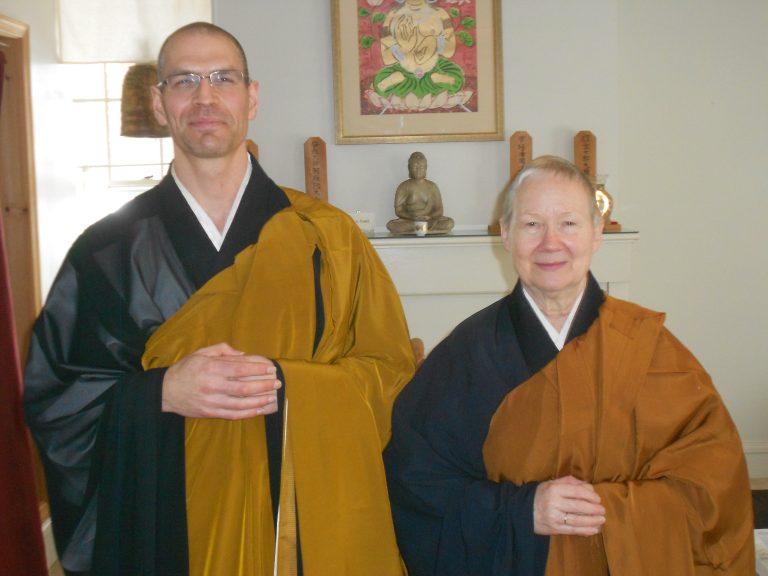
This is not to say we ignore our mental state. Pure gold does not tarnish. This is likened to a state of mind that remains pure and unmoved even when insulted or harmed in some way. Through practice we learn not to accept abusive behavior but to be willing to learn from teachers who are further along the path than we are, or from friends who have our best interests at heart. Meditation helps us see our mind and prune behaviors and attitudes that no longer serve us or the wellbeing of others. We learn to let go of clinging to the past or grasping after a future that is not yet here, and to be genuinely and immediately present with and for the people right around us. We come to pay attention less to our own self-absorption, and more to the needs of those around us in a way that allows for loving connection. In behaving this way, in practicing in a way that assumes we are “gold” on the inside, people come to see the “gold” in themselves.
Admittedly, it’s easy to forget about the discipline of putting our practice at the center of our lives every day, however that may look. Practice doesn’t always have to be formal meditation with a group, as helpful as that might be. It also means we are physically and mentally upright in whatever activity we happen to be engaged in. We will inevitably hit pitfalls that we need to be willing to be okay with, and to turn into an opportunity for practice.
When my father passed away, I had to postpone my formal Zen activities, including teaching, to be present for my family. That being present for and grieving with my family became my Zen practice. Helping my mother get her financial affairs in order was Zen activity. We don’t need to be in a special place to practice. It’s always right now, right here.
Zen Master Dogen said when questioned about the fruits of practice, “nyu nan shin,” or “a flexible heart/mind.” Gold is malleable. When heated, it forms into whatever shape one desires. This parallels the fruits of Zen practice. We learn to be flexible in the heart and mind, being able to adapt to whatever the situation calls for, not afraid to let go of long-established patterns of behavior, even if they might be considered “good.” There’s a certain degree of spontaneity in practice that allows one to change, accepting whatever discomforts might be present. When we recognize that gold is, metaphorically, a part of our hearts, there’s no fear in change. Zen practice, especially zazen, helps us connect with our innate flexibility, even if we don’t recognize the gold metaphor. Outward signs of this inner gold include self-discipline, being grounded in the here and now, and a display of fortitude (as opposed to bravado), and a flexible attitude.
This calligraphic phrase is intended to be a blessing. It says, “May you have longevity like that of a gold rock.”
To see ourselves as having the qualities of a gold rock is to treasure our self, to value our self, to love our self. But in our world people will spend a lot of money to find these qualities outside themselves, not valuing their own life. This calligraphy is reminding the observer to value themselves as they would value their weight in gold. While our true value has no price tag, nevertheless this restless part of ourselves is always making comparisons and value judgments. We don’t have to get rid of our restlessness, but direct it, or redirect it towards something worthy of our veneration. “May you have longevity like that of a gold rock.”

Amid the roar of opinions, Zen says do one good thing, like washing the dishes.
Religious beliefs are many. Some people believe in heaven. Others believe in reincarnation. Some believe there’s only one God, some believe in many gods, and others believe in no God at all. Some say we all need to accept Jesus to be saved, others say it’s through Buddha, still others, Krishna. So which belief is the right one? If one is right, what about all the others? If they’re all right, then what’s the point in following any one of them?
When people learn that I’m Buddhist, they invariably ask what Buddhists believe. Belief appears to be the cornerstone of anyone who follows something that goes under the category of “religion.” Is Buddha your God? How do you worship Buddha? What makes you Buddhist? Do you have to meditate to be Buddhist? If so, how often?
These are all legitimate questions that beg for clarification. But will explanations be helpful?
The answers to these questions don’t touch what it means to be a practicing Buddhist, as far as I understand it. The following Chinese phrase helps to explain why such questions are not adequate:
龍吹鶴語 為善最楽
王讃, Ohsan (206 - 265 CE)
It reads, “Dragons roar and cranes whoop. Isn’t doing good a joy?
Dragons are mythical beasts that have captured the imagination of all of us around the globe, whether courageous knights fighting them in battle or sages riding them. Dragons symbolize enlightenment, right speech, and the forces of nature, and in Zen circles meditation is considered the true dragon. It’s said that when a novice priest enters a monastery, s/he goes from being a fish (symbolic of an ordinary being) to a dragon (symbolic of an enlightened being). Zen Master Dogen refers to dragons in his Universal Instruction for Meditaton, when he writes,
"Do not doubt the true dragon."
Zen Master Dogen
The true dragon is not a mythical creature but our own body-mind as it is unearthed through meditation. Contemplative practices dig up things buried deeply in our unconscious mind, some of which we’d rather remain hidden. Maybe, through practice, we learn to accept some side of ourselves we’d rather not become public. Dragons are not to be controlled or repressed. They are to be acknowledged in some way as symbols for a powerful force that animates us and the world.
Dogen also compares zazen to a dragon having entered water. The water is the place dragons reside, so to do zazen is to come home completely to our natural resting place beyond location or time. When we are really IN zazen we are not fooled by anyone. It’s like being at home base. No one can tag you out.
But this phrase, “Dragons roar and cranes whoop,” has a different nuance to it than the above meanings. Here, the dragons and cranes are referring to the loud voices of others. Everyone has an opinion, and like little kids, we shout it out because we want others to listen to us. The dragon in this phrase is a symbol of a vociferous perspective on something. Others, like the crane, are more refined in their conduct and approach, but nonetheless still vie for attention. The dragons and cranes are like the many different religious beliefs that are out there, and their cacophony confuses and confounds us. Buddhists believe X. Christians believe Y. Some other group believes Z. Which is the right one?
This business of opinions is not confined to religious beliefs. What or who are these dragons and cranes in modern society? Politicians vying for control? Business leaders directing our resources? Scientists telling us about the latest and greatest discovery? Religious leaders telling us what to think? Or perhaps scrolling through one’s preferred social media feed and seeing who is doing what. In any case, this ancient phrase from two thousand years ago is just as relevant for us today, perhaps even more so, as we are inundated with information and have a hard time discerning what to think or believe.
The phrase 龍吹鶴語 is only the first half of this aphorism, and doesn’t make sense without the second half, which is 為善最楽. This may be translated as, “Nothing is more enjoyable than doing a good thing.”
The totality of this phrase accurately frames the ethos of a Zen training monastery, but it can also guide any of us living in the world today. If you were to train at a Zen temple, the teachers would not care what you think. They want to know if you are able to drop your opinions, be aware of what’s happening around you, and do your job. The Chinese phrase offers clear guidance on how to navigate through the murkiness of people’s opinions, posts, and perspectives. The Zen teachers I’ve practiced with have consistently placed less concern on one’s views of the world and have been much more concerned with how to actually live. All views are erroneous by nature, as they never represent the whole picture, and they can be argued over endlessly about who is right and who is wrong. We can go down a rabbit hole scrolling for hours through what people think, all the while forgetting what’s really important, or doing what we need to do to take care of our own life and responsibilities. The 3 pure precepts say what to do succinctly: Do nothing that is bad. Do all that is good. Purify the mind.
Who here has succeeded at this completely? Or maybe we get stuck in our past accomplishments, patting ourselves on the back too soon.
Studying World Religions and philosophy in college was like listening to a cacophony of voices. I walked away more confused than ever, not knowing what to do until I met my teacher. She didn’t say a thing about what to believe. She gave me a practice to help settle and purify my mind, to do good, to refrain from bad. To stop doing drugs.
After three months of training my teacher taught me the importance of cleaning up after myself. This was a more important lesson than zazen. I learned the simple task of washing the dishes.
I returned to my family at that point to test my practice. Had I changed at all? How would I be around my parents? What could I show them for my three months in a Zen temple? While my parents were very caring and loving people in so many ways, extraordinarily generous with their time and money, they consistently argued around meal times, either about the meal itself or something else. Arguments became the music of our home and came to be expected, like a bad song on repeat during dinner.
When I returned home I was unsurprised to hear the “music” of my parent’s home at the dinner table. I decided to do something novel. Rather than giving into anger, impatience, or resentments, or even to fight along with them, I decided to look at how I was contributing to their argument with my own opinions. I noticed that the dishes we had just eaten from had yet to be cleaned. I got up from the dinner table and began washing them. That was my “good action” and it brought joy in that moment, knowing that I no longer had to be imprisoned by various perspectives. I spotted the one thing I could do and did it. As a bonus, my parents noticed my action and quit their bickering. My mother even expressed her gratitude for my training.
Many of us get so caught up in what people are saying that we have neglected our own duties. We’ve forgotten that our main action is not to argue but to derive joy from doing good, refraining from evil, and purifying our mind. We get anxious about what people are saying, thrown around by petty whims, and meanwhile, the one thing that we can do gets overlooked.
In my own household with my wife and son, too, it’s important for me to continue to practice cutting through opinions and doing some beneficial action. This is the path of the Bodhisattva, one who strives to lessen suffering in the world. While I often fail at this, Zen practice calls me out on it and asks me to look around, talk less and do beneficial actions.
What are the ways you get caught in arguments that don’t go anywhere, and how have you found ways out of such predicaments?
Dragons Roar
Cranes Whoop
Our politicians are power hungry
Hungry ghosts never get enough money
See through
The Sea foam
Don’t get caught in the waves of opinion
The Great ocean is always here.
Enter it.
Practicing doing all that is good.
Even a 6 year old understands.
Even a 60 year old can’t do it.

Zen balances study and martial skill (Bun Toku Bukou), used to help others, not to fight them.
文徳武功 or “Bun Toku Bukou” can be translated as something like, “Literary/Cultural virtue and martial skill.”
As a kid, I had a fascination with martial arts movies. I was enamored by the movie Kung Fu, with David Carradine, and how he was this martial artist who attempted to bring about justice, and to protect the weak. To enter the martial arts training, the young martial artist must first prove himself by sitting outside the temple every day and waiting. This is a mirror image of how one enters a Zen monastery in Japan, during training as a monk. When I experienced “tangaryo”, I was certainly buoyed by memories of Kung Fu. “Tanga-ryo” (literally “room for overnight guests”) refers to the practice of sitting outside the monastery waiting to enter. It’s a test of one’s resolve to practice the rigors at a Zen temple.
Star Wars, too, has a similar motif of the warrior-monk protecting the vulnerable, in the concept of the Jedi master. As a child I pretended to play the role of a powerful Jedi wielding my light saber and learning the ways of the force. Such warrior-monk types existed in the time of Dogen Zenji, though he was quite critical of them for neglecting the practice of meditation among other things.
When I entered the monastery at 23, I almost completely stopped watching movies, but my interest in martial arts was occasionally ignited upon hearing about and seeing Zen masters wield a sword in kendo, and my teacher referring to similarities between martial arts and Zen. As an adult no longer training formally, I still love to see a good fight in a movie.
Zen has a long history with martial arts. Shaolin Temple in China is said to be both where Bodhidharma, the first Indian Zen Ancestor, resided, and the birthplace of martial arts. Emperor Wu was the epitome of Bun Toku Bukou, as he both spread the Dharma and built universities (Bun Toku), but also acted in several instances as a successful General (Bukou) in battle.
All the major religions of the world spread, in part, because of the practice of Bun Toku Bukou. Various rulers achieved some degree of appreciation for the development of the intellect or of a cultured mind (Bun Toku) and acted in ways that served to protect (Bukou) that development. The Prophet Muhammad exemplified this by being both a spiritual leader and a political leader. Prophet Muhammad was so successful at both Bun Toku and Bukou that the entire Arabian peninsula converted to Islam within his lifetime.
It wasn’t until the 4th century when Emperor Constantine of the Roman Empire converted that Christianity achieved similar success and spread throughout Europe. Constantine provided the protection that Christians needed to spread a particular culture. For three centuries prior to his conversion, Christians were not protected by the state and were often unjustly killed by the whims of the authorities, preventing Christianity from having wide appeal.
We can find similar stories within the Hebrew Bible of leaders such as King David. King David possessed the ability to lead with both military might and with spiritual fortitude. His downfall was when he sees himself as above the law, neglecting the exhortations within the 10 Commandments, particularly around adultery and murder, reminding the reader that it’s not enough to be mighty, but that one needs also to continue to refine oneself through studying and practicing God’s precepts.
Confucianism, too, spread and helped to unify China once the ruling class saw the wisdom of both refining the intellect or heart/mind AND protecting the state. Prior to the unification of China the elite or ruling classes were lopsided in their thinking, thirsty for power, and ruthless. They paid little attention to literary virtues or the pursuit of the intellect or virtue (Bun Toku). It took centuries for Confucius’ aphorisms to be taken seriously, but once they were, they were embraced by the Chinese.
Buddhism, too, spread thanks to the Buddha growing up as the heir to his father’s throne. As an insider into the kingdom of Magadha where he was raised and expected to take his father’s throne, he was groomed to understand the politics of his time. The neighboring kingdoms respected him in part because they knew he was formerly a prince. It’s through this that knowledge of the warrior turned monk grew. Shakyamuni Buddha was born into the Warrior Caste in India and was adept at the martial arts of his time and culture. He understood the duty of protecting the kingdom (Bukou), yet he thwarted it for Bun Toku.
King Ashoka, centuries later, spread the Buddha’s message beyond the confines of the Indian subcontinent, again, thanks to the awareness of Bun Toku Bukou. Prince Shotoku of Japan, in the 7th century, included Buddhist principles in his governing and was responsible for facilitating the spread of the Dharma in Japan. It’s because of the merging of religion and politics (Bun Toku Bukou) that Buddhism became a World Religion. Literary pursuits, culture, the development of wisdom or virtue all require protection by the State. In our times, our Constitution attempts to curtail the alliance of religion and politics, but it does protect religious freedom. This protection is to our benefit.
In many liberal Buddhist circles the United States government is often rightly criticized not for having a strong military, but for exceeding the needs required to protect the country. Some Buddhists like Joanna Macy point to the life-threatening proliferation of nuclear weapons as an example. While this is an important point, it’s also thanks to adequate military protection that a certain degree of law and order persists at present in the United States and allows for freedom of religion, and for us to practice without feeling threatened for doing so. (Even with protection by the State, still underlying prejudices, anti-Semitism, Islamophobia, etc., make many religious practitioners feel unsafe and unprotected in the United States.) This is not the case in all countries. There have been pogroms in China that destroyed Buddhist, Confucian and Daoist temples. At present, in Burma, the lack of separation between religion and politics is a cause of corruption within Buddhism.
We have little control of what happens on the national level, where we can see the presence or absence of Bun Toku Bukou. Nonetheless, this way of being infiltrates Zen practice and thought. My teacher often said, “You have to study.” Zen is about learning Buddhist principles like the precepts (virtue) and ways of meditating and then putting this learning into practice. The very first aphorism in The Analects of Confucius reads:
“Having studied, to then repeatedly apply what you have learned – is this not a source of pleasure.”
Confucius
My teacher also said regarding study, “It won’t do you any good.” In other words, we need to let go of prior knowledge if we want to continue to advance in our practice. We can’t rely on previous experiences as our sole guide. We must be open to continually learning. This could be referred to as “beginner’s mind.” “In the expert’s mind there are few possibilities, but in the beginner’s there are many.” (Suzuki Shunryu, Zen Mind Beginner’s Mind.) One of her teachers, Narasaki Ikko Roshi, said, “Never Cease Cultivating.” The spirit of this is that we are never done with practice.
Yet, this kind of constant cultivation warrants some degree of protection beyond the walls of a monastery. If there is fighting, such as internal warfare, how can one concentrate deeply, relax, or even think of studying the self? Thus, in Japan, martial arts have served as a means of protecting the development of the spirit.
My teacher’s first Zen teacher, Omori Sogen Roshi, was renowned in Japan for his high degree of presence. My teacher said when Omori Sogen Roshi practiced martial arts that his eyes seemed to be looking everywhere, yet he was perfectly still. He could take on and defeat many men simultaneously while wielding the sword. Yet he was also an adept calligrapher, studying culture and virtue. He was the epitome of 文徳武功.
Also, Noda Daito Roshi, my teacher’s root teacher, was both a practitioner of martial arts and a promoter of education. He constructed a school on the temple grounds of Kappa Dojo. This school is dedicated to disadvantaged children not able to make it in mainstream schools due to bullying. He teaches the kids how to protect themselves, and how to fight.
If we widen our definition of martial arts to include all sorts of physical activity, then 文徳武功 is also valued in our own country. When we witness well-educated students that also excel in athletic performance that is a kind of Bun Toku Bukou. The A student who studies engineering in college but is also competitive in football or basketball, or other activities that require physical strength and dexterity similar to that of those that yield the sword in former times, is such an example.
It’s not enough to study and refine our mind. We also need to involve our physical body through practical and concrete actions that serve others in some fashion. Likewise, brute strength and might is not enough. We need to be able to think intelligently before acting. 文徳武功,if employed in balance, leads to success in life’s pursuits.
I’d like to offer some caution before fully embracing martial arts (Bukou) as a part of cultivating the spirit (Bun Toku) in Zen. Martial artist and Zen practitioner Som Pourfarzaneh, has the following to share regarding contradictions between martial arts and Zen:
According to Buddhist teachings, all things are mutually dependent on one another, empty of an unchanging, independent self. It thus follows that an unnuanced martial arts practice that singularly positions a “self” versus an “opponent” is incompatible with the nondual ethos of Zen. Likewise, any aim to harm others, even if one learns to be “in the moment” to better respond to a variety of attacks, is antithetical to Zen.
Purfarzaneh, Som. “No Self, No Opponent.” In Lion’s Roar Magazine, September, 2023
This seems very important to keep in mind. In correcting this, Purfarzaneh further states:
“A martial arts practice grounded in Zen methods must aim to help others. Developing your martial arts skills to cause harm, or as a means by which to benchmark yourself against opponents, is by default contrary to Zen practice. Yet, you can infuse martial arts training with the intention to be of benefit to others, inverting the traditional mode of opposition into one of active compassion. With this disposition of altruism, you engage in practice to improve your fitness, enhance your discipline and focus, and develop skills in defense and protection in order to help those around you. Your opponents, once perceived as aggressors, become intimate companions who are themselves controlled by emotions, such as anger, attachment, and delusion. No longer obsessed with the false dichotomy of “self” versus “other,” you’re better able to apply your skills to restore peace and harmony in a potentially violent situation, thus fulfilling the embodiment of silent illumination by using your expertise for the common good.”
I’d like to conclude this by inviting Zen practitioners to think of “Bukou” or martial skill more broadly. If we think of Bukou as activity that is a form of “protection,” many activities may count as “protection” in a sense. Cooking, cleaning, sports, gardening and other physical activities can serve to protect both our mental and physical wellbeing. In this sense, Bun Toku Bukou can serve to remind us of the importance of balancing our more intellectual and spiritual parts with life’s physical demands. Zen is not just a practice sitting on the cushion. It’s our whole life in balance.
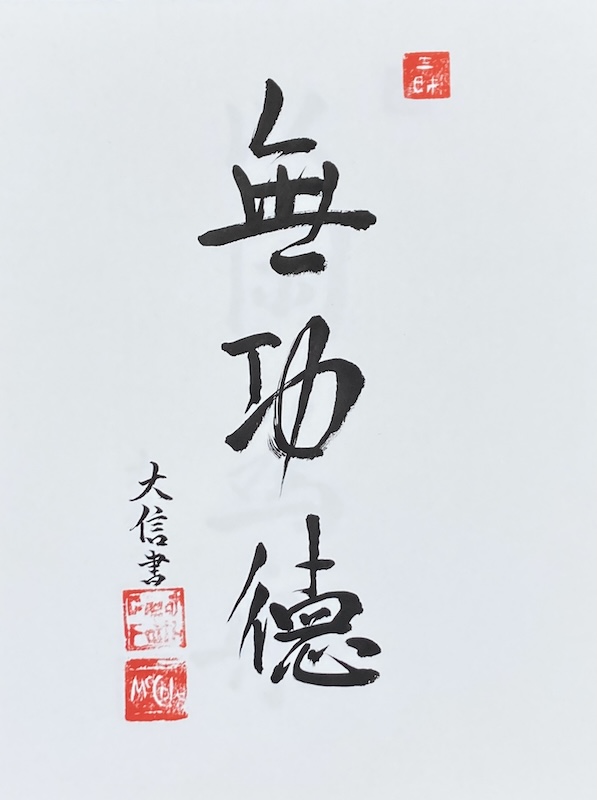
Kudoku (merit) isn’t ours to keep; practice generates it to be shared so the Dharma shines.
“Bodhidharma’s Emptiness,” is a story often pointed to as a foundational Zen text, yet one of its central concepts – merit – is assumed intelligible to any western reader. I studied this story for my “Shuso Ceremony,”# and though I became intimate with it some 20 years ago, there’s much of it that I’ve taken for granted. The story appears as the second case in the Shoyoroku, or the Record of Serenity, and as such is of primary importance for understanding Zen. How is it that “merit” has gotten so overlooked?
In the story, Emperor Wu learns that an illuminated teacher from India, named Bodhidharma, has traveled to the Great Chinese Empire to transmit Buddhist teachings. Emperor Wu was an enormous supporter of Buddhism, showing his patronage by building temples for monks and nuns to live in, and by spreading the Dharma. He desires to know from Bodhidharma what “merit” there is in doing such deeds.
Bodhidharma, however, catches the emperor off guard by telling him, “No merit.” This must have been a dangerous thing for him to say because, in those days and in that culture, he could have been beheaded if the Emperor felt insulted or embarrassed. Emperor Wu was probably expecting Bodhidharma to affirm his activities, but he instead becomes confused, and returns to his palace.
Much later, the story goes, perhaps years later, Emperor Wu realizes the truth of Bodhidharma’s response and regrets not understanding his words sooner. Generally speaking, many interpreters of this story say the main point of Bodhidharma is not to do any actions, even those that support Buddhism, for the sake of merit. Don’t practice for the sake of merit, but for the sake of seeing deeply into the nature of reality.
The story isn’t just about emperors. It’s about us. We are like Emperor Wu, though we may not consider ourselves as powerful as an Emperor. If we’re totally honest, in each one of us is some part of our mind that is seeking to know what merit there is for our good deeds. We’re looking to be recognized from some outside authority.
# The Shuso Ceremony is a public event where a novice monk demonstrates their leadership abilities and understanding of the Dharma.
But what is “merit” referring to in the story? Does “merit” mean the same thing for us today as it did for Emperor Wu, Bodhidharma, and other Asian Buddhists? My teacher often brought up how difficult it is to explain the concept of “merit” to westerners, as we don’t have it as an integral part of our culture.
The Japanese pronunciation of the Chinese Characters that have been translated as “merit” is kudoku. I don’t want to assume that an English translation of the word kudoku actually does the translation justice. How may our culture define merit, and how close is that definition to the word kudoku?
In American culture merit is something that is intangible, but it usually refers to the quality or worth of someone or something based on the characteristics of that person or thing. In an academic setting, merit is used to evaluate a student’s studies. In a work setting, merit might be used to evaluate a particular task. In a meritocracy, merit refers to evaluating individuals based on their particular performance, as opposed to other qualities such as race, gender, age or familial relationships. When someone is said to have “merit” it often means they are honest or trustworthy, that they will do what they say they are going to do.
“Merit” in the United States, then is a term used to evaluate the worth of people or things. When Emperor Wu questions what his “merit” is, he is, in a sense asking for an evaluation of his activities. But I find something curious about the Emperor asking about “merit” as we understand it in America. It doesn’t initially strike me as a question non-Asians would ask a renowned teacher. I hear them ask questions about how to meditate properly. I hear about how to deal with problems in their family or in their workplace from a Dharma perspective. I hear them ask questions about how to see the world differently. But I don’t hear them asking about merit.
In order to understand why “merit” takes on a central role right at the beginning of a collection of koans, I think we need to understand what “merit” means from an Asian context. My teacher tried to explain to me that merit was like the electricity in a set of Christmas tree lights. The movement of electricity through the Christmas tree lights is what causes it to light up. It’s this light that helps us to clarify or to see more deeply the “tree.” Otherwise, the tree remains an ordinary tree. The tree is always an ordinary tree, but the lights around it helps us to recognize the extraordinary qualities of the tree, and to point us to a deeper truth. In the same way, the generation of merit moves through the universe and highlights the truth (Dharma) for us so that we can see it more clearly. The highlighting of the truth or Dharma through merit making creates a kind of “north star” so that we know which way to steer our lives, or what to place importance in.
After every sutra we chant there is an “Eko.” Eko is not echo like in English. “Eko” is referring to the transfer of merit that has been generated by the recitation of the sutra. Every time we chant a sutra we believe that this ephemeral “merit” is generated and that it can then be dedicated. Depending on the sutra, the dedication goes to various people, such as the Buddha, Dogen Zenji or Keizan Zenji. By dedicating the merit to these people, we are highlighting, like the lights on a Christmas tree, what they represent: the Dharma. Otherwise, they are just ordinary people like you and me. Sometimes we dedicate the merit to the Arhats. Sometimes we dedicate the merit to sick people or those deceased. If you listen carefully to the Eko you’ll understand better who the ceremony is dedicated to. The point of the dedication is not that things will turn out the way humans want them to, but that they will turn out the way the Universe wants them to.
One difference, then, between “merit” as understood in the West and kudoku is that kudoku can be produced through spiritual practices such as chanting or sitting zazen. In the West, we don’t necessarily associate chanting or meditation with the production of merit, as we don’t generally value those activities as we would, for example, earning an academic degree, making a scientific discovery, or with business prowess. Kudoku is not exactly the same as “prayers” either. We’re not necessarily asking for a change in health, such that a sick person may recover from illness. Recovery from illness may happen or it may not. In either case, it is independent of kudoku. My teacher said we make the dedication of kudoku so that the kudoku generated goes where it needs to go. We’re not in charge of where it goes or what happens with it once it gets there, but that what needs to happen in the Dharma happens in accordance with the ripening of karma.
A deeper understanding of “kudoku” can help clarify these differences. Kudoku consists of two Chinese Characters: 功 and 德. In Japanese this is pronounced “kudoku.”
The first character, 功,(ku) is the combination of two separate characters which mean “construction” and “power.” There’s a sense of great effort or even new creation being produced. Think of the effort it takes to birth a human, an animal, a business, or to grow a simple garden. Possible definitions of ku include the following:
The second character, 德,(doku when following “ku”or toku when by itself), is more complicated to explain, as it has layers of possibilities, depending on context. In Chinese it is pronounced “de” and is the central Chinese Character in the Title of the Tao De Jing. De or Toku is often translated as “virtue.” Incidentally, some Japanese Buddhist priests use “virtue” synonymously with “merit.” Toku is a very important quality for individuals to have or cultivate in an Asian context. The Chinese were and are concerned with how to attain Toku. It is equated with learning to become good, as it is assumed that becoming good is what it means to be a fully developed human being.
One has more or less Toku depending on their actions. When a person performs their deeds in a way that is in alignment with the natural Way of things, then those actions are virtuous (Toku), and the person is said to have Toku, or to lead with Toku. It is similar to the idea of merit in that our good deeds have good results, and can be used as a measurement for future successes or failures. However, Toku is not based solely in human ideas of worth. It’s based on the degree to which that person has aligned their activities with the Way or Dao. Toku is a kind of power that one possesses.* For humans, aligning oneself with the Dao doesn’t necessarily make you successful in the eyes of humans. You can be keenly tuned in to the Dao – living in a way that is in harmony with universal laws (Dharma), and still be poor. Conversely, you can be wealthy and be totally out of harmony with the Dao.
A person with Toku is not concerned that others think badly of them when they follow the Dao. They are more concerned that others think well of them when they are not in alignment with the Dao. Consider the following words from Dogen Zenji:
Even though people criticize you, if it is the activity of the buddhas and ancestors and in accordance with the sacred teachings, you should follow and practice it. Even if people in the world praise you, if it is not prescribed in the sacred scriptures nor what the ancestors have done, you should not practice it. (Zuimonki 3-13)
Rulers in ancient China were quite concerned with the amount of Toku (power) they had personally accrued. If the country was in good harmony – there were no famines, war was at bay, the people were generally happy – it was indicative of a ruler with ample Toku. The opposite would be the case if the ruler was bereft of Toku – the people would be unhappy, there would be constant wars and famines.
Before China existed as we know it today, it was separated into many smaller states which were in constant warfare. It was believed that the ruler had a great responsibility to receive the “mandate of Heaven” in order to rule justly. It would be obvious to the general populous that if a ruler had virtue (Toku), they also had the mandate of Heaven. But if they lacked virtue (Toku), then they lost the mandate and were vulnerable to being deposed.
In this sense, developing Toku was important for emperors like Wu, because it would ensure that they remain unseated. Ruling with Toku was equated with having power and influence over others. It should be noted, though, that it wasn’t just rulers that could acquire Toku, but even the common person.
Buddhism finds a way to adapt to Chinese culture by linking itself with the Chinese concept of Toku. When ku (功)and toku (德)are put together, we get the word kudoku. Kudoku, then, may be seen as a way to generate virtue, something the emperors (as well as common people) coveted for themselves. Buddhism basically said that you can generate virtue (kudoku) through chanting the sutras. But it is my understanding that Buddhism adds another dimension to how this concept is understood within Chinese culture. The Eko of a chant, the dedication, recognizes that kudoku has been generated. It takes it one step further and suggests a direction to “send” that kudoku. The contribution to Chinese culture, in my view, is that the transference of kudoku (generation of virtue or merit) is not to be held on to for oneself, but released out into the universe so that the Dharma can be recognized by others.
Emperor Wu, as I understand his question, was wondering what merit was in it for him in particular. Yes, he was doing great things, but he was thinking somewhat selfishly about it. He may have been concerned about holding onto power. When Bodhidharma said, “no merit”, could it not have been that the merit – kudoku – that Emperor Wu generated was never intended for him in the first place, and that he didn’t understand that? We don’t hold kudoku for our self. The kudoku generated by our deeds (whether it be chanting, zazen, or some service project) is never for us. It’s to be let go of. If we don’t let it go, it never gets out there in the universe to do its job. It would be like only one light on the Christmas tree working. If only one light on the Christmas tree is working, it’s considered broken. In the same way, merit needs to be shared rather than amassed for oneself.
Furthermore, we don’t generate kudoku for the sake of kudoku. Just as we don’t have Christmas lights for the sake of the Christmas lights. The lights on the tree point to something deeper. They highlight an ordinary tree revealing its extraordinary nature. In the same way, kudoku helps highlight the deeper truth of the Dharma. The Dharma appears all around us in ordinary form. Because of this it is hard to see. Kudoku is a kind of light that helps us to really see.
* For an indepth discussion of the concept of virtue, see, Ivanhoe, Philip, Confucian Moral Self Cultivation, 2nd edition, 2000, Hackett Publishing Company.
Part 2 of video below will be available on October 5th