Here you’ll find reflections, teachings, and writing from the Zen Fields sangha, gathered over the years. Topics range from meditation and Buddhist philosophy to parenting, yoga, social and ecological justice, interfaith connection, and the places where Buddhism meets science. Browse by category below, or start with the most recent post and follow what draws you in.
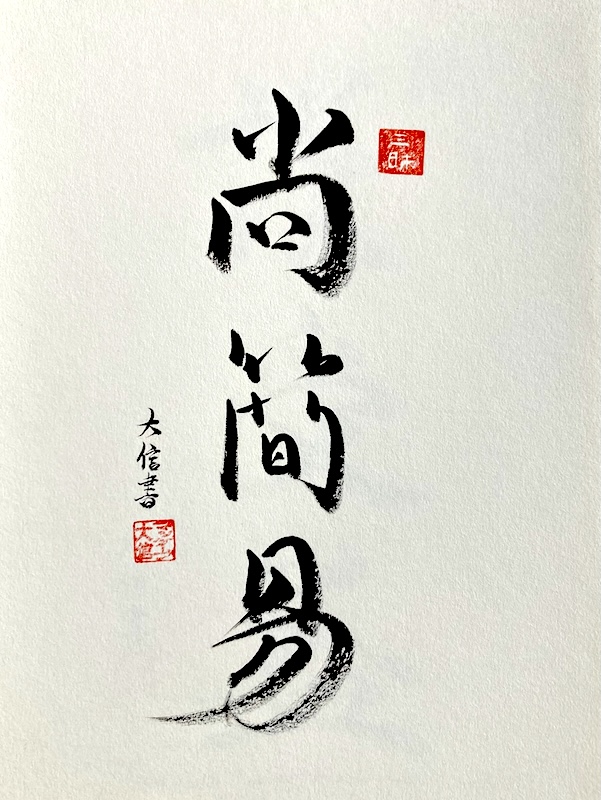
Zen means making do with what we have; awakening is already here, no extra program needed.
Value Simplicity and Effortlessness
Zen teaches us to make do with what we have. I remember working as the Tenzo (Head Cook) at Mount Equity Zendo, where I trained in central Pennsylvania. My teacher gave me one central guideline: Look at what you have in the refrigerator and cupboard before deciding on a recipe. It was simple enough instruction. She said, “Rather than looking up a recipe and going out to buy the ingredients for it, in Zen we make the most of what we have already before going out to buy a missing ingredient.”
We often have more than enough, but don’t bother to look. Keeping rooms clean is part of Zen practice because it helps us to notice what we have. When we don’t clean, we lose sight of what’s right in front of us, and then we make great efforts to figure out how we are going to obtain what we already have. When I clean the kitchen cupboards and fridge, for example, I start to see all the food items I have neglected.
The same is true for our zazen practice. Enlightenment is right in front of us, yet we complicate our lives thinking we need some kind of program to help us find it, something extra, something we need to go out and purchase. Some people take this to mean that even a teacher is unnecessary. This may be the case for those who can wake up themselves without help. But I am not such a person. For me, a teacher is necessary to help me see this. We wake up in relationship to others, not in isolation from relationships.
Just quietly sit down and notice what’s right in front of your eyes. It’s simple. No need to go somewhere. Dogen Zenji says, “The Way is basically perfect and all pervading. What good does it do to travel around to practice?” Wake up with the circumstances present in your life right now. Don’t wait for some future time when things will be “better.” That future time may never arrive.
Furthermore, any endeavor we embark upon requires some effort, whether it’s zazen or some other activity we are engaged in. However, when we think about all the effort that has taken place by various factors of the universe from the Big Bang up until this moment, any effort that we make is comparatively negligible. Keeping our own effort in context with the truly great and unfathomable effort that has come before us, effortlessness isn’t something I or you (ego) practice now, but the fruit of eons of activity. Our activity is simply the “cream on top.” This is not to say that what humans do is the crowning achievement of the universe, but simply the tiny action of the present moment, something that we often gloss over or think of as insignificant.
It’s not that we shouldn’t put effort into zazen or our daily activities. Surely it takes effort to get ourselves out of bed and sitting on the meditation seat. It takes effort to commit to sitting regularly. However, pondering the effort we generate and making it into a big deal is all ego-based thinking. In reality the great universe gets us from where we are and takes us to wherever we are going, and when we put our reliance on the myriad causes and conditions that preceded us, then our activity takes on an effortless quality (and new meaning). We are not burdened by what needs to happen. We can take our time, knowing that everything does not depend on us, and yet at the same time, if we fail to take seriously our part, then everything falls apart.
In Dogen Zenji’s days, he spoke of the unity of practice and Enlightenment, and that although we are already endowed with original Enlightenment, we still need to practice. Effortlessness is like that. It is the fruit of the labor that’s come before us. If we put any effort into this moment, including reading this sentence, consider connecting with the myriad factors that allow you to read this, including your eyes, your fingertips, your ability to comprehend English, etc.
The first Chinese character in this saying above (尚) has several possibilities:
As a verb, it can possibly mean one of the above. According to Wiktionary, the fourth possibility, “to assist” is obsolete. However, assisting simplicity (簡) and effortlessness (易) to arise makes sense to me. It takes ego out of the equation. We’re not the one’s acting with “simplicity” or “effortlessness,” we are assisting their manifestation in the present moment. We are recognizing or being mindful of both the potential to act with simplicity and effortlessness AND to relax into these attitudes while in the process of whatever activity we are doing.
However, to “value,” “esteem” or even “worship” simplicity and effortlessness, are all possibilities, and depending on which one is chosen, a different emphasis and feeling is placed on 簡 and 易.
In Japanese 尚簡易 reads, Kan I wo tatsutobu. “Value simplicity and effortlessness.”
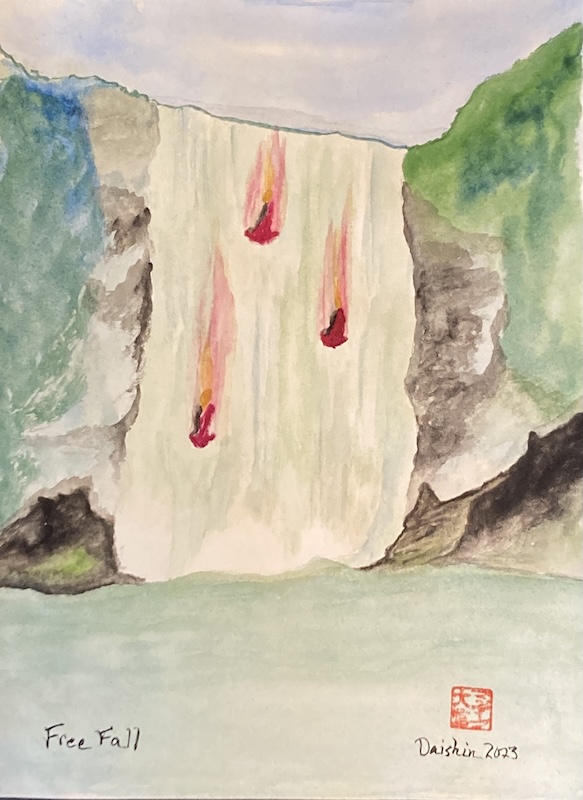
Each view is partial; doubt and beginner’s mind help us see zazen as a free fall.
Zazen as Freefall
Zen Master Jingqing asked one of his students, "What's that sound outside?" The student replied, "It's the sound of the rain." The master said, "All beings are upside down: they lose themselves in pursuit of things.... I am the sound of the rain!"
Accidentally dropping into a Zen temple, one may perceive those doing shikantaza (whole-hearted sitting) as stillness of body. One may stumble into a room full of bald-headed monks, sitting on raised platforms wearing robes and facing a wall and think, “why are they sitting so still, and how come nobody is talking, and what the hell are they wearing?” Or, “How could (or why would) anyone do that for any length of time?”
Anyone looking from the outside in at someone else’s practice is, by definition, caught in a spider’s web of thought. In other words, they are not in touch with true reality, but trapped in a one-sided view of what they perceive as reality. They don’t realize that they can’t perceive reality fully with their senses. Or they are ensnared by the belief that the fullness of reality can be comprehended through acquiring intellectual knowledge or data.
All of us, whether we know it or not, are tangled up by our particular views, and mistake them as the whole of reality. We have views of religion, of science, of our friends, of our intimate partners, of our children, of our politicians, and of the Oak tree in the yard, to name but a few. Forming views is the nature of our mind, and we all do it. The problem is that we conflate our particular view with the whole of reality. We say, “My child is like ____X_____.” Or, “My spouse always does it like ‘this’.” Or, “My religion sees the world like ‘such and such’.” Meanwhile, someone else may see a totally different aspect of that same child, that spouse, or that religion that is unknown to us. It’s not that one view is better than the other, but that they are both form a small piece of the whole picture.
Dogen Zenji poetically illustrates the multifaceted nature of reality in describing water in his, “The Mountains and Waters Sutra”:
In general, then, the way of seeing mountains and waters differs according to the type of being [that sees them]. In seeing water, there are beings who see it as a jeweled necklace…. Some see water as miraculous flowers, though it does not follow that they use flowers as water. Hungry ghosts see water as raging flames or as pus and blood. Dragons and fish see it as a palace or a tower…. [Others] see it as woods and walls, or as the Dharma nature of immaculate liberation, or as the true human body, or as the physical form and mental nature.
(The Mountains and Waters Sutra, p. 29 Okumura Translation)
While we may get thrown by terms such as “hungry ghosts” or “dragons,” we need to keep in mind that, first, these are mythical beings personifying certain qualities found either in humans or in nature, and, second, we need to be careful not to lose the overall point – water is seen differently depending on who or what is looking at it. Fish see water as humans see air. Some people see water as drinkable, others see it as swim-able, still others see it as hydro-electric power. It all depends on the situation.
Our fundamental problem as human beings is, in any situation we find ourselves, we often mistake what we perceive in the present moment as 100% reality. I was listening to a famous scientist, Neil deGrasse Tyson, being interviewed by Joe Rogan on his youtube channel (see https://youtu.be/g5mAm5BgvVE) about everything from the Big Bang to how we humans are more genetically related to mushrooms than we are to plants. Joe proceeded to ask Neil if he had ever taken psychedelic mushrooms. Neil’s response to this question was quite revealing. He had never eaten magic mushrooms because he didn’t want anything to distort how he was seeing reality. Neil further stated that there is an “objective” truth that can be verified, and that when we take a mind-altering drug, we miss the objective reality.
Regardless of what one feels about taking mind-altering substances, Neil’s mistake, and ours, is that we, in this age characterized by faith in scientific methods and empirical knowledge, believe an “objective” reality exists, can eventually be known in its fullness, and is slowly being revealed to us.
I deeply respect Neil’s knowledge and his disillusionment with mushrooms, and my mind is often blown by the discoveries of science – such as learning our genetic relation to mushrooms – because to me these verify what Buddhism has been teaching all along – everything is related. Science has been able to show this empirically through DNA.
The mistake of our modern period, however, is this idea of an objective reality. It has the tendency to dismiss multiple views, and to erase circumstantial wisdom. There’s a belief that the rational view is far superior to the artist’s view, or other views, for example. Our glaring blind spot is summed up by Dogen Zenji.
Given that what different types of beings see is different, we should have some doubts about this. Is it that there are various ways of seeing one object? Or is it that we have mistaken various images for one object?
The Mountains and Waters Sutra
I love that Dogen Zenji has us raise doubt about what we see. Doubt is essential for deepening our practice. It allows us to not assume what we know or see, to be absolutely true. It leaves room for other possibilities. As Shunryu Suzuki said, “In the expert’s mind there are few possibilities. In the beginner’s there are many.” Aoyama Roshi says we need to have “Kindergarten mind.” When we are stumped by something, or angered by the way someone is living their life, being stumped or angry is an indicator that we don’t have the full picture. We have to watch ourselves carefully and act with great caution in such circumstances.
Returning to the opening scene of the monks sitting zazen facing a wall, what are they doing? What are they thinking? What are they feeling? From an outsider’s perspective they appear to be doing nothing at all, or “just” sitting there, perhaps bored out of their minds. But what of the subjective experience of the monks? How might they be experiencing zazen? What might happen if someone tries zazen for the first time and sincerely engages with it? I’ll suggest that there are those beings who see zazen as nothing but free fall.
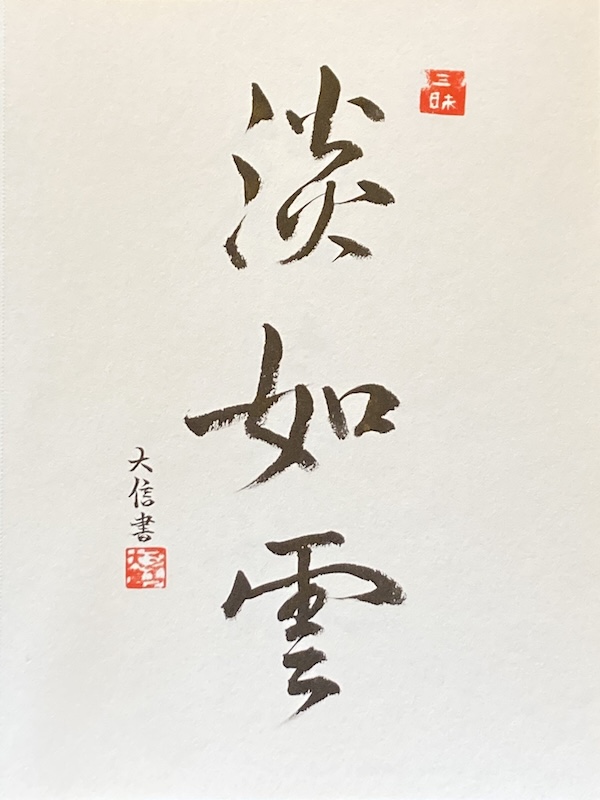
Like a cloud that keeps changing, we can accept who we are now; life does the transforming.
“A cloud never dies” is a saying I heard Venerable Thich Nhat Hanh speak on several occasions. The cloud doesn’t go anywhere. It just continues to transform: rain -> soaks into earth, streams and oceans -> nourishes plant life -> animals are nourished by water and plants -> water once ingested, becomes the activities and thoughts of humans.
Dogen Zenji says in “The Mountains and Waters Sutra”:
To say that there are places water does not reach is the teaching of the listeners of the Small Vehicles or the mistaken teachings of people outside the way. Water exists inside fire and inside mind, thought, and ideas. Water also exists within the wisdom of realizing buddha nature. Eihei Dogen
While clouds take on forms, they are not caught in their forms. The strong wind blows them this way and that and they are constantly changing their shape, size, and color. They are not bound by their previous shape. This is the lesson of the cloud for us humans. We humans get caught in the following:
Forms – fat, skinny, healthy, sick
In our intellect – smart, stupid, average
In our age – old, young, middle age
In our ideas and perceptions – good, bad, neutral, ugly, beautiful
Etc.
We are constantly judging and comparing ourselves with our previous self, the self we want to become, or the selves of other people, wanting to become something other than what we are today. However, Enlightenment in the Soto school is impossible to attain by self-improvement. While practice never precludes continual refinement of our actions and following the 16 Bodhisattva Precepts, it’s about accepting where and who we are in this moment, because in the next moment the strong winds of life change us (and/or our environment), just as the cloud transforms into a different shape, second after second. Like the cloud, it is not us (= ego self) that changes ourselves, but life that transforms us.
Be carefree like a cloud.
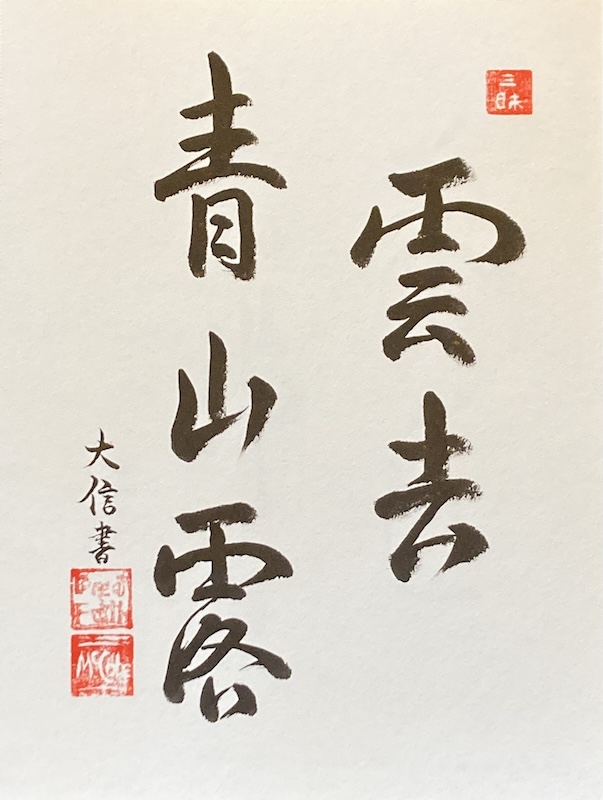
Our view is always partial, like clouds over a mountain; patience, not force, brings clarity.
“Cloud Goes, Blue Mountain Appears” is a metaphor for zazen. We might think of the clouds as thoughts and the mountain as what is real, or beyond thought. Or the clouds may be our deluded views and the mountain as Enlightenment. Or the mountain could be our very body/mind and the clouds our thoughts that prevent us from seeing the full picture.
Clouds could also be symbols for fluidity, acceptance, letting go, and not being obstructed by forms or social norms. Mountains are a symbol for stability, power, and groundedness. A Zen practitioner needs to have both qualities available depending on the circumstances. Sometimes we need to demonstrate flexibility, like a cloud, not getting too attached to ideas and views. Other times, like a mountain, we need to be rooted, not being swayed by the delusions of the masses, being strong in our physical posture and clear about the causes and end of suffering.
Clouds come and go in an endless cycle. In the same way, delusion and Enlightenment are a pair. There’s not a “once and for all” Enlightenment in our practice, but rather brief moments of clarity when the clouds’ part. But even when the clouds part, are we sure they have completely parted? Do they ever part completely? Is there not always something blocking our view?
Often, we are impatient with our practice and are looking for that “mountain.” We may try to forcefully remove the clouds from our minds. But this approach is to go against the natural flow of things, just as you can’t get a cloud to move by blowing at it from down on Earth. The cloud has its own timing and movement that needs to be respected. Developing patience in the process and not constantly seeking results is imperative.
However, is it a problem that the cloud obscures the mountain? What if we were to accept that our view of the world is almost always concealed, limited, and incomplete? What if we were to accept that what we are seeing is never the full picture? When anger arises, for example, can we notice how we are, in effect, desperately blowing at the clouds to no avail?
In one fascicle of Shobogenzo Dogen Zenji gives the image of looking at one corner of the sky through a bamboo pole. We mistake the one corner for the whole sky and don’t know it.
Practically speaking, it’s not until we socialize with those that have different views than our own that we realize the limits of our understanding. For example, on my travels, when I meet people for the first time, engaging in pleasantries, they eventually ask about my robes and ask what I do. I say, “I’m a Buddhist priest.” For some, this is a delight to hear, as it confirms their own beliefs. For others, however, they don’t know what to think or how to respond, as they have never met a Buddhist priest. I can sense their discomfort in that moment. There’s nothing I can do or say to such people, as I can sense them either reaching for some defense of their own views or having to modify existing prejudices. We all do this to some extent, and we must move outside of our social comfort zones to see this.
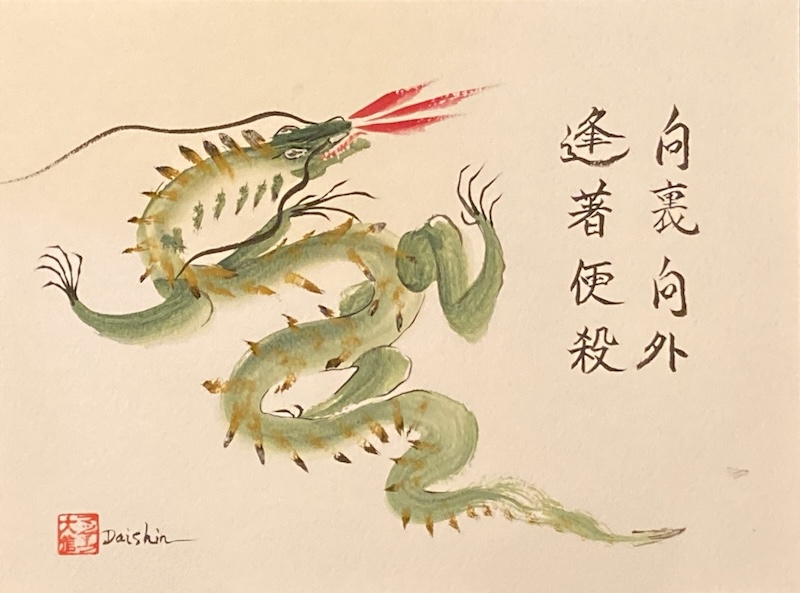
Shikantaza starts where the jhanas end: we sit as already awakened, with no stages to climb.

All art by Daishin

At the edge of a forest filled with immense banyan trees a man wearing ochre-dyed cloth draped over one shoulder, leaving the other bare, prepares a pile of mindfully gathered grass under large tree. Bending his knees to sit on the grass, he crosses his legs with great attention, placing his right foot on his left thigh and his left foot on his right thigh. His back lengthens like a cobra rising. He sits stably, like a thick and heavy stone, unmoved by howling wind, pounding rain, or swirling emotional hurricanes. His eyes half open not here nor somewhere else. His whole body seems to be covered with eyes. His face brightens as a subtle smile flowers forth. The mere sight of him is like gravity in the belly.
What did this man, known as the Buddha, or awakened one, experience while sitting in meditation? What were the meditative states that constituted his awakening? Some of his early teachings offer a clue.
I compare an early Buddhist text, “The Fruits of the Contemplative Life,” with Soto Zen teachings on Shikantaza, or “Just Sitting,” as I understand it. I attempt to show that ways of practicing and understanding Buddhist meditation (What was the Buddha experiencing under the tree?) have evolved over time. Earlier forms of meditation have become hidden in later teachings. Shikantaza is a unique practice within the Buddhist panoply of meditation practices that dispenses with earlier techniques, but at the same time assumes some of the “fruits of contemplative life” at the beginning of practice. In other words, these fruits of practice are not something practitioners of Shikantaza can anticipate. Rather, they are always present within Shikantaza from the very first time one practices.
It’s important to note that I have limited experience of Buddhist practice outside of Soto Zen. I speak from within my own tradition and mean no disrespect to other forms of Buddhism that may be more explicit about Jhanas or understand them differently. I’m especially grateful for earlier teachings of Buddha including how they manifest in what in modern times is known as Theravada Buddhism. What follows is not a critique of other schools of Buddhism, but simply an expression of my own finite understandings and musings based in experiences of shikantaza.
What did this man, known as “Buddha”, “awakened,” do while sitting in meditation? What did he experience in that profound state?
The Buddha lived for 80 odd years, over half of which he spent teaching the way to what came to be known as “Enlightenment.” Home leavers, wearing simple clothes, shaving their heads, sleeping under a canopy of trees, having cut family ties, having no job but to train for liberation of the heart/mind from this world of suffering, trading spiritual advice for food, clothing, and medicine, were attracted to him, and respectfully sought out his guidance. Far more of his students chose not to leave the comforts of a roof. They had their own families and jobs to tend. They too greatly benefited from his teachings, from simply witnessing him sitting, standing, and walking.
Kings, both wise and stupid, even, sought the guidance of Buddha. King Ajatasattu was such a person, plagued by fear and often acting with violence. He asked Buddha, as recounted in the Samannaphala Sutta (The Fruits of the Contemplative Life), about the fruits of meditation, what someone would gain from such a practice. Buddha graciously responded to the King with his own set of questions, and thus a dialogue ensued revealing the fruits of a life of renunciation.
King Ajatasattu was riddled with guilt and anxiety, having had his own father murdered so he could assume the throne. He encouraged divisiveness within the Buddha’s sangha by supporting Devadatta, a former disciple and cousin of the Buddha, who, like the King, was thirsty for power, even attempting (though failing) on three occasions to kill the Buddha. The price of the King’s rise to prominence was mental illness. In asking the Buddha for advice in spiritual matters he must have been experiencing bone-chilling regret and confusion, all affecting his internal peace.
Out of Ajatasattu’s dialogue with Buddha emerges a teaching that includes, among many things, descriptions of what are known as the four jhanas. The jhanas are the results of having generated mental stability through pratyahara, or withdrawal of the senses, having ended unwholesome qualities of mind like greed, hatred, and delusion, and having stilled “directed” thought. Having cultivated wholesome qualities of mind the practitioner experiences pleasure, rapture, joy, equanimity, and mindfulness, among other qualities.
Buddha describes the transition of the mind from delusion to Enlightenment and the practices that allow one to move through various jhanas. This must have been a very prized teaching in the 5th century BCE, in a worldview that proclaimed that escape from the round of suffering is possible, but only after many lifetimes of assiduous and dedicated practice.
A seismic change occurred with the emergence of the Lotus Sutra and other Mahayana texts between the first century BCE and the second century CE. The Mahayana texts are known for the radical proposition that liberation is available not only to monks who dedicate their lives to practicing meditation, but to everyone. No longer is there one Buddha–Shakyamuni, the historical Buddha who awakened under the Bodhi tree. Instead, there are many, including the solo practitioner who has no need for a teacher. In fact, the Buddha of the Lotus Sutra predicts that all of his disciples, male and female, are destined for buddhahood. He even guarantees enlightenment to those who doubt it’s possible.
Mahayana made enlightenment accessible to lay people, including:
The Lotus Sutra was a radical exposition then, and I think it remains so today. From the time of the historical Buddha to the present, the Dharma has been flowing like a river, its waters turning and churning as it emptied into the forest and city geographies of East and Southeast Asia, and crossed the Pacific Ocean entering North and South America.
Mahayana Sutras set the stage for shikantaza, a practice that may appear at odds with earlier forms of Buddhism that emphasized cultivation from an unenlightened state to an enlightened state.
Chan (Chinese for “Zen”) Buddhism, which developed in China in the sixth century CE, deepens the accessibility of Mahayana teachings to everyone by introducing the idea of “sudden and gradual enlightenment” . One no longer needs to wait lifetime after lifetime for liberation, as in the time of Shakyamuni Buddha. Instead, one can catch glimpses of liberation in one’s own lifetime. Freedom from the round of rebirth and suffering is possible here and now, in this very life, regardless of one’s previous lives.
The jhanas, as described in the “The Fruits of the Contemplative Life,” are the product of a different mindset, one that takes reincarnation for granted. Unlike modern America with its secular leanings, ancient India presumed a universe where we are continually reborn into a world of suffering until we have the means to escape this world (referred to as Nirvana) through meditative practices. This escape was only afforded to those who could renounce the world and become monks. According to “The Fruits of the Contemplative Life,” states of deep meditative absorption can be experienced in the here and now through exertion. However, unless one becomes a monk and dedicates oneself unremittingly to meditation, they are largely unattainable. A twenty-first century American reading the “The Fruits of the Contemplative Life” might get the impression that such lofty states require a great deal of time, patience, and, perhaps, instruction from a teacher regarding proper technique that could be experienced in this life. However, they may not be aware that it was written for someone who had lifetimes of practice and previous incarnations before they attempted such practices.
The practice of shikantaza, or “just sitting,” developed within a Chan context, and derived from a confluence of cultures, ideas, worldviews, and habits of the heart. While the idea of reincarnation was imported to Japan, this idea doesn’t play a big role in who could practice. Moreover, there’s no mention of the jhanas or how to reach them in Dogen’s Fukanzazengi, or “Universal Instructions for Zen Meditation,” written in the thirteenth century. Where did they go? How does one “attain” them?
The following story found in the Denkoroku, or Transmission of Light, a collection of koans attributed to the thirteenth-century Zen master Keizan, is instructive:
Seigen Gyoshi went to study with the Zen master Daikan Eno and asked, “What work is to be done so as not to fall into stages?” The Zen master inquired, “What have you done?” Seigen Gyoshi said, “I do not even practice the holy truths.” The Zen master said, “What stage do you fall into?” Seigen Gyoshi said, “If I do not even practice the holy truths what stages are there? The Zen master recognized his profound capacity.
Both ancient and modern Soto Zen teachers discourage practitioners of shikantaza from actively pursuing special states of mind such as those described by the jhanas. Seeking them generates separation or clinging and obscures awareness of anuttara samyak sambodhi, or complete perfect enlightenment. Rather, Soto Zen encourages becoming less concerned with a release from the world of suffering, and more concerned with identifying oneself as the very world one lives in.
Soto Zen says, “stop grasping after anything, good or bad,” for to push away the bad only makes it worse. Rather, learn from the wave. Water rushes backward to go forward. Bad and good are two sides of one coin: delusion and enlightenment can’t be separated. Enlightenment can only be found within the deluded mind, not once all delusions disappear.
Zen Master Dogen used images to help the practitioner compassionately meet the mind that wants to eliminate delusion. In Universal Instructions for Zazen, for example, Dogen says“[t]he dragon attains water” and “the tiger returns to the mountain” . The dragon, a mythical beast of great power and wisdom, dwells in water—that’s its home. But the dragon also dwells within us. The tiger’s home is the mountain. That tiger, too, is within us. Shikantaza is the practice of returning, or rotating, the mind to something (not a place or state) that has never left us. When the dragon attains the water and the tiger enters the mountain it is in its natural environment – it knows where its family is, and where to find things.
In my experience, people often take a “pauper to a king or queen” approach to meditation. They devalue their present state of mind, like King Ajatasattu in “The Fruits of Contemplative Life” (and who could blame him for wanting to feel differently?), and are seeking something grander – the mind of a Buddha, an “enlightened” mind. They might work their way through various mental states and after many hard years of practice begin to get some glimpses of so-called “Buddha Mind.” They may equate this “Buddha Mind” with some kind of privileged status, and if they attain it may even gain some recognition from their teachers or others in their meditation community.
Shikantaza practice within mainstream Soto Zen takes a slightly different approach. From the very first moment of meditation, we are kings and queens: we manifest Buddha Mind simply by sitting upright on our cushions. Indeed, Dogen Zenji says, “Shu sho ichi nyo”: practice and enlightenment are one.
In shikantaza, we embrace whatever arises, so there’s no difference between the person who meditates for the first time, and the person who has been meditating regularly for 30 years. It’s not that people immediately experience the same psychological state when they practice shikantaza, but that whatever is present is given permission to be there. The person who has been at it longer only sees this more clearly than the person who’s just begun.
I find several similarities between the Buddha’s instructions to King Ajatasattu in “The Fruits of the Contemplative Life” and Dogen Zenji’s, Universal Instructions for Zazen. After introducing zazen as the practice of a Buddha, Dogen offers practical instructions for how to do it. First, he says, find a quiet room. Eat and drink moderately, and put aside all involvement with the world. To me, this mirrors the Buddha’s description in “The Fruits of the Contemplative Life” of the home leaver who abandons worldly attachments and eats just one meal a day. Dogen, however, makes shikantaza accessible to everyone by advising practitioners to “eat moderately” instead. Watch the quantity of food you put in your body so you can remain alert in meditation. You can have three meals a day, just eat in moderation.
Moreover, during the span of meditation practice—whether we are sitting for five minutes or 45 minutes, Dogen exhorts us to put aside worries about the day. Dogen was not opposed to cutting off ties to the world as the monks of the Buddha’s time did, but he also thought in terms of one meditation period. He encouraged practitioners to cut off worldly ties for however long they were meditating—five minutes, five hours, five days, five years, or a lifetime. Practice and enlightenment are always available immediately; there’s no need to wait for some special time. All of us, home leavers or not, can set aside five or ten minutes from our busy lives once or twice a day to let go of worldly attachments.
Buddha, in the “The Fruits of the Contemplative Life”, describes the ending of “directed” thought as responsible for the emergence of a particular jhana. But ending directed thought, in my view, is not the same as stopping thought altogether. When the Buddha speaks of “directed” thought, he means concentrated thought: focusing one’s mind on a particular object, and not losing that focus. People new to meditation often mistakenly think that the goal is to fix one’s mind so thoroughly on the breath that no thoughts whatsoever can penetrate the mind. While this might have some benefit and is not a necessarily a bad practice, it can be very misleading. Often I hear people express their failure at meditating because of this misunderstanding this practice.
When the Buddha instructs King Ajatasattu that one of the jhanas is the result of stilling directed thought, I believe he is describing the practice of allowing “undirected” thought—and this, in my experience, is exactly what shikantaza is about. In shikantaza we don’t try to fixate on a particular object, such as our breathing, or try to rid our minds of thought. Instead, we view our thoughts like a flowing river. Good and bad thoughts pass us by. There’s no need to hold on to the good ones or the bad ones. We just sit as if on on the bank of a river and watch the thoughts rush by. Practicing this way, the meditator may notice changes to the mind and may even experience feelings of mental ease. But ease of mind is only a possiblity; it is not a guarantee, and it is certainly not the “goal” of meditation practice.
Another point of convergence I found between the Buddha’s descriptions of the jhanas in “The Fruits of the Contemplative Life” and Dogen’s “Universal Instructions for Zazen” is the quality of joy that meditation can elicit. The Buddha says that joy is one aspect of the first of the four jhanas. The practitioner who reaches this state of meditative absorption will experience “rapture and pleasure born from withdrawal.” Similarly, Dogen Zenji describes shikantaza as anraku no ho mon—“the dharma gate of joy and ease.”
Joy ought to be present in our own practice as well. It arises from temporarily but responsibly turning our minds away from our incessant worries and desires.–We constantly want more: more money, more stuff, more attention, more sex. There’s no shame in mindfully observing these desires in ourselves. The problem happens when we are not aware of how destructive these desires are for our own lives as well as our planet when actively pursuing them.
The jhanas Buddha describes in “The Fruits of the Contemplative Life” are stages—states of concentration that one passes through on the way to enlightenment. For Dogen, practice begins at Buddha’s finish line: we practice as if we are already awakened beings—because we are! No former practice is necessary; there’s only now. Dogen invites us to trust in our own inherent Buddha nature, something our rapacious minds delude us into thinking we have lost. Shikantaza can be considered a non-dual approach to meditation that moves us, similar to the jhanas, from deluded humans to Enlightened Buddhas.
Two other areas of overlap between “The Fruits of the Contemplative Life” and Dogen’s shikantaza are the practice of confession and of the precepts. While, I will leave these for a later writing, it’s important to note that confession and the practice of the precepts are a common thread that runs through all forms of Buddhism, both in ancient and modern times. While in modern times meditation has become accessible to everyone, and one can experience liberation here and now, we cannot presume that we are above the need to confess our short-comings nor to practice the precepts.
On the surface there appears to be a great gap between shikantaza and earlier teachings of the Buddha. No doubt, shikantaza is not practiced in the linear fashion that “The Fruits of Contemplative Life” describes the jhanas. Because shikantaza doesn’t mention the jhanas, however, doesn’t mean they are not present in shikantaza. We see Dogen Zenji advocating for following the precepts, confessing, and leaving the world behind (even temporarily), just as Buddha either directly or indirectly supports in “The Fruits of the Contemplative Life.” While Dogen Zenji employs images like “the dragon attaining the water”, Buddha offers a more matter of fact approach – “if you do this, that will happen.” If you let go of worldly affairs, joy – the first jhana – will arise in the mind.
Lastly, the contrast between the Buddha’s approach and Dogen Zenji’s approach demonstrate the adaptability and flexibility of Buddhism across time and culture in meeting the needs of people where they are. Buddhism is not a monolithic tradition. There’s room for diversity of beliefs and practices, and we see that diversity fits well with the American mindset in the United States in the 21st century.
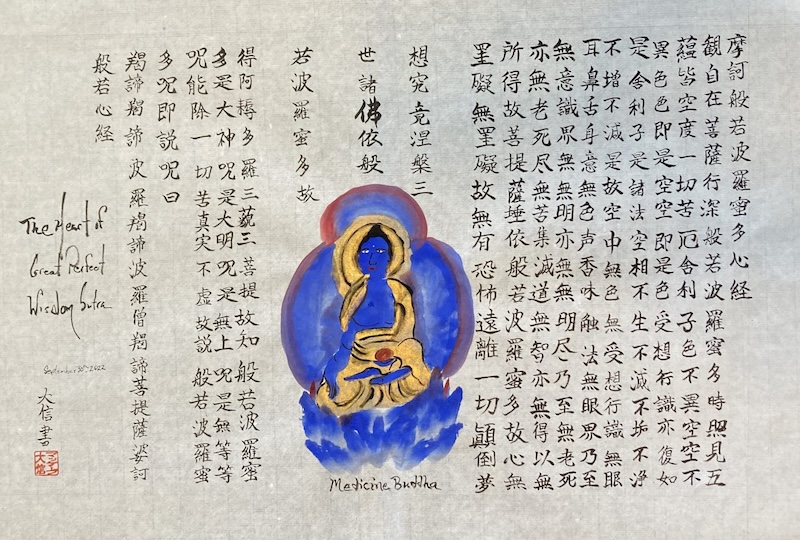
Zen sees medicine everywhere: befriend illness, and look with the Dharma Eye to find healing.
Manjushri said, “Go out and bring back one stalk of medicinal herb.” Sudhana left and looked throughout the entire earth, but there was nothing that was not medicine.
Dogen's Extensive Record
Dai-En Roshi had bad asthma living in Tokyo in the 1970’s. She suffered by the oppressive pollutants in the air for over 10 years living in her small apartment, working as an English teacher so that she could pursue her love of classical ballet. When she left Tokyo behind to become a nun, she became a resident on the island of Shikoku at a mountain temple called Kappa Dojo. The longer she was at Kappa Dojo the more her lung condition improved. She was healthier than she had ever been. The mountain air was fresh and clean without all the pollutants found down in the city. She grew physically strong on the mountain. Her life consisted of a ton of manual labor – digging pits, moving rocks, gardening – back-breaking work. Dai-En Roshi was content, though, and at peace with her situation having no designs of ever leaving. Though life was rugged, she experienced a deep kind of happiness that could not be taken away, or so she thought.
She grew quickly dismayed and disillusioned when her teacher, Noda Daito Roshi, told her she’d need to move to Nagoya to train at the Nisodo (Women’s Monastery). Nagoya is a big city like Tokyo, with very poor air quality, not much better than what she inhaled in the nation’s capital. In expressing her complaint to Daito Roshi, he responded, “Make friends with your asthma.” In other words, don’t run away from your problems. Change your perception of your issue, whether it’s a physical, mental, or spiritual dilemma. Within the illness lies the cure.
But our way of dealing with health issues in the west is not necessarily to accommodate them, but to eradicate them. I would never advocate for doing nothing for a serious health issue. In fact, I believe a host of physical, mental and spiritual issues can be treated inexpensively through a diet high in greens, fruits, legumes, and nuts, through moderate exercise like integral yoga, and a good night’s rest. Dogen Zenji advocates eating moderately, and elsewhere we can find Zen Master’s pointing out the importance of sleep:
After eating, I relax and enjoy a nap.
Sekito Kisen
The Chinese Chan Master Hua was an advocate of a vegan diet, and he spoke vehemently on the karma that we have accumulated as a result of the way we humans have treated animals over the past 2000+ years.
Good diet, exercise, and sleep are easy to understand, but often challenging for a variety of reasons to implement.
But what if we have an illness that is not easily curable. Buddhism has a way of perceiving illness that is different from our western ways.
In the west, we often find our answers in pills. If you have a problem, take a pill. We don’t think about changing our lifestyle. That’s perhaps a bit too inconvenient.
In any case, modern medicines are derived from plants among other things. We generally think of medicine as something material like a tablet that can be absorbed into the body through the stomach. From a Buddhist perspective, however, the Dharma itself is medicine, and the Buddha is a doctor. Healing from physical, mental, and spiritual ills through taking in the Dharma-medicine has always been a part of the Buddhist tradition. In other words, there is no separation between body, mind, and spirit from a Buddhist perspective. A spiritual illness can influence us on the physical plane. Likewise, physical illnesses can affect us spiritually.
Take a moment to look away from these words and to land your eyes on a tree or something in the natural world. Take a moment to really be with it, not as an object, not as something fleeting, but as a friend and a companion on life’s journey.
We share the same DNA with oak trees. Not 100%, but we are related. The chlorophyll molecule that makes plants look green to our eyes is related to the same molecules in our eyes that allow us to capture light and to see. This ability of sight, found in so many creatures on our planet, did not always exist, but evolved over millions of years of life and death. It took many generations and thousands of years before eyes that were water-based evolved. [1] Is this not a miracle!
Take a moment to look back at that green tree or plant. Take a moment to appreciate the fact that you can see, and that you have soft water-based eyes that share some of the same genetic material as that of plants.
From a Zen perspective, the very act of looking deeply like that is the ingestion of medicine. If you can feel the presence of gratitude within you, the medicine has taken hold.
Every moment is a moment of awakening to our relatedness with “fences, walls, tiles, and pebbles,” Dogen Zenji’s way of referring to the inanimate world. This is not merely an idea. It’s that feeling that you have when you come home after being away in a far-off place for a long time. Your whole body recognizes “home” and can finally be at ease.
Humans have two kinds of eyes. We have our physical eyes. But we also have our mind’s eye, or what Zen calls the “Dharma Eye.” We can see forms with our physical eye. But we also have another kind of eye that we don’t often acknowledge, or are unaware of, namely the Dharma Eye.
[1] See, for example, the following article: https://www.nature.com/articles/eye2017226
Take a moment to look back at that tree and see if you can distinguish these two “Eyes” at work.
Physical sight by itself has us see or treat things as mere objects for our use. If we look only with the physical eye, we see how the tree is either in our way or a means to our own ends. We might see the tree as wood we can cash in on, as an inconvenience in Fall when we need to tend to the leaves that drop, or as an ornament for the space it’s occupying.
We don’t see that the tree has its own plan that might be different from ours. That a tree has its own plan may sound ridiculous to us in an age where we think of ourselves as lords over all creation. We may not recognize the spiritual dimension when we rely solely on physical sight. Unless we have a practice or have a spontaneous awakening, we spend most our time in relying solely on our physical eyes with very little awareness of our Dharma Eye.
For most, the Dharma Eye is shrouded by excessive thought, or as Uchiyama Kosho Roshi calls them, “secretions of the brain.” With “secretions of the brain” predominating, there is little or unskillfully concentrated effort at the base of our awareness. This kind of awareness may be characterized as daydreaming on one end of the spectrum, to unruly or agitated rumination on the other end. Our thoughts create reality, and they pull us in one direction and then another, like a fish that’s been hooked and is being pulled around.
Believing in our thoughts can create an internal hell, and this is where practice is essential. We come to recognize that thoughts are just thoughts. Just as we wipe away excessive sweat when working out, we learn to wipe away excessive thoughts when we meditate. This takes practice. Meditation with a group (especially in the same physical location) is essential as we begin this practice. Meditation not only grounds us in the here and now, but it also allows us to use our minds as we wish, rather than our minds pulling us here or there or creating false images. As Dogen Zenji says in his instructions for zazen, “The treasure store will open of itself, and you may enjoy it freely.”
The Dharma Eye is a unique gift to humans. We have the capacity to think about our lives, and not just make decisions based on our reflections, but to simply notice that we notice. This is contemplation, and it is sometimes synonymous with meditation, and I would also suggest that it can be at times equal to medication because it can heal our mind, or help us deal better or respond more skillfully to the pressures that life throws at us.
We can’t distance our mind from the world. The world creates our mind, and our mind creates the world. It’s thanks to the world around us that we can see – both kinds of sight. From a Buddhist psychology perspective, the world doesn’t exist without us. There is no objective world or universe apart from what we see. Our sight – both kinds of sight – are dependent on the natural world (as well as the human world).
Take a moment to check out your posture. Can you sit more upright now? If you made any physical changes to how you are sitting, do you notice any accompanying mental changes?
Your ability to notice the relationship between your posture and how you feel is a kind of insight or contemplation.
Manjushri is not just any monk or person, but the embodiment of wisdom. He’s a teacher of the monk, Sudhana. But he is also depicted in Buddhist imagery riding a lion. He sits upright in the center of Zen meditation halls around the world, encouraging practitioners to have an upright posture. In shikantaza (just sitting), we simply sit upright. We don’t try to direct our mind or focus on something.
In the quotation above, Manjushri (the embodiment of Wisdom) is pointing out the relationship between the medicine we can “see” in the world – all the herbs – and the medicine that comes from meditation. Sudhana uses his “Eye” to “look” for medicine. He’s using both his physical and his Dharma Eye to look, otherwise he couldn’t return and say, “there is nothing that is not medicine.” The medicine we are looking for is found within us, and it’s also found all around us in the natural world. Even our illnesses contain within them the seeds of medicine if we know how to see them. There is nothing that is not helping us to mature. Looking with the Dharma Eye, taking in the Dharma is healing.

Sitting upright taps our body’s own medicine; Soto Zen says we are already healed as we are.
“We can put the drug companies out of business if we learn to tap into our own natural highs through meditation.” This is what I told the patients at the residential drug and alcohol treatment program that I worked at. During my priest training at Mount Equity Zendo I offered zazen and yoga for those in recovery once a week for three years between 2010 – 2013.
I consistently heard feedback from the residents going through opiate withdrawal how much better they felt after engaging in meditative practice, and this made me realize what a service meditation could be – whether in stillness or in movement – for folks dealing with drug addiction. I don’t see zazen as THE answer, but it’s certainly an important piece.
Sitting upright itself, can help us go a long way in feeling our best self. How are you sitting right now, as you read these words? What if you were to change your posture, look away from the screen for a moment, and turn your mindfulness towards your breath and body? Try it for 10 seconds, then continue reading.
Did you notice anything change?

When I first began sitting with my teacher, I felt better than I’d ever felt without taking any drugs or drinking alcohol. I knew this was the path for me. Zazen was medicine. I had been looking everywhere outside myself – in friends, in family, in relationships, in studies, in work – for happiness. Mindfully observing what was literally right under my nose held a key to unlocking my own internal medicine cabinet.
Stability and joy can be found by stopping our search for stability and joy, and turning our attention back to our self – to our physical body, sitting upright, with eye’s cast down and a soft focus.
Life and death come and go, but your body itself is the truth.
Dogen Zenji in "The Real Form of All Things"
We generally think of medicine as something we must ingest. We take a pill, for example, to cure what ails us. In the same way, we think we need to hear something from a wise person to know the truth. What if, however, our body itself contained its own medicine, as well as the truth? The problem is not whether it’s there or not, but how to access it. How about sitting upright in this moment. What changes? Can we put the pharmacies out of business through this practice?
I’m in no way suggesting we stop taking whatever medicines we need to cope with our illnesses, nor that we don’t receive wisdom from sages. I am, however, suggesting a reorientation to how we understand healing. The Soto tradition emphasizes that we are already, as we are, perfectly healed. This is the starting point for practice. In other words, we don’t use practice to heal, but as an affirmation that healing has already been accomplished.[1] This is a counter narrative to how most of us, including myself, understand mindfulness practice – namely as a tool to improve oneself in some way.
Is zazen medicine? Are we already healed as we are? Can it be both?
[1]For a fuller understanding of this, read Paula Arai’s book Bringing Zen Home: The Healing Heart of Japanese Women’s Rituals.
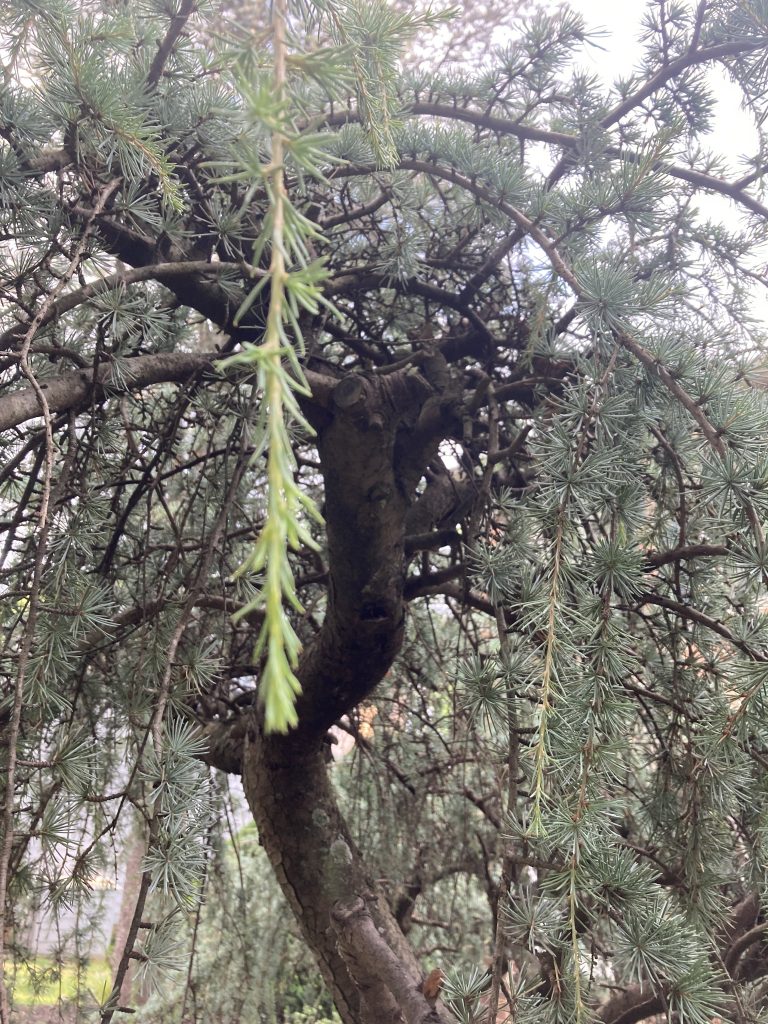
Like trees and rocks, we can sit still and accept ourselves as we are, no gadgets needed.
An old tree conveys the transformative function without moving even slightly. A large rock completely holds the mind seal but its markings are not apparent.
Dogen's Extensive Record
Zen is very much a THIS – worldly tradition. It’s not about finding nirvana after we die or getting to an other-worldly paradise. The above verse takes us to the heart of Zen in affirming not only the natural world but the human body. Zen masters look to nature for guidance and find it in trees and rocks. How is it that a tree can remain so still it’s whole life? It’s born, lives, and dies in the exact same spot (barring any human involvement in transplantation). Trees teach us how to be content in zazen. They teach us the non-dual nature of reality when we ourselves embody a tree in our own body and mind during meditation. Like a tree, we don’t need to direct our mind to something. We simply enter the present moment right now, as it is.
I laugh when I see meditation referred to as a technology or a technique. Zen Master Dogen said that zazen is not “step-by-step” meditation. Yet many are looking for the right technique and thus ignore the reality of the here and now. Modern technology is now available for people desiring to attain certain so-called meditative states. You can purchase an app or get the right head gear to produce a sound that moves you into a flow state, or gets you to preferred brain waves. Ridiculous!
What is wrong with our body and mind as it is? Absolutely nothing. Yet, here are advertisements telling us, once again, that we are not good enough as we are, that we are deficient in some manner, and that if we just purchase the right tool it will fix all our problems. Don’t believe the hype. Every state of mind is unstable, even the “preferred” ones.
This is not to say that we should not use technology or that we should remain satisfied with an unpleasant state of mind. I encourage people to use apps that work for them. In Zen temples bells and drums are used to begin and end zazen. The sound of a bell can bring peace to the mind. Chanting sutras can also change certain mind sets. No doubt we do need to develop some technique as we meditate. Dai-En Roshi said that learning how to sit zazen is like making an ice sculpture with a butter knife. In other words, we need time and patience. We’re not going to “get it right” overnight.
But the idea that we can somehow fix ourselves with technology is laughable at best, and removes us from the central placement of community in Buddhist life. Intentional sound in Buddhist practice is the result of people working together in harmony to bring those sounds about, and we lose that sense of the human face working in concert when we rely too heavily on tech. In other words, we need to recognize the human face to attain enlightenment. We need all of us, even the people we hate.
Keep practice simple. Notice the natural world around you and learn from it. Notice your body and mind in all its ugliness and beauty, and love it. Notice how everybody is working in their own way to help us attain our goals. The true person is the one who can embrace themselves as they are, even those parts they wish to hide from others, or wish to erase from themselves. Trees and rocks are never embarrassed.
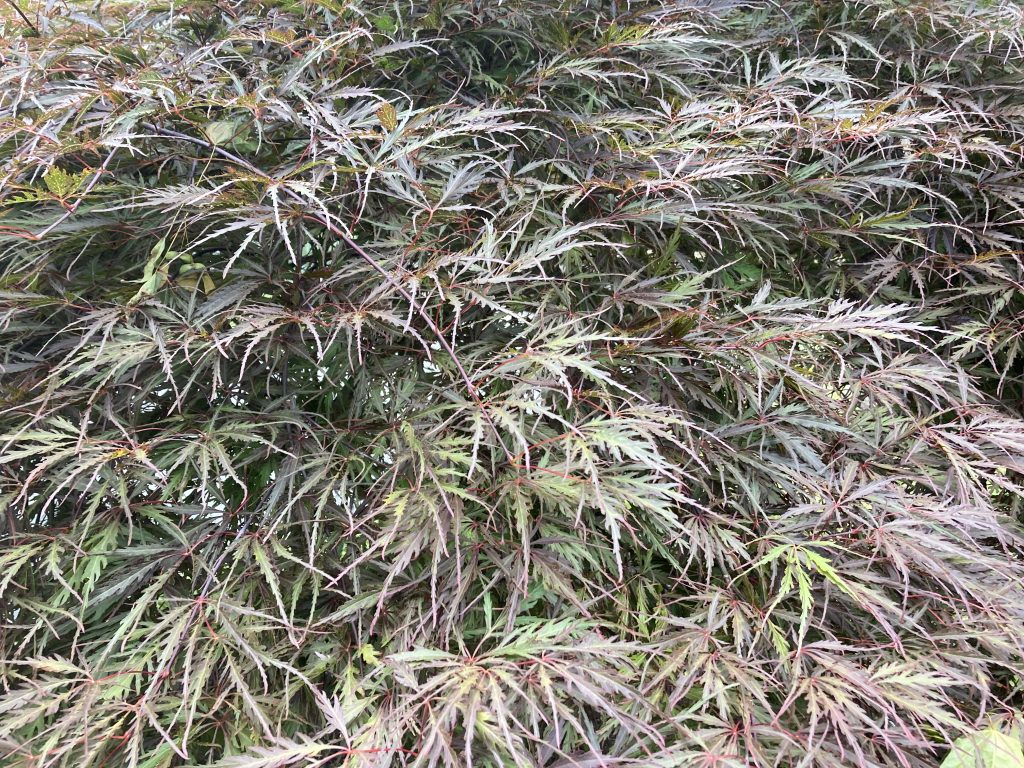
Shikantaza is just sitting, letting thoughts go; patience and a good teacher make it easier.
Many people are confused by descriptions of shikantaza. It’s seems elusive, where there is nothing in particular to grasp, and nowhere to put your mind.
One of our YouTube viewers wrote in to say the following:
… I'm struggling with how to figure out, what it practically means to just sit with the "sensory doors open" … because my mind wants to focus on something - a sound, a visual object, my breath, a little pain in the neck etc. etc. - either because it enters the sensory doors spontaneously or because I start searching for something to focus on. So, what would you recommend I do when the mind starts wandering about?
I love this question! It’s very honest as to what our experience may be when trying “to do” shikantaza.
One possibility when sitting down “to do” shikantaza is to remember that every moment we have a choice. We can choose to do several things with our attention. The Buddhist tradition distinguishes between two kinds of concentration: active and selective. In other words, there are two ways to practice paying attention.
Active concentration is where the meditator does not focus on one thing but allows “whatever” to come into one’s field of awareness. The practitioner is aware of sounds, body sensations, thoughts and smells, but deliberately does not focus on any one of these objects. The meditator simply allows them to come into their field of awareness without holding on to any of them. Uchiyama Kosho Roshi refers to this kind of awareness as, “opening the hand of thought.”
Shikantaza can perhaps be put in the category of active concentration. Of course, sometimes while practicing shikantaza a meditator will get caught in a particular thought or line of thinking. For example, during my meditation this morning I began to think of my response to a question someone asked me, from a previous day. It was a question unrelated to zazen in that moment. During zazen I found myself mulling over in my mind how I might respond to this person’s question. This is an example of what often happens when we sit down to meditate. We get stuck in a mental rut that pulls our mind out of the present.
Here is where the practice comes in. Once we notice what we are doing there are at least two possible responses with regards to active concentration. We can beat ourselves up for getting caught in our own thoughts, thinking, “I can’t do this,” “It’s too hard,” “I’m not cut out for meditation,” etc.” Or we could practice patience and gently return to the practice of letting go of that train of thought, until then next train of thought comes.
When I first began meditation, I found myself often involved in the first response – “I’m not good at this.” To discipline my mind, I felt the need to deepen my concentration so that I would not let myself get hooked by my thoughts. While I would not recommend this approach today, it is a possible response.
What I’ve described above constitutes the first kind of concentration – active. Active concentration forms the base for shikantaza.
Selective concentration is where the meditator chooses a particular object to focus on such as the breath, the body, the rise and fall of emotions, a particular sound, a koan story, etc. In this case, when the mind wonders, instead of returning to “nothing in particular,” the meditator returns to their object of meditation.
In selective concentration, like active concentration, the meditator may disparage their practice every time their mind wanders off. Here, too, patience is required to gently bring one back to the object of meditation. Meditators need to be honest with themselves during practice, recognizing that sometimes whole swatches of time go by, and we are lost in our thoughts, not focused on our object of meditation. This is part of the process of meditation. The problem is not our unfocused mind as much as our ego telling us to quit. On the eve of his Enlightenment, even the Buddha faced the desire to quit. He could have it good as a prince or a king. Why bother with a practice that has him look at how weak and vulnerable he is?
Shikantaza is like a mirror reflecting our mind. We might not always like what we see. But at least we see what is.
One form of concentration is not better than the other. Active concentration is not superior or inferior to selective concentration. Meditators always have a choice as to which one to employ. Here’s where I would recommend finding a teacher to work with. I don’t know how people do the practice these days without having a teacher to observe. Meditation practice is not so much about a technique to do as much as it is about a relationship to develop with a teacher and a sangha, in my experience. I learned to meditate by watching my teacher and other students, not just listening to verbal instruction. I’ve found it indispensable to have an example, and to see that even a teacher doesn’t always “get it right.” Sometimes we set our personal standards too high and expect too much from our practice.
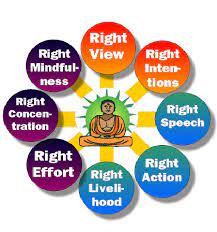
One last thing to mention here is that meditation is only one part of the Buddha’s 8-fold path. Other aspects of his path to healing include right livelihood and right action. Right action refers to practicing the precepts in our daily life. We need to include our actions and livelihood as part of our practice because they affect our meditation. If we’re not at peace with our work, or we don’t study the precepts – not to lie, steal, commit sexual misconduct, etc – then our meditation practice will reflect that and be affected by that. On the other hand, as we practice meditation – especially with proper guidance from a bonafide teacher – right livelihood and right action become clearer.
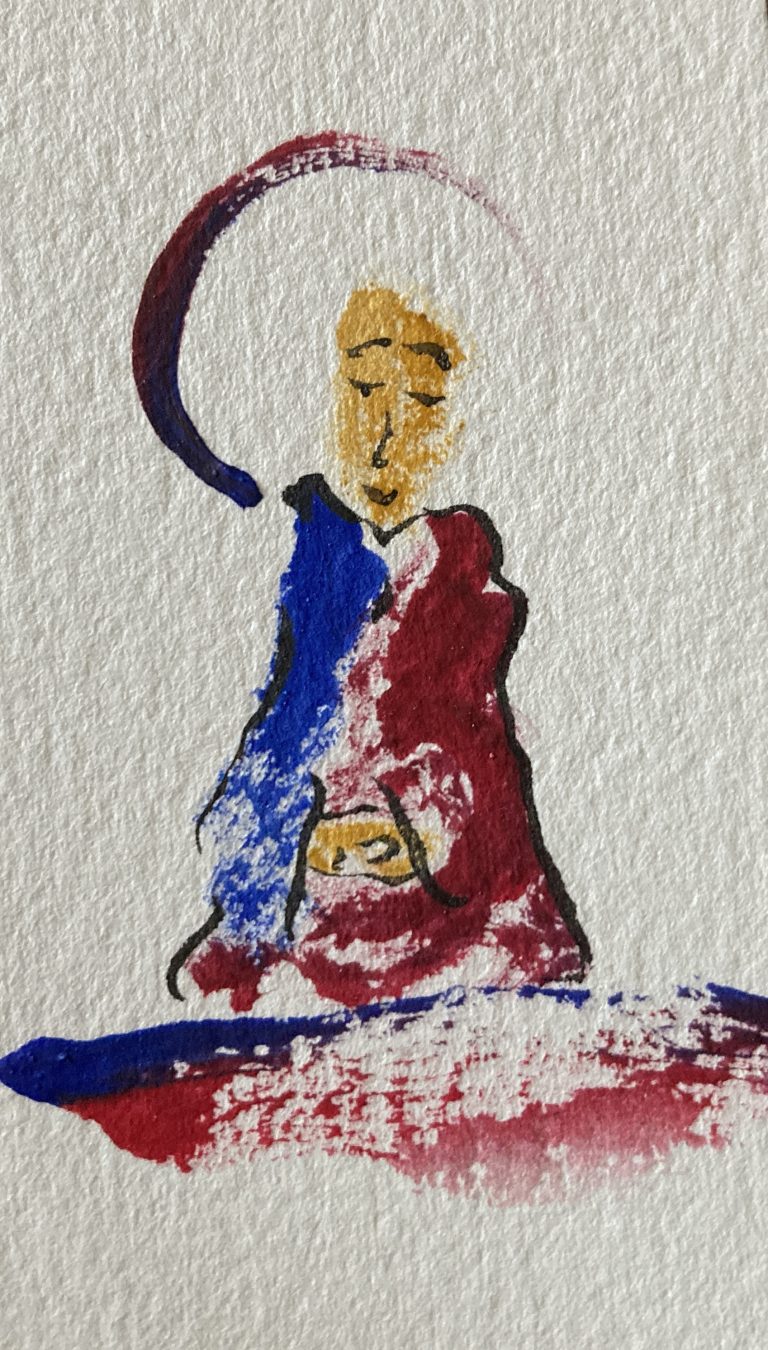
How do we give birth to the Buddha within?
Upon being born, baby Buddha took seven steps. Under each step a lotus flower blossomed. He pointed one hand up and one hand down and said, “Under Heaven and above Earth I alone am the World Honored One.”
This is a profound thing for anyone to say, let alone a baby just born. We can question whether this event happened or not, but that misses the point.
To celebrate the birth of the Buddha is to water the seeds of the emerging Buddha within your own body, heart, and mind. How do we allow the Buddha in? We open the door of our own heart. How do we open the door of our heart? Sitting upright in samadhi with a slight smile.
Happy Birthday Buddha!
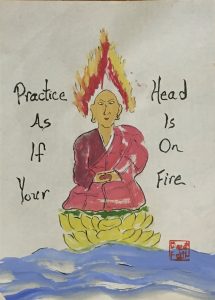
Urgency gets us onto the path; once there, we slow down and practice as if the fire were out.
Is your head on fire? I’m guessing it is not. However, do you really want to end your suffering here and now? I’m guessing you do, but generally we don’t believe it can be done and we may end up settling for coping with suffering. Meanwhile, the happiness of the present moment continues to elude us.
So, the Zen Masters out of compassion for our circumstances throw at us extreme statements like “practice as though your head were on fire” to get our attention. It’s like we are wandering through the jungle anxious and lost for weeks with no signs of civilization. Then, suddenly, we begin to hear a car off in the distance. We get excited and start to run in the direction of the sound. Finally, there is a chance we can get out of this predicament, we think. Once we find the road where the sound came from, we can catch the bus, get oriented to where we are, and find our way back to our home.
The initial sound of the car is like the statement, “practice as though your head were on fire.” You run as quickly as you can to get to a place connected to what is familiar. In the same way, when we are suffering and we hear about the way out of suffering, we need to do everything we can to end our suffering without delay. We need to take seriously that there is actually a way to proceed that gets us out of the mess we’re in.
Finding the road in the wilderness is like finding the Noble Eightfold path, or the way out of suffering according to the Buddha. Once you get to the path, there’s no need to continue to “practice as though your head were on fire.” That’s just the initial inspiration we needed to get to the road. Once there, however, we can begin to slow way down and start our practice in a calmer state. Our heart rate decelerates because we know for sure that we are no longer in the jungle and that there is a clear road to get us back to our home. In the same way, when we find the 8-Fold path and begin to walk it we can begin to soften our steps and have confidence that we are going to where we need to.
We must be careful about not confusing our initial attitude to practice (as though our head were on fire), with our engagement of practice. If we try to practice calming our mind down when we are disoriented, confused, anxious, or fearful, we probably won’t get very far because we don’t see the path (or hear the car) yet. If we understand with our intellect that there is a path to follow, but then act with our body like we’re totally lost while engaging practice, then we are being dishonest with ourselves. That fiery attitude will only make us crazier, and the path will continue to evade us.
Once we cross our legs and sit down, lower our eyes, and place our hands in the cosmic mudra, then we practice as though the fire on our head is completely out, and we have faith in the path set out by the Buddhas and Ancestors. We begin to employ the various methods such as lengthening our spine upright, counting our breaths, or listening to sound.
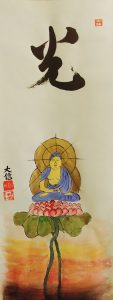
Like moonlight, practice makes us radiate our own light; what we do touches countless others.
Zen Masters sometimes talk about ways in which the present moment can be accessed or clarified. One of the ways Zen Master Dogen refers to this process is by using the concept “connecting pivot.” In other words, the present moment is a pivot point. We can move in a thousand different directions from right here. Which way do we want to go? This movement is not only referring to our body, but also our mind/thoughts.
For Buddhist practitioners the “pivot place” is that which moves us away from delusion and towards Enlightenment. It’s not that we get rid of delusion, but there is a tendency among human beings to lean towards it. The same is true of Enlightenment. It’s not that Enlightenment isn’t there, but there is a tendency to want to grasp at it. Neither is good. But the pivot point needs to be recognized and, in a sense, settled on. When we find it it’s like we become a spinning top. Lean too far one way or the other and balance is lost.
In his Eihei Koroku, Zen Master Dogen says:
If someone asked [me Dogen], “What is the connecting pivot right now?” I would say to him: One person transmits emptiness, and then ten thousand people transmit reality.”
What we do influences others around us beyond our comprehension. The Lotus Sutra says,
Those who abide in meditation,
Attain transcendent powers,
Listen to the teaching regarding the emptiness
Of every existence with great joy,
And save sentient beings
By emitting innumerable rays of light,
Are just like the flourishing large trees.[1]
Both the Lotus Sutra and Zen Master Dogen are saying something very similar, that what we do matters and has an effect on those around us, perhaps beyond what we are willing or prepared to notice.
To give a modern example, cosmologist Brian Swimme, co-writer and star of the Emmy award winning “Journey of the Universe” film puts this in scientific terms. Classical physics, he says, sees photons emanating from the sun as tiny pellets. When these photons hit an object like the moon, they bounce off it. We’re used to thinking of the light that we see coming off the moon as the light or photons from the sun bouncing off it, like tiny pellets, and then hitting our eyes.
Swimme says that it’s much more interesting than that, however. We now know that photons from the sun interact with substances on or near the surface of the moon in such a way that these substances generate their own light. Moonlight, then, is not simply sunlight bouncing off it, but the moon is generating its own light.
In the same way, in taking refuge in Buddha we are allowing the “light” (or Dharma) of the Buddha to interact with our own heart/mind. Something changes in us when we practice the Dharma, and we then emit our own “light.” The light that comes from us is uniquely our own but was born thanks to our allowing the light from the Buddha to penetrate us.
Just as the actions of the Buddha cross centuries of time and have influenced billions of people living and dead, so too, our actions do the same. One person transmits emptiness, and ten thousand people transmit reality. What you do matters.
[1] The Lotus Sutra, translated from the Chinese of Kumarajiva by Tsugunari Kubo and Akira Yuyama. Bukkyo Dendo Kyokai and Numata Center for Buddhist Translation and Research, 2007. Page 102.